
India becoming the world’s largest rice producer and recording a record wheat acreage may signal food security success at the national level. But for Punjab — the state that once anchored the Green Revolution — these milestones underscore a deeper agrarian crisis. What was designed as a lifeline for a food-deficient nation in the 1960s has, over time, hardened into a farming system that is ecologically fragile, economically stagnant, and socially volatile.
Why record production hides regional distress
According to Union Agriculture Ministry data, India produced over 150 million tonnes of rice, overtaking China, while wheat acreage touched an all-time high in the 2025–26 rabi season. Farmers across states have shifted towards wheat amid weak prices of alternative crops, easing concerns over food supply and export curbs.
For Punjab, however, this surge reflects not resilience but rigidity. The state’s agriculture remains overwhelmingly locked into the wheat–paddy cycle, with these two crops accounting for nearly 85 per cent of its gross cropped area. Far from being a natural choice, this pattern is the outcome of decades of policy incentives.
The policy architecture behind monoculture
Punjab’s crop dominance is rooted in institutional design. Assured procurement at minimum support prices, subsidised electricity for irrigation, and a procurement infrastructure unparalleled elsewhere have made wheat and paddy the safest economic options. In an environment of rising input costs and market uncertainty, farmers respond rationally to what the system rewards.
Repeated calls for diversification into maize, pulses, oilseeds or horticulture have faltered because these crops lack comparable guarantees. Price volatility, weak procurement mechanisms, and inadequate storage and processing facilities turn diversification into a high-risk gamble rather than a planned transition.
Groundwater depletion and ecological stress
The environmental costs of this static cropping pattern are now stark. Paddy cultivation in a semi-arid region has driven groundwater extraction to unsustainable levels. Official assessments indicate that over three-quarters of Punjab’s groundwater blocks are overexploited. Data from the Central Ground Water Board shows that Punjab records the highest rate of groundwater extraction in India, with water tables falling by nearly a metre annually in several districts.
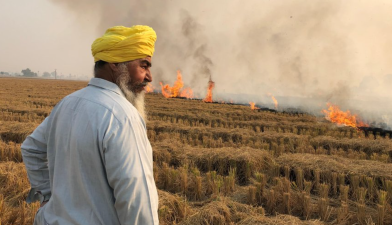
Deeper tube wells, soaring electricity use, and rising cultivation costs have become structural features of farming. Soil health has also deteriorated due to repeated mono-cropping and intensive fertiliser use, depleting organic carbon and micronutrients. Stubble burning — a byproduct of mechanised harvesting and compressed sowing cycles — has turned into an annual environmental crisis extending far beyond the state.
Economic stagnation behind price security
While MSP-backed procurement ensures price stability, it has not delivered sustained income growth. Input costs for seeds, fertilisers, diesel and labour have risen faster than returns. Small and marginal farmers, heavily dependent on credit, remain especially vulnerable.
Punjab continues to report farmer suicides, a grim indicator that procurement-led security has not translated into prosperity. The contrast between high aggregate output and persistent farm distress exposes the limits of a system focused narrowly on volume rather than viability.
From economic stress to political mobilisation
Agrarian distress in Punjab has increasingly spilled into public protest. Farmers have repeatedly mobilised in recent years, demanding legal guarantees for MSP, debt relief, and accountability for assurances made during the repeal of the 2020–21 farm laws. Protests at mandis over delayed procurement and unsold stocks, and confrontations at sites such as Shambhu and Khanauri, highlight how economic insecurity is morphing into political confrontation and deepening mistrust.
Diversification without assurance: a policy contradiction
Successive governments have launched diversification schemes, including incentives to shift from paddy to maize. Yet these interventions remain piecemeal. One-time payments cannot substitute for assured buyers, robust supply chains, or processing capacity. Nor do they offset decades of institutional familiarity with wheat and rice.
Punjab’s predicament also reveals a national contradiction. India celebrates record grain output as a symbol of food security, while urging states like Punjab to diversify for environmental reasons. As long as agencies such as the Food Corporation of India procure rice and wheat in bulk while alternative crops face open-market risks, farmers will logically stick to staples. Diversification cannot succeed when monoculture is structurally rewarded.
Redesigning incentives for sustainable transition
A credible transition requires aligning national priorities with farmer incentives. If pulses, oilseeds and maize are central to nutrition security, import substitution and sustainability, they must be backed by procurement assurance, price support and infrastructure investment comparable to wheat and rice. Punjab’s farmers cannot be asked to absorb the costs of national food policy adjustments alone.
Beyond field crops, Punjab has potential to emerge as a hub for high-value agriculture — dairy, fruits, vegetables and food processing. Realising this requires investment in cold chains, logistics, agro-industries, cooperative models and land consolidation, while safeguarding small farmers from market domination.
A generational warning for Indian agriculture
There is also a demographic dimension to the crisis. Younger farmers increasingly view agriculture as high-effort, low-dignity and uncertain. Many seek livelihoods outside farming or migrate abroad. Without structural reform, Punjab risks not only ecological collapse but also a steady erosion of its human capital.
What to note for Prelims?
- India’s position as the world’s largest rice producer
- Wheat–paddy cycle and its regional concentration
- Groundwater overexploitation in Punjab
- Role of MSP and procurement agencies
What to note for Mains?
- Critically analyse how procurement-led food security has shaped Punjab’s agrarian crisis
- Discuss the environmental and economic costs of monoculture farming
- Examine the contradiction between national food policy and crop diversification goals
- Suggest reforms to align farmer incentives with sustainable agriculture
Punjab’s experience is a cautionary tale for India as a whole. It shows the risks of measuring agricultural success purely in tonnes produced rather than sustainability achieved. The state once fed the nation. Today, it needs a new social contract that balances food security with ecological survival and farmer welfare.
Last Modified: January 17, 2026