
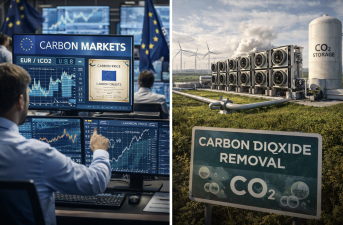
The European Union’s carbon market is set to become a key tool in removing carbon dioxide from the atmosphere. A 2026 study by the Potsdam Institute for Climate Impact Research (PIK) marks how the EU Emissions Trading System (ETS) can support large-scale carbon dioxide removal (CDR) while maintaining strong emission reduction goals.
EU Emissions Trading System and Carbon Removal
The EU ETS caps total emissions and allows trading of emission allowances. The study shows that integrating carbon removal technologies like direct air capture and bioenergy with carbon capture and storage (BECCS) could remove about 60 million tonnes of CO₂ annually by 2050. This integration would provide financial certainty for investors, especially when public funds are limited. The carbon market can thus push industries to reduce emissions and invest in removal technologies simultaneously.
Balancing Emissions Cuts and Removals
A key concern is that reliance on carbon removals might reduce efforts to cut emissions. The study finds this risk is low within a capped system like the EU ETS. If removals fall short, carbon prices rise, forcing extra emission cuts elsewhere. However, if policymakers relax the cap due to price increases, this balance could be disrupted. The study also warns of environmental risks from excessive biomass use in BECCS, which may harm land and biodiversity without strict safeguards.
Phased Approach to Market Integration
The study recommends a gradual approach to include removals in the ETS. First, robust monitoring, reporting, and verification systems must be established. Next, removal credits should be introduced slowly with volume limits. Full integration, where removals and residual emissions share one carbon price, is planned around 2040. This phased method aims to protect environmental integrity and avoid policy risks.
Policy Implications for the EU
The European Commission is expected to decide by 2026 on including carbon removals in the EU ETS. The study suggests that emissions trading is a cost-effective alternative to subsidies. It also offers industries clarity on managing hard-to-eliminate emissions. Properly implemented, the EU carbon market could evolve from limiting emissions to actively removing CO₂, supporting net-zero and net-negative goals.
Topics for Prelims:
EU Emissions Trading System (ETS)
- Launched in 2005 as the world’s largest carbon market.
- Caps total greenhouse gas emissions from power and industry sectors.
- Allows trading of emission allowances to meet reduction targets.
- Operates under a cap-and-trade principle.
- Key tool for the EU’s climate neutrality target by 2050.
Carbon Dioxide Removal (CDR) Technologies
- Includes direct air capture and bioenergy with carbon capture and storage (BECCS).
- Removes CO₂ from the atmosphere to reduce climate change.
- BECCS uses biomass energy and captures emitted CO₂ underground.
- Direct air capture uses chemicals to extract CO₂ from air.
- Scalability and cost are major challenges for deployment.
Phased Integration of Carbon Removal in Markets
- Begins with monitoring, reporting, and verification standards.
- Gradual introduction of removal credits with volume limits.
- Full integration expected around 2040.
- Aims to maintain environmental integrity and avoid policy risks.
- Supports investor confidence and market stability.
Questions for Mains:
- Discuss in the light of the European Union’s Emissions Trading System how market-based instruments can support climate change mitigation and carbon dioxide removal. [GS-III-Economic Development]
- Analyse the environmental and economic challenges of integrating carbon dioxide removal technologies in emissions trading systems with suitable examples. [GS-III-Environment & DM]
- With examples from global carbon markets, critically discuss the role of phased policy integration in balancing emission reductions and carbon removals. [GS-II-Governance]
- Examine the implications of carbon pricing mechanisms on industrial innovation and sustainability transitions in the energy sector. Discuss in the light of the EU ETS experience. [GS-III-Science & Technology]
Answer Hints:
1. Discuss in the light of the European Union’s Emissions Trading System how market-based instruments can support climate change mitigation and carbon dioxide removal. [GS-III-Economic Development]
- EU ETS caps total emissions and enables trading of emission allowances, incentivizing reductions where cheapest.
- Market-based instruments provide financial certainty, encouraging investments in low-carbon technologies and carbon removal.
- Integration of carbon dioxide removal (CDR) technologies like direct air capture and BECCS can be incentivized via ETS credits.
- Cap ensures total emissions remain limited; rising carbon prices motivate additional cuts if removals underperform.
- Market mechanisms are cost-effective alternatives to subsidies, optimizing resource allocation under fiscal constraints.
- Supports simultaneous emissions reduction and scaling of negative emissions, aiding EU’s net-zero 2050 target.
2. Analyse the environmental and economic challenges of integrating carbon dioxide removal technologies in emissions trading systems with suitable examples. [GS-III-Environment & DM]
- Environmental risks include land use pressure and biodiversity loss from excessive biomass use in BECCS without safeguards.
- Economic challenges involve high costs and scalability issues of CDR technologies like direct air capture.
- Risk of weakening emission reduction incentives if carbon market caps are relaxed due to rising prices.
- Need for robust monitoring, reporting, and verification to ensure integrity and prevent greenwashing.
- Phased integration with volume limits can mitigate policy and market risks.
- Example – EU ETS proposes gradual credit introduction and sustainability standards to address these challenges.
3. With examples from global carbon markets, critically discuss the role of phased policy integration in balancing emission reductions and carbon removals. [GS-II-Governance]
- Phased integration allows gradual incorporation of removals, starting with monitoring and verification systems.
- Limits on removal credit volumes prevent market oversupply and maintain emission reduction incentives.
- Full integration (single carbon price for emissions and removals) planned only after maturity and risk mitigation (e.g., EU ETS by 2040).
- Examples – EU ETS’s stepwise approach; California’s market cautiously exploring offsets and removals.
- Phased approach reduces policy risks, ensures environmental integrity, and builds stakeholder confidence.
- Balances short-term emission cuts with long-term negative emissions to meet climate goals.
4. Examine the implications of carbon pricing mechanisms on industrial innovation and sustainability transitions in the energy sector. Discuss in the light of the EU ETS experience. [GS-III-Science & Technology]
- Carbon pricing incentivizes industries to innovate low-carbon technologies to reduce allowance costs.
- EU ETS’s rising carbon prices signal market demand for clean energy and carbon removal solutions.
- Provides financial certainty, attracting investments in technologies like BECCS and direct air capture.
- Encourages energy transition from fossil fuels to renewables and cleaner alternatives.
- Risk of carbon leakage and competitiveness concerns addressed via allowances allocation and border adjustments.
- EU ETS experience shows market-based carbon pricing as a driver for sustainable industrial transformation.