
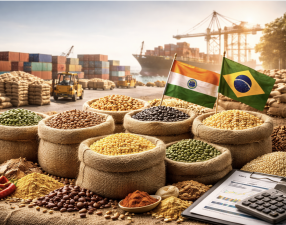
India’s management of pulses — a staple source of protein and livelihood for millions — sits at the intersection of trade policy, farmer welfare, and food security. Recent indications in U.S. trade documents suggesting India’s commitment to import American pulses have stirred political unease. For a country still sensitive to farm policy after the 2020–21 protests, any perception that imports may undercut domestic farmers is fraught. The debate once again highlights India’s structural dependence on pulse imports and the unresolved vulnerabilities in its agricultural policy framework.
Why Pulses Matter in India’s Food Economy?
Pulses are not merely another crop category. They form nearly a quarter of India’s non-cereal protein intake and are cultivated largely in rain-fed regions by small and marginal farmers. Around five crore farmers and their families depend directly or indirectly on pulse cultivation.
Despite their importance:
- Annual production hovers around 2.5 crore tonnes.
- Domestic demand is estimated at nearly three crore tonnes.
- The shortfall is bridged through imports.
This structural gap makes pulses both a food security and a trade policy issue.
Import Policy: A Double-Edged Instrument
India manages pulse demand through a combination of imports, price stabilisation operations, and limited MSP procurement. Among these, imports are the most immediate lever. A central decision to lower import barriers can quickly cool retail prices when supplies tighten.
However, such interventions:
- Depress domestic market prices.
- Disincentivise farmers from investing in pulse cultivation.
- Create uncertainty in planting decisions.
The recent reference in U.S. documents implying India’s obligation to purchase American pulses raised concerns that domestic farmers’ interests may be subordinated to trade negotiations. In a politically sensitive climate shaped by the farm law protests, this perception alone carries weight.
The Weakness of the MSP and Procurement System
Unlike rice and wheat, pulses do not benefit from a robust and predictable procurement regime. Although MSPs are announced, procurement under the Price Support Scheme has remained limited.
Between 2019–24:
- Procurement fluctuated between 2.9% and 12.4% of total production.
- Many States lack adequate procurement centres.
- Farmers often sell below MSP to private traders due to limited government presence.
This patchy implementation creates a credibility gap. Without assured procurement, MSP remains largely notional. Farmers, therefore, shift acreage toward crops with more reliable returns, reinforcing the production shortfall.
The 2025 Self-Sufficiency Mission: Ambition vs. Skepticism
In October 2025, the government announced a pulse self-sufficiency Mission with an outlay of ₹11,440 crore. The programme aims to:
- Expand cultivation to 310 lakh hectares.
- Increase production to 350 lakh tonnes by 2030–31.
The Mission seeks to address productivity gaps and reduce import dependence. However, farmers remain cautious. Past initiatives have often faltered due to inadequate follow-through, weak procurement infrastructure, and insufficient extension support.
If India simultaneously opens its markets to greater pulse imports, especially from competitive suppliers like the United States, it risks undermining the very incentives the Mission seeks to create.
Structural Challenges in Pulse Cultivation
Pulse cultivation faces inherent constraints:
- Predominantly rain-fed production vulnerable to climatic variability.
- Lower yields compared to global competitors.
- Limited irrigation and input support.
- Inadequate storage and marketing infrastructure.
Without sustained investment in productivity enhancement and irrigation support, farmers remain trapped in low-return cycles. This perpetuates dependence on imports.
Trade Agreements and Political Sensitivities
Agricultural trade commitments carry high political salience in India. The inclusion — even if later clarified — of pulses in U.S. trade documents triggered anxiety because it appeared to contradict domestic self-sufficiency goals.
The issue illustrates a broader dilemma:
- Consumers benefit from stable and lower prices via imports.
- Farmers require assured remunerative prices to sustain production.
- Trade commitments can constrain domestic policy flexibility.
Balancing these competing interests is central to agricultural policymaking.
What Structural Reforms Are Needed?
Breaking the cycle of import dependence requires more than removing contentious clauses from trade texts. It demands:
- Strengthening procurement infrastructure across States.
- Ensuring credible MSP guarantees for pulses.
- Investing in productivity improvements in rain-fed areas.
- Developing market incentives that reward diversification into pulses.
- Enhancing storage, processing, and value-chain integration.
Only structural reform can simultaneously protect farmers and reduce vulnerability to external supply shocks.
What to Note for Prelims?
- India’s pulse production: ~2.5 crore tonnes; demand: ~3 crore tonnes.
- Price Support Scheme covers pulses under conditional procurement.
- October 2025 Pulse Self-Sufficiency Mission: ₹11,440 crore outlay.
- Target: 350 lakh tonnes production by 2030–31.
- Pulses form about 25% of non-cereal protein intake.
What to Note for Mains?
- Discuss the challenges in achieving pulse self-sufficiency in India.
- Examine the tension between trade liberalisation and farmer welfare.
- Analyse the limitations of MSP in non-cereal crops.
- Evaluate policy reforms needed to reduce structural import dependence.
- Assess the political economy of agricultural trade negotiations in India.