
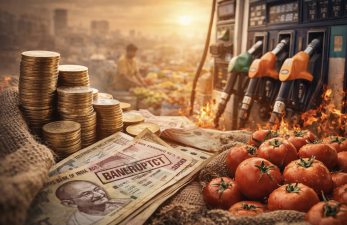
India faces renewed inflation concerns in 2026 following the US attack on Iran and the resulting energy supply shock. The conflict has disrupted crude oil supplies, pushing global oil prices to levels not seen since 2008. This has direct implications for India’s inflation rate and economic stability.
Current Inflation Scenario
India’s inflation rate aims to be around 4%, considered optimal by the Reserve Bank of India (RBI). This target balances producer incentives and consumer demand. Since 2019, inflation has frequently exceeded this target due to global and domestic shocks like the Covid pandemic, the Russia-Ukraine war, and unusual weather patterns. Inflation moderated to about 2% by March 2026, enabling lower interest rates and cheaper borrowing costs.
Impact of US-Iran Conflict on Oil Prices
The US attack on Iran and Iran’s decision to block the Strait of Hormuz have caused crude oil prices to surge. Brent crude futures rose to nearly $110 per barrel, with spot prices hitting over 141. This spike threatens to increase India’s inflation sharply. Expectations of a quick US withdrawal were dashed by President Donald Trump’s April 2 speech signalling continued conflict, adding uncertainty to energy markets. </p> <h4>Role of El Niño Phenomenon</h4> <p> El Niño, a climatic event causing higher temperatures and reduced rainfall, is another key factor influencing inflation. A severe El Niño would worsen India’s agricultural output, raising food prices and overall inflation. Moderate El Niño effects combined with high oil prices could still keep inflation within RBI’s comfort zone, but an extreme El Niño could push inflation beyond acceptable limits even if oil prices fall slightly. </p> <h4>Future Inflation Scenarios and RBI Response</h4> <p> HSBC forecasts a 4% inflation rate for FY27 before the energy shock. Post-shock scenarios suggest inflation could breach RBI’s comfort range (2%-6%) depending on oil prices and El Niño severity. Rising inflation risks may force the RBI to increase interest rates, raising borrowing costs and impacting economic growth. Prolonged US-Iran conflict could exacerbate these pressures. </p> <h4>Topics for Prelims:</h4> <h5>Reserve Bank of India (RBI)</h5> <ol> <li>Established in 1935 as India’s central bank.</li> <li>Main role – control inflation and regulate monetary policy.</li> <li>Inflation target set at 4% with a 2%-6% tolerance band.</li> <li>Uses repo rate to influence borrowing costs.</li> <li>Monitors supply shocks affecting economy.</li> </ol> <h5>El Niño Phenomenon</h5> <ol> <li>Periodic warming of Pacific Ocean surface waters.</li> <li>Causes higher global temperatures and irregular rainfall.</li> <li>Leads to droughts or floods affecting agriculture.</li> <li>Occurs every 2-7 years lasting 9-12 months.</li> <li>Impacts global food prices and inflation.</li> </ol> <h5>Crude Oil Prices</h5> <ol> <li>Global benchmark – Brent crude oil.</li> <li>Prices influenced by geopolitical events.</li> <li>Major oil supply routes include Strait of Hormuz.</li> <li>Price spikes increase fuel and transportation costs.</li> <li>Directly affect inflation and economic growth.</li> </ol> <h4>Questions for Mains:</h4> <blockquote> <ol> <li>Analyse the impact of geopolitical conflicts on India’s inflation and economic stability with examples from the US-Iran conflict. [GS-III-Economic Development]</li> <li>Discuss in the light of climatic phenomena like El Niño, how climate variability affects India’s agricultural economy and inflation. [GS-III-Environment & Disaster Management]</li> <li>Examine the role of the Reserve Bank of India in managing inflation amid external shocks and supply disruptions. Critically discuss with reference to recent trends. [GS-II-Constitution of India & Polity]</li> <li>With examples, discuss the significance of global oil price fluctuations on India’s macroeconomic policies and energy security. [GS-III-Economic Development]</li> </ol> </blockquote> <h4>Answer Hints:</h4> <h5>1. Analyse the impact of geopolitical conflicts on India’s inflation and economic stability with examples from the US-Iran conflict. [GS-III-Economic Development]</h5> <ol> <li>Geopolitical conflicts disrupt global supply chains, especially energy supplies (e.g., US attack on Iran, Strait of Hormuz blockade).</li> <li>Sharp rise in crude oil prices (Brent crude surged to110-$141/barrel) increases fuel and transportation costs, pushing inflation up.
2. Discuss in the light of climatic phenomena like El Niño, how climate variability affects India’s agricultural economy and inflation. [GS-III-Environment & Disaster Management]
- El Niño causes higher temperatures and deficient monsoon rainfall, leading to drought conditions.
- Reduced water availability adversely affects crop yields, especially rain-fed agriculture.
- Lower agricultural output causes food supply shortages, pushing food inflation higher.
- Food inflation impacts overall consumer price inflation in India due to large food expenditure share.
- Severe El Niño events exacerbate rural distress and can raise poverty levels.
- Climate variability demands adaptive agricultural practices and disaster management to mitigate inflationary risks.
3. Examine the role of the Reserve Bank of India in managing inflation amid external shocks and supply disruptions. Critically discuss with reference to recent trends. [GS-II-Constitution of India & Polity]
- RBI’s primary mandate includes maintaining inflation target at 4% with 2%-6% tolerance band.
- Uses monetary policy tools like repo rate adjustments to influence borrowing costs and demand.
- Monitors supply-side shocks (e.g., Covid, geopolitical conflicts) impacting inflation dynamics.
- Recent trends show inflation volatility due to global energy shocks and climatic disturbances (El Niño).
- RBI balances inflation control with growth support, evident from interest rate cuts when inflation was low (~2%).
- Challenges include managing imported inflation and ensuring financial stability amid external uncertainties.
4. With examples, discuss the significance of global oil price fluctuations on India’s macroeconomic policies and energy security. [GS-III-Economic Development]
- India imports ~80% of its crude oil; price spikes directly increase import bills and widen trade deficits.
- Rising oil prices increase fuel, transportation, and manufacturing costs, fueling inflation.
- Macro policies like fiscal deficit management and monetary policy are influenced by inflationary pressures from oil prices.
- Energy security concerns arise due to dependence on volatile regions (e.g., Middle East, Strait of Hormuz blockade).
- Government initiatives include strategic petroleum reserves, diversification of energy sources, and renewable energy promotion.
- Global oil price volatility necessitates policy buffers and reforms to reduce vulnerability and ensure economic stability.