
The evolution of the Swachh Bharat Mission (SBM) represents a critical pivot point in India’s developmental journey, moving from the initial phase of “access” to the more complex stage of “management.” While the construction of infrastructure was a massive logistical feat, the mission is now navigating the “deeper challenge” of sustainability through Swachh Bharat Mission 2.0 (Grameen). The current focus has transitioned from achieving Open Defecation Free (ODF) status to attaining ODF Plus credentials.
The Shift to ODF Plus: Addressing the “What Happens Next”
To address the long-term viability of sanitation, the mission is prioritizing three significant hurdles that arise after the initial hardware is installed:
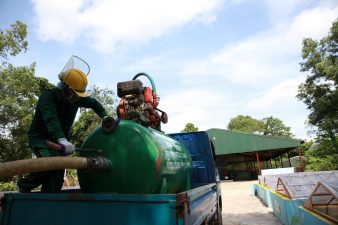
- Faecal Sludge Management (FSM): Many of the 12 crore toilets constructed utilize twin-pit systems, which are designed for on-site composting. However, in regions where single pits or septic tanks were installed, the challenge lies in ensuring these are emptied safely and the waste is treated professionally, rather than being dumped into local water bodies.
- Greywater Management: Increased toilet usage and the expansion of piped water through the Jal Jeevan Mission have led to a surge in household wastewater (greywater) from bathing and washing. Villages are now implementing soak pits and drainage systems to prevent stagnant water and the subsequent spread of disease.
- Sustainability and Usage: Beyond physical hardware, the “software” of human behavior remains a priority. Efforts are focused on ensuring toilets are not repurposed as storage rooms and that infrastructure is maintained for the next generation, representing a constant effort in behavior change communication.
This transition illustrates a classic developmental paradigm where solving one problem “unlocks” a more technical and resource-intensive set of challenges.
Key Design and Implementation Features of SBM
The success of the mission in its first decade was driven by a shift from simple infrastructure delivery to a massive, tech-enabled social movement.
Political Sponsorship and the “Jan Andolan”
Unlike previous sanitation programs, SBM received “political sponsorship” from the highest level of government. The Prime Minister acted as the chief communicator, branding the mission as a Jan Andolan (people’s movement). This was supported by over 6 lakh Swachhagrahis—grassroots volunteers who used interpersonal communication to trigger community demand.
Financial and Technical Frameworks
- Direct Financial Incentives: To ensure affordability, the government provided an incentive of ₹12,000 per Individual Household Latrine (IHHL) in rural areas via Direct Benefit Transfer (DBT).
- Real-Time Monitoring: Every toilet was mandatorily geotagged and mapped in a central Integrated Management Information System (IMIS), ensuring transparency and accountability.
- Competitive Federalism: The Swachh Survekshan annual survey fostered healthy competition among cities and districts, ranking them on cleanliness and encouraging local bodies to optimize performance.
Challenges in Faecal Sludge and Wastewater Management
The shift to management has exposed distinct challenges in both rural and urban contexts.
Rural India: Retrofitting and Volume
In villages, the primary issue is correcting design flaws and managing the increased volume of liquid waste.
- The Septic Tank Trap: Many households opted for large septic tanks over the recommended twin-pit systems. These tanks require mechanical emptying, yet many rural areas lack the necessary vacuum trucks or Faecal Sludge Treatment Plants (FSTPs).
- The Cost of Emptying: Private emptying services can cost between ₹800 and ₹2,000, a significant financial burden that can lead to “slippage,” where toilets are abandoned once full.
Urban India: The “Sewerage Illusion”
Urban challenges are defined by high density and an over-reliance on often non-existent underground networks.
- Connectivity Gap: Only about 30% of urban India is connected to a formal sewage network; the remainder relies on on-site septic tanks.
- Unregulated Desludging: An informal market of private vacuum trucks often dumps sludge into storm drains or rivers to save on transportation costs to distant treatment plants.
- Infrastructure Mismatch: Many Sewage Treatment Plants (STPs) are designed for diluted sewage and can be damaged by the highly concentrated septage delivered by trucks.
Comparison of Global Sanitation Strategies
India’s strategy under SBM 2.0 can be compared with models in Bangladesh and Indonesia.
| Feature | India (ODF Plus) | Bangladesh (CLTS) | Indonesia (STBM) |
| Primary Approach | Government-led “Jan Andolan” with heavy financial subsidies (DBT). | Community-Led Total Sanitation (CLTS) focusing on social norms with minimal subsidies. | Focus on behavior change and scaling rural delivery through local entrepreneurs. |
| Financing | High capital investment from the central government. | Predominantly self-funded by households through low-cost products. | Hybrid mix of community mobilization and local government support. |
| Current Focus | Integrated solid and liquid waste management (SLWM). | Strengthening rural supply chains to move users to “improved” toilets. | Professionalizing the “back-end” supply chain and containment. |
Risks of Incomplete Sanitation Reform
Failing to develop systems beyond construction creates a “ticking time bomb” across multiple dimensions.
- Public Health: Without treatment, the fecal-oral loop remains unbroken, leading to waterborne epidemics, childhood stunting, and the rise of Antimicrobial Resistance (AMR).
- Environmental Degradation: Leaking pits contaminate groundwater, which provides 85% of rural domestic water. This can lead to toxic agriculture and the biological collapse of surface water bodies.
- Social and Human Cost: The lack of mechanized cleaning systems perpetuates manual scavenging. Despite legal bans, workers from marginalized communities are often forced into hazardous manual labor to clear solidified sludge, leading to frequent occupational fatalities from toxic gases.
Necessary Interventions for a Sustainable Ecosystem
Building a sustainable end-to-end ecosystem requires a tri-fold approach:
Institutional Governance
- Urban-Rural Convergence: Linking village clusters to urban STPs for efficient sludge processing.
- O&M Responsibility: Fixing legal responsibility at the Urban Local Body (ULB) and Gram Panchayat levels for the long-term maintenance of assets.
Technological Innovation
- Decentralized Systems (DEWATS): Utilizing nature-based solutions like constructed wetlands and Soil Bio-Technology (SBT).
- Waste-to-Wealth: Scaling the GOBARdhan initiative to convert waste into biogas and organic manure.
- Bio-digesters: Promoting DRDO-developed bio-digester toilets for high-altitude or water-scarce regions.
Behavioral Habit Formation
- Beyond Triggering: Moving from “disgust-based” messaging to aspiration-based habit formation.
- Inclusion: Ensuring specific campaigns for menstrual hygiene management and the needs of people with disabilities to achieve true Sampoorn Swachhata (complete cleanliness).
Questions
- Critically analyse the role of the Swachh Survekshan in promoting competitive federalism among Indian cities. How has this ranking system influenced the prioritisation of solid waste management at the municipal level? {GS-II: Governance}
- Examine the socio-economic and technical barriers that lead to ‘slippage’ in ODF-certified villages. What measures can be adopted to ensure that toilet usage remains a permanent behavioural trait in rural India? {GS-I: Indian Society}
- Discuss the significance of the GOBARdhan initiative in achieving the dual goals of rural sanitation and renewable energy production. How can this model be scaled to ensure economic viability for small-scale farmers? {GS-III: Economic Development}
- Critically examine the persistence of manual scavenging in India despite the Prohibition of Employment as Manual Scavengers and their Rehabilitation Act. To what extent can technological interventions in faecal sludge management eliminate this practice? {GS-II: Social Justice}
- With suitable examples, discuss the potential of Decentralised Wastewater Treatment Systems (DEWATS) in addressing the greywater management challenges posed by the Jal Jeevan Mission. {GS-III: Environment & DM}
- Taking example of the twin-pit technology, explain why on-site sanitation remains more ecologically suitable for rural India compared to conventional centralised sewerage systems. What are the implementation challenges of this technology? {GS-III: Science & Technology}