
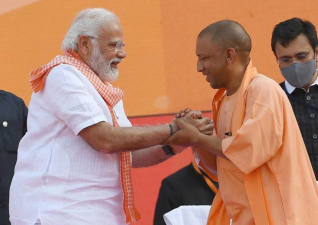
As Assembly elections approach in Kerala and Tamil Nadu, Prime Minister Narendra Modi has reiterated the call for a “double-engine government” — a situation where the same political formation governs both the Union and the State. In practice, this refers to the Bharatiya Janata Party or its allies in the National Democratic Alliance being in power at both levels.
The political slogan raises a deeper constitutional question: does political alignment between the Centre and States lead to faster growth and better governance, or does it weaken India’s federal balance?
Understanding the “Double-Engine” Argument
The core claim behind the double-engine framework is that political symmetry improves coordination, reduces friction, and accelerates development. The argument suggests that when the Centre and State share political alignment, policy implementation becomes smoother and resources flow more efficiently.
However, this framing carries an implicit assumption — that States governed by Opposition parties are structurally disadvantaged or less efficient. This has triggered political debate, particularly in southern States where non-NDA governments preside over relatively strong socioeconomic indicators.
At a conceptual level, the slogan positions efficiency as dependent on political homogeneity.
Centre–State Fiscal Transfers: Rules Versus Discretion
To assess whether political alignment translates into material advantage, one must distinguish between rule-based and discretionary fiscal transfers.
A significant portion of Centre–State financial transfers are determined by the Finance Commission of India. These formula-driven transfers are based on objective criteria such as population, income distance, and fiscal capacity. By design, they are insulated from overt political bias.
However, discretion enters through Centrally Sponsored Schemes (CSS), where conditionalities, matching grants, and administrative approvals allow for greater flexibility. Delays in release of funds, procedural bottlenecks, and compliance requirements have often generated friction between the Union and States.
The challenge, therefore, lies less in constitutional design and more in the growing scope of discretionary channels within fiscal federalism.
Centralisation Trends and Shrinking Fiscal Space
The debate around double-engine governance cannot be isolated from the broader trend of fiscal centralisation.
Key developments include:
- The introduction of the Goods and Services Tax (GST), which subsumed several State taxation powers.
- The increasing reliance of the Union government on cesses and surcharges, which are not shareable with States.
- The restructuring of planning mechanisms after the replacement of the Planning Commission with the .
While the 14th Finance Commission significantly enhanced tax devolution to States, concerns remain that conditionalities in CSS and discretionary fund flows constrain effective autonomy.
Importantly, these trends affect all States, irrespective of political alignment. The structural compression of fiscal space predates the double-engine discourse, though political narratives now shape its interpretation.
Federalism: Efficiency Versus Democratic Pluralism
India’s Constitution establishes a federal system that accommodates diverse political identities. Multiple parties governing different States are not anomalies but expressions of democratic pluralism.
The double-engine argument reframes this diversity as an administrative obstacle. In doing so, it risks positioning political difference as inefficiency. This framing may unintentionally weaken what scholars describe as a “culture of federal restraint,” where both levels of government respect each other’s domains.
Historically, periods of strong central dominance — irrespective of party — have witnessed tensions in Centre–State relations. The question is whether political alignment enhances cooperative federalism or simply reduces visible conflict.
Southern States and the Growth Question
The experience of southern States complicates the claim that political alignment is essential for development.
Consider:
- , which has achieved sustained industrial growth through early social justice movements, land reforms, and manufacturing investments.
- , where remittances, social sector investments, and human development indicators have driven growth.
These trajectories are rooted in long-term political mobilisation, institutional capacity, and historical social reforms — many of which predate contemporary national alignments.
India’s development is regionally uneven, with industrialisation concentrated in the south and west. Economic outcomes reflect structural factors such as education levels, migration patterns, governance quality, and policy continuity — not merely party alignment.
Does Alignment Guarantee Better Outcomes?
There is little empirical evidence to suggest a consistent pattern linking double-engine governance to superior economic growth or fiscal advantage.
While political alignment may reduce bureaucratic friction and agency intervention, growth outcomes are shaped by:
- Institutional capacity at the State level.
- Quality of public administration.
- Social sector investments and human capital formation.
- Long-term policy stability and private investment climate.
Conversely, States with aligned governments may benefit from symbolic political coordination, but structural economic variables remain decisive.
What to Note for Prelims?
- Constitutional position and functions of the Finance Commission of India.
- Role and nature of Centrally Sponsored Schemes (CSS).
- Impact of GST on fiscal federalism.
- Distinction between tax devolution and cesses/surcharges.
- Role of NITI Aayog in Centre–State coordination.
What to Note for Mains?
- Debate between cooperative and competitive federalism.
- Impact of fiscal centralisation on State autonomy.
- Political alignment versus institutional capacity in determining growth outcomes.
- Federal accommodation as a pillar of India’s constitutional design.
- Regional variations in development and their historical roots.
Jeeva
February 21, 2026 at 1:05 amwhat happened? Why stopped posting after February 14. I just found your site and your website looks cool and I like it.
Will you continue posting or stopped it?