
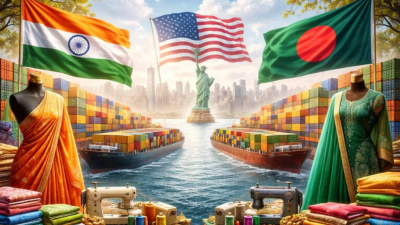
Days after India concluded a trade arrangement with the United States, Bangladesh secured a fresh agreement with Washington that grants zero reciprocal tariffs on specified volumes of textile and apparel exports, subject to quota-linked conditions. The announcement has unsettled Indian textile markets, with exporter stocks tumbling. Beyond immediate market reactions, the development signals intensifying geoeconomic competition in labour-intensive sectors where margins are thin and tariff differentials matter.
The New Bangladesh–US Understanding
Bangladesh and United States have agreed to create a mechanism allowing certain Bangladeshi textile and apparel goods to enter the US at zero reciprocal tariffs, up to a specified quota. The size of this duty-free window will reportedly be linked to Bangladesh’s imports of US cotton and man-made fibre inputs.
Bangladesh also committed to:
- Significant preferential access for US industrial and agricultural goods.
- Purchases of US agricultural commodities such as wheat, soy, cotton and corn.
- Long-term procurement of US energy products.
The agreement reflects the transactional character of contemporary trade diplomacy — tariff concessions in exchange for guaranteed demand and supply-chain alignment.
Why It Matters for India
India currently faces an 18% US tariff on comparable textile exports. Earlier expectations in Indian trade circles were that Bangladesh would face slightly higher tariffs (around 19%), offering India a narrow competitive edge. The new arrangement effectively reverses that perception.
The challenge is two-fold:
- Tariff asymmetry: Even a 1%–2% differential is critical in a sector characterised by low profit margins and price-sensitive buyers.
- Input displacement: If Bangladesh substitutes Indian cotton yarn with US-origin inputs to qualify for tariff benefits, India’s upstream textile exports to Bangladesh could be adversely affected.
Bangladesh is the world’s second-largest textile exporter after China. Any incremental advantage in the US market could intensify competitive pressure on Indian firms.
Dhaka’s Strategic Calculus
The move comes amid domestic political transition in Dhaka and heightened concern over trade competitiveness. Following India’s recent trade engagements with the UK, the US and the European Union, Bangladesh faced the risk of losing relative advantage in labour-intensive exports.
Bangladesh is also preparing for its graduation from Least Developed Country (LDC) status — a transition that entails the loss of certain trade concessions in European markets. Its leadership, including Chief Adviser Muhammad Yunus, has pushed for an accelerated Free Trade Agreement with the EU to cushion the impact.
The US deal, therefore, is part of a broader diversification strategy aimed at preserving export-led growth.
Geopolitics and Strained Bilateral Ties
The trade realignment acquires additional significance in the context of cooling India–Bangladesh relations. New Delhi’s termination of transhipment facilities for Bangladeshi cargo last year altered regional logistics dynamics. Remarks from Dhaka about leveraging Bangladesh’s geographic position as the “gateway” to India’s Northeast further sharpened sensitivities.
The northeastern Indian states — connected to the mainland through the narrow Siliguri Corridor — rely on stable regional transit arrangements. In the past decade, India engaged the government of Sheikh Hasina to improve connectivity to the Northeast via Bangladeshi territory. Political changes in Dhaka have complicated this engagement.
Against this backdrop, Bangladesh’s overtures to Beijing and its renewed trade activism with Washington add a strategic layer to what might otherwise appear as sectoral tariff negotiations.
Competitive Pressures in the EU Market
In the European Union’s textile import basket, China leads, followed by Bangladesh, Turkey, Vietnam and India. India accounts for roughly 5% of EU textile and apparel imports. Any shift in Bangladesh’s trade positioning — whether through an EU FTA or preferential arrangements elsewhere — has implications for India’s export share.
Thus, the current episode is not merely about the US market. It reflects a wider contest over global supply chains in textiles and apparel.
What India Must Consider
India’s textile industry operates in a highly competitive, price-sensitive global environment. To mitigate risks arising from tariff asymmetries, policy responses may include:
- Accelerating trade negotiations with key markets.
- Enhancing competitiveness through productivity gains and scale economies.
- Strengthening value addition in man-made fibres and technical textiles.
- Ensuring stable and competitive input costs, especially cotton and energy.
More broadly, India must recognise that trade diplomacy is increasingly intertwined with geopolitical positioning. Market access is negotiated not in isolation but within broader strategic alignments.
What to Note for Prelims?
- Bangladesh’s status as the second-largest global textile exporter.
- Concept of reciprocal tariffs and quota-based tariff concessions.
- LDC graduation and its impact on trade preferences.
- Siliguri Corridor (“Chicken Neck”) and its strategic significance.
- Role of cotton and man-made fibre inputs in textile value chains.
What to Note for Mains?
- Analyse the impact of tariff differentials on labour-intensive export sectors.
- Discuss how trade agreements are increasingly shaped by geoeconomic competition.
- Examine the implications of Bangladesh’s LDC graduation for regional trade dynamics.
- Evaluate India’s strategic options in managing economic competition alongside sensitive political relations in South Asia.