
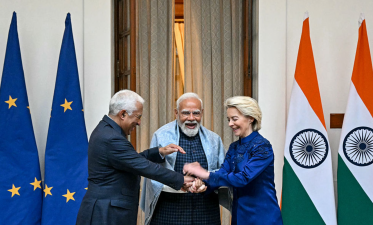
India and the European Union have formally concluded negotiations on their long-pending Free Trade Agreement at the India–EU summit, marking a decisive shift in global trade alignments. Announced jointly by Prime Minister Narendra Modi and European Commission President Ursula von der Leyen, the deal caps negotiations that began in 2007 but gained unprecedented momentum only in the past six months. The speed of closure reflects not just bilateral convergence, but deeper geo-economic churn reshaping global trade.
A deal delayed, then suddenly accelerated
For nearly 17 years, India–EU trade talks moved slowly, weighed down by differences over tariffs, automobiles, agriculture, intellectual property, and regulatory standards. As recently as July last year, only seven of the 21 negotiating chapters had been closed.
What changed was context. In the past year, sharp shifts in the global trading system — especially aggressive tariff actions by the United States — injected urgency into the talks. Faced with rising uncertainty, both New Delhi and Brussels reassessed their negotiating red lines and prioritised market diversification over prolonged bargaining.
Washington’s protectionism as a catalyst
A major external driver has been the U.S. turn away from the liberal trade order. At Davos, U.S. Commerce Secretary Howard Lutnick openly declared that globalisation had “failed” the West, urging countries to prioritise domestic workers through protectionist policies.
This shift has had direct consequences. Washington imposed steep 50% tariffs on Indian exports in August last year, hitting labour-intensive sectors hard. The EU, while negotiating with the U.S., remains exposed to tariff threats — from disputes over technology regulation to geopolitical tensions involving Greenland. Even the EU–U.S. deal that reduced tariffs to 15% last year is widely viewed in Europe as tactical and fragile.
For both India and the EU, dependence on the U.S. as the largest export market has become a strategic vulnerability.
Trade diversification amid multilateral drift
As U.S. trade policy grows unpredictable, multilateral institutions like the World Trade Organization have struggled to remain effective arbiters. This has pushed countries toward bilateral and regional agreements.
Brussels recently concluded a trade pact with Mercosur, while India has signed FTAs with the UK, New Zealand, and Oman. The India–EU FTA fits squarely into this diversification strategy, reducing over-reliance on any single market.
The China factor and supply chain anxiety
Another shared concern binding India and the EU is China’s manufacturing dominance. Beijing’s record $1.2 trillion trade surplus underscores its grip on global supply chains, including critical industrial inputs.
Both India and the EU import large volumes of intermediate goods from China, a dependence that became glaring during the COVID-19 pandemic. According to the Delhi Policy Group, the crisis exposed the risks of China-centric supply chains and prompted both sides to pursue diversification and de-risking strategies.
In response, the EU imposed tariffs of up to 35% on Chinese electric vehicles in 2024, while India continues to levy over 100% duties on imported automobiles even as it selectively opens its market through FTAs.
US pressure and the geopolitics of overcapacity
Washington has also pressed India and the EU to reduce reliance on Chinese manufacturing and avoid acting as transhipment hubs. Lutnick has criticised Europe’s climate ambitions without domestic battery production and flagged India’s dependence on China for pharmaceutical inputs, even while calling India a strategic ally.
Such pressure has reinforced the incentive for India and the EU to build alternative production and trade networks together.
Brexit, automobiles, and the UK precedent
India’s recently concluded trade agreement with the UK played an indirect but important role in reviving India–EU talks. By offering market access to Britain in sectors like automobiles — once a deal-breaker in India–EU negotiations — New Delhi signalled greater flexibility.
Negotiations with the EU had collapsed in 2013 largely over India’s reluctance to open its automobile sector. The India–UK deal, Britain’s largest since Brexit, demonstrated that India was willing to recalibrate its trade strategy. UK government estimates suggest major export gains in beverages, tobacco, and motor vehicles — figures closely watched in Germany and France.
Why timing mattered as much as terms
Ultimately, the India–EU FTA is as much a product of timing as of trade-offs. The convergence of U.S. protectionism, Chinese overcapacity, weakened multilateralism, and precedents set by post-Brexit trade deals created a narrow window where compromise became preferable to delay.
Both sides moved from defensive trade postures to strategic alignment, seeing the agreement not just as an economic instrument but as a hedge against global uncertainty.
What to note for Prelims?
- India–EU FTA negotiations began in 2007 and concluded in 2025.
- Only seven of 21 chapters were closed by mid-2024; the rest were finalised in six months.
- US tariffs of 50% on Indian exports acted as a key external trigger.
- China’s trade surplus and supply-chain dominance shaped negotiations.
What to note for Mains?
- The India–EU FTA reflects a shift from multilateral to bilateral trade strategies.
- US protectionism and Chinese overcapacity are reshaping global trade alignments.
- Brexit and the India–UK FTA influenced India–EU negotiating flexibility.
- The deal highlights trade as a tool of geo-economic resilience, not just market access.