
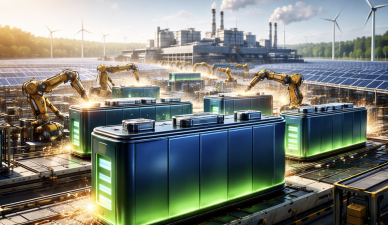
India’s clean-energy transition received a major push as Waaree Energies announced plans to establish the country’s largest integrated lithium-ion battery gigafactory at Rambilli in Anakapalli district of Andhra Pradesh. With an investment of ₹8,175 crore and a planned capacity of 16 GWh, the project marks a significant milestone in India’s efforts to build domestic capabilities in advanced energy storage and reduce import dependence.
What the Rambilli Gigafactory Will Produce
The greenfield facility is designed as a fully integrated lithium-ion battery manufacturing hub. Unlike standalone assembly plants, the Rambilli project aims to cover the entire battery value chain.
Its proposed components include:
- Cell manufacturing – the core electrochemical unit of lithium-ion batteries.
- Battery pack assembly – integrating multiple cells into usable modules.
- Battery Energy Storage Systems (BESS) – large-scale storage solutions for grid and industrial use.
With a capacity of 16 GWh, the plant will be capable of supporting both electric mobility and grid-scale renewable energy storage, positioning it as a strategic asset in India’s energy transition.
Why Lithium-Ion Manufacturing Matters
Lithium-ion batteries are central to three transformative sectors:
- Electric Vehicles (EVs) – powering cars, buses, and two-wheelers.
- Renewable Energy Integration – storing solar and wind power for stable supply.
- Grid Stability – managing peak loads and balancing intermittent energy sources.
Currently, India relies heavily on imports—particularly from East Asian economies—for advanced battery cells. Domestic manufacturing reduces supply chain vulnerabilities, enhances energy security, and supports the “Make in India” push in high-value manufacturing.
Policy Backdrop: Andhra Pradesh’s Clean Energy Vision
The project received in-principle approval from the State Investment Promotion Board and aligns with the Government of Andhra Pradesh’s Integrated Clean Energy Policy. The State has already attracted investments in renewable power generation and solar module manufacturing.
The Waaree gigafactory represents the next phase—backward integration into advanced energy storage. By creating a complete ecosystem spanning:
- Power generation (solar and wind),
- Equipment manufacturing (modules and components),
- Energy storage (lithium-ion batteries and BESS),
Andhra Pradesh seeks to position itself as a clean-energy manufacturing hub.
National Context: India’s Push for Gigafactories
The project complements broader national initiatives such as the Production Linked Incentive (PLI) scheme for Advanced Chemistry Cells (ACC). The Government of India has prioritised domestic battery manufacturing to support:
- National Electric Mobility Mission Plan (NEMMP),
- FAME (Faster Adoption and Manufacturing of Electric Vehicles),
- Renewable energy targets of 500 GW non-fossil capacity by 2030.
Large-scale battery storage is increasingly viewed as critical for meeting India’s climate commitments under the Paris Agreement while ensuring grid reliability.
Economic and Strategic Implications
The ₹8,175 crore investment is expected to generate direct and indirect employment, enhance technology transfer, and strengthen India’s position in global clean-energy supply chains.
Strategically, it addresses key concerns:
- Reducing dependence on imported battery cells.
- Strengthening supply chains for EV manufacturers.
- Enhancing grid resilience amid rising renewable penetration.
- Attracting ancillary industries in materials, recycling, and logistics.
However, challenges remain. Securing raw materials such as lithium, cobalt, and nickel will require diversified sourcing and international partnerships. Environmental safeguards and battery recycling frameworks will also be crucial to ensure sustainability.
What to Note for Prelims?
- Concept of Gigafactory and its relevance to lithium-ion batteries.
- Advanced Chemistry Cell (ACC) and PLI scheme.
- Battery Energy Storage Systems (BESS).
- Andhra Pradesh’s Integrated Clean Energy Policy.
What to Note for Mains?
- Discuss the role of energy storage in India’s renewable energy transition.
- Analyse how domestic battery manufacturing strengthens energy security.
- Examine the economic and environmental challenges associated with lithium-ion production.
- Evaluate the importance of State-level industrial policy in advancing national climate goals.