
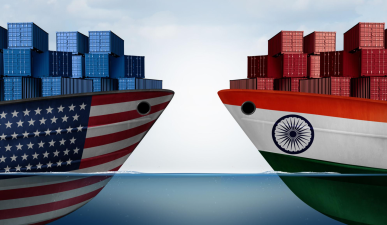
On February 6, India and the United States released a joint statement outlining an interim framework under the proposed Bilateral Trade Agreement. While presented as a step towards deeper economic cooperation, the framework raises serious questions about balance, autonomy, and long-term consequences for India’s trade and strategic policy space.
What the interim trade framework proposes
The joint statement reflects a familiar US negotiating template: securing market access, regulatory concessions, and strategic alignment upfront, while postponing or limiting reciprocal commitments. The framework is explicitly interim, but several provisions risk locking India into obligations that are politically and economically difficult to reverse once accepted.
A key pillar is the commitment to strengthen “economic security alignment” to address the non-market policies of third countries — language that carries implications well beyond trade.
Economic security alignment and strategic autonomy
The notion of economic security alignment effectively links India’s trade and economic decisions to US geopolitical priorities. If the US were to impose steep tariffs or restrictions on imports from countries such as Russia or China on economic security grounds, India could face pressure to mirror those actions.
Such alignment may also require India to limit trade, investment, or financial transactions with countries sanctioned by the US, constraining its ability to pursue an independent foreign policy. For a country that has historically guarded its strategic autonomy, this represents a significant shift.
Spillover risks into procurement and future negotiations
The implications could extend further into procurement and standard-setting. India may be compelled to favour US suppliers — including in sensitive sectors such as nuclear reactors — over alternative global partners. There could also be expectations that India consult the US before entering into digital trade or regulatory agreements with third countries, to ensure US commercial interests are not adversely affected.
Similar commitments have already been extracted by the US from Malaysia, highlighting a pattern rather than an exception.
The $500 billion import pledge: ambition versus feasibility
The joint statement records India’s intention to purchase $500 billion worth of US goods over the next five years. Achieving this would require India’s annual imports from the US to nearly double, from about $45 billion to close to $100 billion.
Aircraft purchases are highlighted as a major component. India currently operates around 200 aircraft from Boeing. Even adding another 200 aircraft over five years would amount to roughly $60 billion — far short of the stated target. Moreover, such purchases are commercial decisions made by private airlines, not sovereign procurement commitments. The headline number therefore appears economically implausible.
Digital trade and erosion of policy space
India is already deeply dependent on US software and technology firms. Against this backdrop, the digital trade language in the joint statement is particularly concerning. The US seeks binding commitments to remove barriers to digital trade, which could force India to abandon its opposition at the World Trade Organization to a permanent moratorium on customs duties on electronic transmissions.
Accepting such rules would constrain India’s ability to tax global technology firms, levy equalisation taxes, regulate large digital platforms, or shape its digital economy in line with domestic priorities. For a country striving to build digital sovereignty, these concessions would be costly and difficult to undo.
Tariff cuts, agriculture, and manufacturing concerns
India has agreed to reduce or eliminate MFN tariffs on all US industrial goods and on a wide range of agricultural products, including animal feed, edible oils, fruits, wine, and spirits. In automobiles, electronics, smartphones, and solar panels, tariff elimination could undermine domestic manufacturing efforts if not carefully capped through quotas or partial duty reductions.
By contrast, the US has not reduced its normal MFN tariffs. It has merely lowered so-called “reciprocal tariffs” from 50% to 18% — a modest concession compared to other US trade deals. Indian exporters in textiles, apparel, leather, chemicals, and artisanal goods stand to gain, but the overall balance remains asymmetric.
Non-tariff barriers and regulatory dilution
India has also committed to easing several regulatory measures that the US labels as non-tariff barriers — including medical device rules, ICT import licensing, and standards recognition. In agriculture and dairy, this raises sensitive domestic concerns. US objections to India’s certification rules on cattle feed, for instance, overlook cultural, ethical, and public health realities.
Experiences from Malaysia, where US sanitary certificates were accepted without reciprocal access, suggest India could face regulatory dilution without corresponding gains.
Geopolitics embedded in trade concessions
The joint statement broadly aligns with claims made by Donald Trump on February 2, except that India has not confirmed any commitment to halt Russian oil imports. Yet the US has indicated it will monitor India’s energy trade and could reimpose high tariffs if expectations are not met. This underscores that tariff relief is conditional on geopolitical compliance rather than purely economic terms.
What to note for Prelims?
- Interim framework under India–US Bilateral Trade Agreement.
- Concept of “economic security alignment” in trade policy.
- MFN tariffs and reciprocal tariffs distinction.
- WTO moratorium on customs duties on electronic transmissions.
What to note for Mains?
- Trade-offs between market access and strategic autonomy.
- Risks of linking trade policy with geopolitical alignment.
- Impact of digital trade rules on regulatory sovereignty.
- Asymmetry in India–US trade negotiations and long-term implications.