
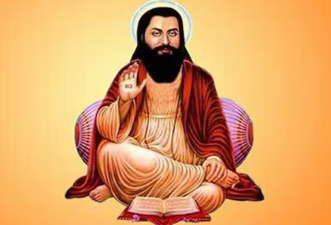
The homage paid to Guru Sant Ravidas ahead of the Union Budget announcement was not a routine ceremonial gesture. It carried a larger moral and political signal — one that drew from India’s long civilisational conversation on dignity, justice, and inclusion. Revisiting the life and thought of Sant Ravidas offers more than historical remembrance; it opens a window into how social harmony is ethically constructed and sustained over time.
A saint rooted in lived experience, not inherited privilege
Sant Ravidas was born into a marginalised community and earned his livelihood as a cobbler. In a society deeply structured by birth-based hierarchy, this location was not incidental — it was central to his moral authority. Ravidas did not reject work; he sanctified it. By infusing everyday labour with spiritual dignity, he challenged the idea that purity, worth, or moral stature could be inherited rather than earned.
Unlike reformers who confronted hierarchy through institutional rebellion, Ravidas’ challenge was ethical and personal. His presence unsettled entrenched assumptions precisely because it refused abstraction. Equality, for him, was not a slogan but a lived insistence that dignity cannot be conditional.
Begampura as a moral imagination, not a utopia
Ravidas’ most enduring metaphor, Begampura — the city without sorrow — is often misunderstood as a utopian fantasy. In fact, it was a moral critique of existing society. Begampura represented a social order where fear, exclusion, and humiliation had no place, and where justice was the foundation of harmony.
Crucially, Ravidas did not define harmony as the absence of conflict. Instead, he framed it as the presence of justice. This distinction remains sharply relevant in a civilisation often tempted to prioritise ritual stability over ethical repair.
Equality within faith and the challenge to ritual hierarchy
Ravidas’ insistence on equality within faith directly confronted the monopolisation of religious authority by lineage. His bhakti did not abolish devotion; it stripped devotion of social gatekeeping. In doing so, he anticipated a recurring Indian tension — between spirituality as moral practice and ritual as social control.
This ethical instinct finds resonance in contemporary moments where ritual participation itself becomes a site of social correction. The consecration of the Sengol in the new Parliament building by OBC pandits, for instance, quietly disrupted inherited hierarchies through inclusion rather than confrontation — a gesture Ravidas would have instinctively recognised.
From community memory to national symbolism
For centuries, figures like Sant Ravidas were deeply revered in community memory but remained absent from elite national symbolism. Recent years mark a shift. The naming of Ayodhya airport after Maharshi Valmiki, and the association of Adampur airport with Sant Ravidas, reflect an attempt — however incomplete — to correct the asymmetry of remembrance.
Such recognition does not erase historical injustice. But it does signal a transition in who is deemed worthy of public honour. In that sense, the Sant Ravidas airport is less an infrastructure decision and more an act of social repair.
Ethical continuity across political and constitutional moments
The same moral thread runs through moments that are often analysed only through legal or security lenses. The removal of Article 370, for instance, extended long-denied rights to Dalits, OBCs, and women in Jammu and Kashmir. Ravidas did not speak the language of constitutionalism, but his ethical position was unmistakable: justice cannot be selective, and harmony cannot coexist with invisibility.
Decades earlier, a similar moral symbolism was visible when Kameshwar Chaupal laid the first stone of the Ram Mandir in 1989 — an act that quietly redefined who could participate in sacred national projects.
From symbolic inclusion to structural participation
What connects these developments is not ideology alone, but intent — the attempt to move from symbolic inclusion to structural participation. Prime Minister Narendra Modi’s emphasis on “sabka saath, sabka vikas, sabka vishwas” echoes an aspiration aligned with Ravidas’ ethical universe, where trust and belonging are outcomes of visible justice.
Ravidas reminds us that real social change reveals itself not in proclamations, but in who is honoured, who performs rituals, who gains rights, and who feels less afraid to belong.
What to note for Prelims?
- Sant Ravidas was a Bhakti saint associated with egalitarian social ethics.
- Concept of Begampura as a moral-social vision.
- Inclusion of Ravidas’ hymns in Sikh Guru Granth Sahib.
- Recent symbolic recognitions: Adampur airport naming.
What to note for Mains?
- Role of Bhakti saints in challenging caste hierarchy through ethical means.
- Symbolism vs structural inclusion in contemporary Indian politics.
- Use of public memory and symbolism as tools of social repair.
- Relevance of Ravidas’ thought to constitutional values of justice and dignity.