
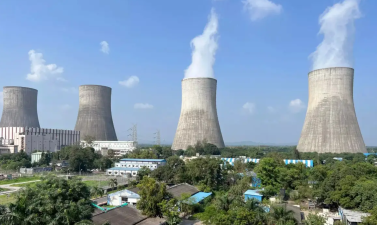
The SHANTI Act, passed in the Winter Session of Parliament, marks a significant shift in India’s nuclear energy policy. It opens the sector to private operators and amends the liability architecture earlier established under the Civil Liability for Nuclear Damage Act (CLNDA).
While the government projects the law as necessary for scaling nuclear capacity, critics argue that changes to supplier indemnity, liability caps and regulatory oversight raise serious concerns about safety, accountability and victims’ rights.
Opening Nuclear Power to Private Operators
Until now, nuclear power generation in India was effectively under the control of public sector entities operating within the framework of the Atomic Energy Act. The SHANTI Act ends this exclusivity by permitting private entities to establish and operate nuclear plants.
This reform is presented as a step toward accelerating capacity expansion and attracting foreign technology partnerships. However, the entry of profit-driven private players into a high-risk sector fundamentally alters the risk–reward balance in nuclear governance.
The Act also provides statutory backing to the Atomic Energy Regulatory Board (AERB), but raises concerns about regulatory independence by vesting appointments in a committee constituted by the Atomic Energy Commission.
Supplier Indemnity and Removal of Right of Recourse
One of the most debated provisions is the indemnification of nuclear suppliers. Under the CLNDA, operators had a “right of recourse” — the ability to seek compensation from suppliers if accidents were caused by defective equipment or design flaws.
The SHANTI Act removes this right and channels liability exclusively to the operator. It also omits Clause 46 of the CLNDA, which had allowed victims to pursue remedies under other laws, including criminal law.
Historically, major nuclear accidents — such as Chernobyl disaster, Fukushima nuclear disaster and Three Mile Island accident — have involved design weaknesses, inadequate safety systems or failure to communicate known vulnerabilities. Critics argue that insulating suppliers from liability reduces incentives for high safety standards.
Supporters of the reform contend that alignment with global nuclear liability norms was necessary to attract multinational suppliers and facilitate technology transfers.
Liability Caps and the Scale of Potential Damage
The SHANTI Act caps operator liability between ₹100 crore (for small plants) and ₹3,000 crore (for the largest plants). The total liability, including the Centre’s contribution, is capped at 300 million Special Drawing Rights — roughly ₹3,900 crore.
When compared to historical nuclear disasters, the scale appears modest. Estimates suggest that economic losses from Fukushima could run into tens of trillions of yen, while post-Chernobyl damages ran into hundreds of billions of dollars.
Even if India accesses additional funds under the Convention on Supplementary Compensation for Nuclear Damage, total compensation would likely represent a fraction of potential catastrophic losses.
The implication is clear: victims’ legal entitlement is strictly limited by statute, and losses beyond the cap would not be recoverable through civil claims.
Moral Hazard and Safety Concerns
By limiting financial consequences, the Act raises the classic economic concern of “moral hazard” — when actors insulated from risk may underinvest in safety.
The legislation also exempts operators from liability in cases of “grave natural disaster,” marking a departure from India’s earlier absolute liability doctrine for hazardous industries. Given that Fukushima was triggered by a tsunami, critics argue that this provision weakens incentives to design resilient plants capable of withstanding extreme events.
A robust regulatory framework could mitigate such risks. However, concerns about the functional autonomy of the Atomic Energy Regulatory Board add another layer to the safety debate.
Nuclear Energy’s Limited Role in India’s Power Mix
Despite decades of policy emphasis, nuclear energy has contributed roughly 3% of India’s electricity generation. Capacity expansion targets have repeatedly fallen short:
- Target of 10 GW by 2000; actual capacity around 2.86 GW.
- Target of 20 GW by 2020; actual capacity around 6.78 GW.
Ambitions of reaching 100 GW by 2047 appear challenging, given high capital costs, long construction timelines and persistent safety concerns.
Emerging technologies such as small modular reactors are still evolving and may entail even higher per-unit costs. The economic viability of large-scale nuclear expansion remains debated.
Commercial Incentives and Global Partnerships
Large nuclear projects involve substantial capital expenditure and technology imports. For example, advanced reactors such as the AP1000 built by global suppliers have involved multi-billion-dollar investments abroad.
By restructuring liability and opening the sector to private capital, the SHANTI Act lowers commercial risk for suppliers and investors. Critics argue that this shifts disproportionate risk onto the public, while supporters view it as essential for unlocking stalled projects and boosting clean energy capacity.
The central tension lies between expanding nuclear energy as part of India’s low-carbon transition and ensuring that safety, accountability and victims’ rights are not compromised.
What to Note for Prelims?
- Key provisions of the Civil Liability for Nuclear Damage Act, 2010.
- Concept of “right of recourse” in nuclear liability law.
- Meaning of Special Drawing Rights (SDR).
- Convention on Supplementary Compensation for Nuclear Damage.
- Role of the Atomic Energy Regulatory Board.
What to Note for Mains?
- Debate between energy security and nuclear safety.
- Concept of moral hazard in regulatory economics.
- Absolute liability versus capped liability frameworks.
- Federal and international dimensions of nuclear governance.
- Balancing commercial incentives with public accountability in high-risk sectors.