
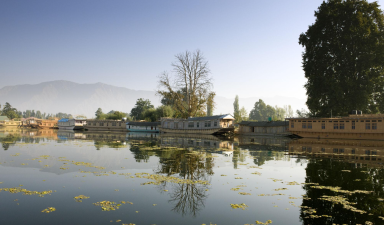
The Jammu and Kashmir government has decided to shelve the ₹416.72-crore restoration plan for Dal Lake and instead pursue an in-situ conservation model that allows residents to continue living within the lake. The earlier plan, approved in 2009, sought large-scale relocation of nearly 9,000 families to reduce pollution and encroachment.
The shift reflects not just a change in strategy but a broader debate over ecology, livelihoods and urban planning in Srinagar.
Why Dal Lake Is Under Ecological Stress
Dal Lake has witnessed severe ecological degradation over the past four decades. A 2022 survey by Sher-e-Kashmir University of Agricultural Sciences and Technology documented alarming levels of pollution and biodiversity decline.
The key stressors include:
- Untreated sewage from residential hamlets and surrounding urban settlements.
- Encroachment and shrinking lake area.
- Excess nutrient load leading to eutrophication and explosive weed growth.
- Invasion by non-native plant and animal species.
- Deforestation, grazing and agricultural runoff in the catchment area.
- Reduced inflows and clogged internal channels affecting water circulation.
Nutrient enrichment has altered the lake’s ecological balance, transforming parts of it into weed-choked marshlands and threatening its tourism value as well as its biodiversity.
The 2009 Relocation-Based Restoration Plan
In 2009, under the Manmohan Singh-led government, a comprehensive restoration plan was approved. It envisaged relocating around 9,000 families from the lake to a rehabilitation colony at Rakh-e-Arth in Bemina.
Each family was offered:
- A plot of land.
- ₹1.05 lakh for structure construction.
- ₹3.91 lakh as one-time compensation.
However, the rehabilitation site required extensive land filling as it was flood-prone and low-lying. Infrastructure development lagged, and over 17 years, only about 1,808 families were relocated. Official assessments suggest that the conservation effort achieved only about 27% of its intended outcomes.
The slow progress, administrative hurdles and resistance from residents ultimately limited the plan’s impact.
The New In-Situ Conservation Approach
In 2022, a High-Level Committee recommended a shift toward in-situ conservation, recognising lake dwellers as integral to the ecosystem rather than external encroachers.
The Jammu and Kashmir Lake Conservation and Management Authority (LCMA) has been tasked with developing a comprehensive policy. The new strategy includes:
- Upgrading 58 internal hamlets, with priority given to six hamlets to be equipped with modular Sewage Treatment Plants (STPs).
- Addressing sewerage issues in 28 internal hamlets.
- Treating inflows from catchment areas.
- Dredging and widening internal water channels to restore circulation and navigation.
A Detailed Project Report prepared by Indian Institute of Technology Roorkee proposes ₹212.38 crore expenditure over five years. The project awaits final financial approval.
The approach seeks to balance environmental restoration with social realities, recognising that forced relocation without viable alternatives may not yield ecological gains.
Ecology Versus Livelihoods: The Policy Dilemma
Dal Lake is not merely a water body but a socio-economic ecosystem. Thousands depend on it for fishing, tourism, vegetable cultivation and houseboat services. Relocation disrupts these traditional occupations.
At the same time, unchecked habitation within the lake contributes to pollution loads and structural encroachment. The challenge lies in designing infrastructure — such as decentralised sewage treatment and solid waste management — that reduces environmental stress without displacing communities.
The in-situ model assumes that environmental protection and livelihood security can be made compatible through better governance and technological intervention.
Urban Planning and Long-Term Sustainability
Dal Lake’s degradation also reflects broader urbanisation pressures in Srinagar. Rapid land-use change, weak enforcement of zoning norms, and inadequate waste management systems have compounded the crisis.
Reviving the lake requires:
- Integrated catchment area management.
- Strict regulation of construction and encroachment.
- Continuous dredging and weed removal.
- Community participation in conservation.
Without sustained monitoring and institutional coordination, even well-designed projects risk underperformance.
What to Note for Prelims?
- Location and significance of Dal Lake in Jammu and Kashmir.
- Concept of eutrophication and nutrient enrichment.
- Role of Lake Conservation and Management Authorities.
- Functions of Sewage Treatment Plants (STPs).
- Catchment area management principles.
What to Note for Mains?
- Urban lake degradation and anthropogenic pressures.
- Trade-offs between environmental conservation and livelihood rights.
- Effectiveness of relocation versus in-situ rehabilitation models.
- Institutional coordination in ecosystem restoration.
- Community participation in environmental governance.