
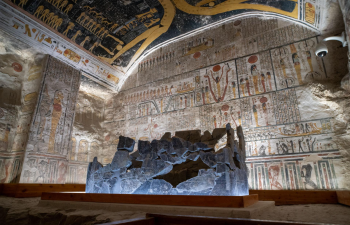
In the shadowed chambers of the Valley of the Kings, where New Kingdom pharaohs were laid to rest, scholars have long known of thousands of Greek graffiti left by ancient visitors. But a recent study (2024–25) by Charlotte Schmid of the École Française d’Extrême-Orient and Ingo Strauch of the University of Lausanne has identified something far more unexpected — nearly 30 Indian inscriptions dating from the 1st to 3rd centuries CE.
Written in Tamil-Brahmi, Sanskrit and Prakrit, these markings suggest that Indian travellers journeyed far beyond Red Sea ports into inland Egypt, leaving behind tangible traces of the Indian Ocean world.
From Red Sea Trade to Inland Pilgrimage
Classical texts by Pliny and Ptolemy long attested to Indo-Roman trade. Archaeological discoveries at Berenike revealed Indian goods such as pepper and beads. Yet Berenike was a port.
The Valley of the Kings lies deep in the Nile valley, near Thebes. The inscriptions here show that Indian visitors did not simply dock, trade and depart. They travelled inland, participated in Mediterranean commemorative practices, and inscribed their presence alongside Greek and Latin travellers.
This suggests not transient contact, but mobility, literacy and cultural confidence.
Cikai Koṟṟaṉ: A Tamil Name Repeated
The most striking discovery is the repeated inscription of the name “Cikai Koṟṟaṉ”, found eight times across five tombs.
The name itself reflects linguistic hybridity:
- Cikai may connect to the Sanskrit “śikhā” (tuft or crown).
- Koṟṟaṉ derives from a Tamil root associated with victory and kingship, echoing Koṟṟavai, the Chera warrior goddess.
The name appears in the Sangam corpus and in inscriptions from South India, linking the Egyptian graffiti to early historic Tamilakam. The repetition suggests deliberate marking — possibly asserting identity in a cosmopolitan space.
“Kopāṉ Came and Saw”
Another Tamil-Brahmi inscription reads: “Kopāṉ varata kantan” — “Kopāṉ came and saw.” The phrasing mirrors Greek graffiti formulae found in the same tombs, indicating cultural borrowing or imitation.
Other names such as Cātaṉ and Kiraṉ correspond to known early Tamil inscriptions in South India. The pattern suggests that these were literate individuals participating in an established Mediterranean tradition of marking sacred or monumental spaces.
Beyond Tamil: Sanskrit and Prakrit Voices
Of the roughly 30 inscriptions documented:
- About 20 are in Tamil-Brahmi.
- The rest are in Sanskrit, Prakrit and Gandhari-Kharosthi.
One Sanskrit inscription refers to an envoy of a Kshaharata king — a dynasty that ruled parts of western India in the 1st century CE. This indicates participation not only by Tamil merchants but also by traders and possibly officials from northwestern India.
The linguistic diversity underscores that Indo-Roman exchange was pan-Indian rather than confined to a single coast.
Rethinking Early Historic India
Tamil-Brahmi inscriptions within India number just over a hundred. The addition of 20 more from Egypt is significant.
This raises questions:
- Were writing practices in Tamilakam more perishable (e.g., on palm leaf)?
- Was stone inscription limited to certain contexts?
- Did merchant communities abroad adopt inscription practices more readily?
The Egyptian graffiti demonstrate that certain Indian merchant groups were literate, mobile and culturally assertive, comfortable inscribing their names thousands of miles from home.
Implications for Indian Ocean History
The discovery complicates older narratives of Roman trade with India as largely one-directional. Instead, it reveals:
- Indians as named individuals in Mediterranean spaces.
- Participation in shared cultural rituals of travel and remembrance.
- Interconnected linguistic worlds spanning Tamil, Sanskrit and Prakrit traditions.
The Valley of the Kings, built in the 16th century BCE, had become an ancient tourist site by the Roman period. Indians joined Greeks and Romans in this cosmopolitan act of leaving their mark.
Why the Discovery Matters
For historians of South India, the find connects the Sangam literary world with tangible global mobility. For Mediterranean historians, it broadens the social profile of ancient visitors.
These inscriptions are brief — scratches rather than deep carvings — yet they endured for two millennia, preserved by Egypt’s dry climate and stable rock-cut tombs.
They remind us that globalisation is not a modern invention. The Indian Ocean world of the early centuries CE was already threaded with trade, language, identity and travel.
What to Note for Prelims?
- Location and historical significance of the Valley of the Kings.
- Features of Tamil-Brahmi script.
- Indo-Roman trade during the early centuries CE.
- Kshaharata dynasty in western India.
- Berenike as a Red Sea trade port.
What to Note for Mains?
- Indian Ocean trade networks in the early historic period.
- Evidence of transoceanic mobility in epigraphy.
- Linguistic hybridity and cultural exchange in ancient India.
- Limitations of textual sources versus archaeological evidence.
- Global dimensions of Sangam-era Tamil society.