
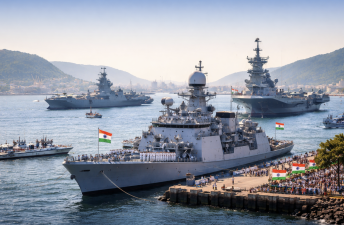
India’s eastern seaboard is witnessing a major convergence of global naval power as warships from across continents gather in Visakhapatnam for the International Fleet Review (IFR) and the multilateral naval exercise MILAN. With 75 naval vessels, including 20 foreign ships, participating, the twin events are not merely ceremonial showcases but strategic platforms reflecting India’s expanding maritime diplomacy and security partnerships in the Indo-Pacific.
What Is the International Fleet Review and MILAN Exercise?
The International Fleet Review is a ceremonial and operational event in which naval ships assemble for inspection by a head of state. It is both a display of maritime strength and a symbol of naval cooperation. IFR 2026 in Visakhapatnam aims to highlight India’s growing blue-water capabilities and its role as a net security provider in the Indian Ocean Region (IOR).
MILAN, initiated by the Indian Navy in 1995, is a biennial multilateral naval exercise that began as a modest gathering of littoral navies but has evolved into a major Indo-Pacific maritime engagement platform. It promotes interoperability, confidence-building, and coordinated responses to common maritime challenges such as piracy, humanitarian crises, and maritime terrorism.
Together, IFR and MILAN combine symbolic naval diplomacy with practical operational collaboration.
INS Tarangini and the Symbolism of Naval Heritage
INS Tarangini, India’s sail training ship, is among the notable vessels present. Commissioned in 1997, Tarangini holds a special place in Indian naval history:
- It became the first Indian naval ship to circumnavigate the globe in 2003–04.
- It represented India at the Sri Lankan Navy’s diamond jubilee International Fleet Review in 2010.
- It was the only tall ship at that event and was the first vessel to be reviewed by the Sri Lankan President.
As a tall ship, Tarangini symbolizes seamanship traditions and naval heritage. Its participation underscores the blend of tradition and modernity in India’s maritime outlook. Such ships play a crucial role in training cadets, instilling discipline, navigation skills, and international exposure.
INS Vikrant and India’s Blue-Water Ambitions
INS Vikrant, India’s indigenously built aircraft carrier, is expected to be one of the highlights of the fleet review. As India’s first Indigenous Aircraft Carrier (IAC-1), Vikrant marks a significant milestone in the country’s defence manufacturing and Atmanirbhar Bharat initiative.
Its presence reflects:
- India’s ability to design and construct complex warships domestically.
- The transition from coastal defence to blue-water naval capability.
- Enhanced power projection capacity in the Indo-Pacific region.
Aircraft carriers are central to sea control and maritime deterrence. For India, positioned astride key sea lanes of communication (SLOCs), such capability strengthens its strategic leverage.
Foreign Participation and India’s Expanding Maritime Partnerships
The participation of foreign vessels illustrates India’s widening defence engagement.
Among them are:
- BRP Miguel Malvar of the Philippine Navy.
- CGS Huravee of the Maldives National Defence Force.
- SCGS Zoroaster (P609) of the Seychelles Coast Guard.
- VNPS 17 of the Vietnam People’s Navy.
These visits signify:
- Deepening India–Philippines defence ties amid evolving South China Sea dynamics.
- Continued maritime cooperation with Maldives and Seychelles, both crucial Indian Ocean partners.
- Strengthening India–Vietnam strategic convergence in the Indo-Pacific.
For India, such naval engagements serve as instruments of soft power, trust-building, and strategic balancing, especially in the context of increased geopolitical competition in the Indian Ocean and South China Sea regions.
Why Visakhapatnam Matters in India’s Naval Strategy
Visakhapatnam, home to the Eastern Naval Command, has emerged as a critical maritime hub. Located along India’s eastern coast, it provides strategic access to the Bay of Bengal and onward to Southeast Asia.
Hosting IFR and MILAN here:
- Showcases the operational readiness of the Eastern Fleet.
- Highlights India’s focus on the eastern maritime theatre.
- Reinforces India’s Act East Policy through naval outreach.
The Bay of Bengal is increasingly central to regional trade, energy flows, and connectivity initiatives. Strengthening presence here aligns with India’s Indo-Pacific vision.
Strategic Significance in the Indo-Pacific Context
The Indo-Pacific has emerged as the primary theatre of 21st-century geopolitical competition. India’s maritime engagements through IFR and MILAN reflect a calibrated strategy:
- Positioning itself as a responsible security provider.
- Promoting a rules-based maritime order.
- Enhancing multilateral naval interoperability.
- Countering non-traditional threats such as piracy and maritime disasters.
Such platforms also complement broader groupings like the Quad and other regional maritime frameworks without being overtly alliance-driven.
What to Note for Prelims?
- INS Tarangini – sail training ship, commissioned in 1997, first Indian naval ship to circumnavigate the globe (2003–04).
- INS Vikrant – India’s first Indigenous Aircraft Carrier (IAC-1).
- MILAN – Multilateral naval exercise initiated in 1995 by the Indian Navy.
- International Fleet Review – ceremonial gathering of naval ships reviewed by the Head of State.
- Visakhapatnam – Headquarters of the Eastern Naval Command.
What to Note for Mains?
- Role of naval diplomacy in advancing India’s Indo-Pacific strategy.
- Importance of blue-water capability for safeguarding Sea Lines of Communication (SLOCs).
- Maritime cooperation as a tool of soft power and strategic balancing.
- Relevance of multilateral naval exercises in strengthening regional security architecture.
- Connection between Atmanirbhar Bharat and indigenous defence manufacturing.