
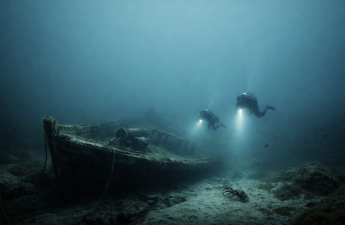
More than 150 years after it sank in a violent storm, the remains of the luxury steamer Lac La Belle have been located at the bottom of Lake Michigan. The discovery not only resolves a long-standing maritime mystery but also adds to the complex history of shipwrecks in the Great Lakes — a region often described as the “inland seas” of North America. For maritime historians and underwater archaeologists, the find represents both a technological achievement and a race against ecological degradation.
The 1872 Storm That Doomed Lac La Belle
Lac La Belle was a side-wheel steamer that met its tragic end on October 13, 1872. After departing Milwaukee for Grand Haven, Michigan, with 53 passengers and crew onboard, the vessel encountered a powerful storm barely two hours into its journey.
The captain attempted to return to Milwaukee as the storm intensified. However, high waves disabled the boilers, and the ship rapidly began taking on water. Around dawn, lifeboats were lowered. Soon after, the vessel sank stern-first. One lifeboat capsized, killing eight people, while others managed to reach the Wisconsin coast between Racine and Kenosha.
The tragedy reflects the unpredictable weather patterns of the Great Lakes — where sudden storms have historically caught vessels off guard, despite the lakes being freshwater bodies.
A Six-Decade Search Finally Pays Off
The wreck was discovered in October 2022 by a team led by Illinois-based shipwreck hunter Paul Ehorn. Remarkably, Ehorn had been searching for Lac La Belle since 1965, making the find the culmination of nearly 60 years of effort. It is the 15th shipwreck he has located.
Using side-scan sonar technology, the team identified the wreck about 20 miles offshore between Racine and Kenosha. The vessel was found within two hours of scanning the narrowed search area, aided by research inputs from maritime explorer Ross Richardson.
The delay in public announcement allowed the team to create a detailed 3D model of the wreck — highlighting how underwater archaeology today blends historical research with advanced imaging technologies.
Lake Michigan and the Graveyard of Ships
Lake Michigan is one of the five Great Lakes and has long served as a critical commercial waterway. However, it is equally notorious for shipwrecks.
According to research estimates, the broader Great Lakes region contains between 6,000 and 10,000 shipwrecks, most of which remain undiscovered. These wrecks span centuries of trade, migration, industrial expansion, and maritime disasters.
The Great Lakes earned the moniker “Shipwreck Coast” due to:
- Sudden and violent storms.
- Limited early warning systems in the 19th century.
- Heavy commercial traffic during America’s industrial growth.
- Cold freshwater that preserves wrecks longer than saltwater oceans.
The discovery of Lac La Belle adds another chapter to this submerged history.
Technology and Ecology: A Race Against Time
Modern wreck discovery relies heavily on side-scan sonar, underwater drones, and digital modelling. These tools allow researchers to map wreck sites without disturbing them.
However, preservation faces a new threat — invasive quagga mussels. These exotic species have colonized the Great Lakes and now blanket many shipwrecks. The mussels gradually damage wooden and metal structures, obscuring historical features and accelerating decay.
In the case of Lac La Belle:
- The exterior is covered with quagga mussels.
- Upper cabins have deteriorated.
- The main hull remains largely intact.
- Oak interiors are surprisingly well preserved.
The ecological dimension highlights how environmental changes can affect underwater cultural heritage.
Maritime Memory and Cultural Heritage
Shipwrecks are not merely relics of tragedy; they are underwater time capsules. They provide insight into:
- 19th-century shipbuilding techniques.
- Trade patterns across the Great Lakes.
- Passenger travel and cargo movement during America’s industrial era.
- Early maritime safety limitations.
As interest in maritime archaeology grows, questions also arise about ownership, conservation, and ethical exploration. Many wrecks serve as protected heritage sites and, in some cases, as underwater memorials.
What to Note for Prelims?
- Lac La Belle sank in 1872 in Lake Michigan.
- Lake Michigan is one of the five Great Lakes of North America.
- Great Lakes contain an estimated 6,000–10,000 shipwrecks.
- Side-scan sonar is a key technology in underwater wreck discovery.
- Quagga mussels are invasive species affecting Great Lakes ecosystems.
What to Note for Mains?
- Role of technology in underwater archaeology and maritime heritage conservation.
- Impact of invasive species on aquatic ecosystems and heritage preservation.
- Importance of protecting underwater cultural heritage under international frameworks.
- Balancing exploration, tourism, and conservation of maritime disaster sites.