
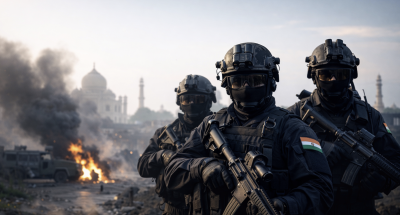
In a significant step towards strengthening internal security, the Ministry of Home Affairs has unveiled India’s first comprehensive National Counter-Terrorism Policy and Strategy titled “PRAHAAR”. Designed as a structured and forward-looking framework, the policy seeks to address both conventional and emerging forms of terrorism — from cross-border infiltration to drone-based attacks and cyber-enabled radicalisation. Its release marks an institutional consolidation of India’s long-standing counter-terror experience into a codified national doctrine.
Why a National Counter-Terror Policy Now?
India has faced diverse terror threats over decades — insurgency in border regions, cross-border terrorism, urban sleeper cells, and ideological radicalisation. However, the threat landscape has evolved significantly in recent years.
Key emerging concerns include:
- Use of drones for arms and narcotics smuggling.
- Cyber platforms for recruitment, propaganda, and encrypted coordination.
- Convergence between organised crime syndicates and terror networks.
- Risk of chemical, biological, radiological, nuclear, and cyber capabilities being accessed by non-state actors.
In this context, PRAHAAR aims to shift from a reactive model to a preventive, intelligence-led and technology-driven counter-terror strategy.
The Seven Pillars of PRAHAAR
The policy rests on seven core principles that shape its operational doctrine:
- Prevention of terrorist attacks through early detection and disruption.
- Swift and proportionate response to neutralise threats.
- Capacity-building of intelligence and security agencies.
- Human rights-compliant operations within the rule of law.
- Addressing conditions conducive to radicalisation.
- Strengthening international cooperation.
- Promoting societal resilience and post-attack recovery.
Importantly, the policy rejects any attempt to link terrorism with religion, ethnicity, or nationality, reaffirming that terrorism is a criminal act rather than an identity-based phenomenon.
Institutional Architecture and Implementation
PRAHAAR builds on existing institutions but aims to enhance coordination and standardisation.
- Intelligence coordination: Strengthening the Multi Agency Centre and Joint Task Force on Intelligence for real-time information sharing.
- Border management: Advanced surveillance systems across land, maritime and aerial borders.
- Critical infrastructure protection: Enhanced security for power plants, railways, ports, aviation, defence, atomic energy and space installations.
- Operational response: Local police as first responders, backed by state units and the .
- Investigation and prosecution: The to lead terror investigations and ensure high conviction rates.
The emphasis is on intelligence-led prevention rather than post-incident response.
Whole-of-Government and Whole-of-Society Model
Unlike earlier fragmented approaches, PRAHAAR adopts a comprehensive model that integrates:
- Government departments and state police forces.
- Private sector stakeholders in critical infrastructure.
- Civil society and community leaders for de-radicalisation.
- Youth outreach and prison monitoring mechanisms.
The policy recognises that counter-terrorism is not solely a security operation but also a socio-political challenge requiring community trust and resilience.
International Dimension and Legal Reforms
Terrorism increasingly transcends borders. PRAHAAR underscores:
- Intelligence-sharing agreements with partner countries.
- Extradition of terror suspects.
- Support for UN mechanisms to designate terrorist entities.
- Denial of safe havens and terror financing channels.
The framework also envisages periodic legal reforms to adapt to evolving threats, especially in cyber-terrorism and financial tracking.
Balancing Security and Civil Liberties
One of the notable features of PRAHAAR is its emphasis on human rights-compliant operations. In a democratic polity, counter-terror measures must remain within constitutional bounds. The policy highlights adherence to due process and rule of law — a critical safeguard against misuse of expansive security powers.
The challenge lies in maintaining this balance while ensuring operational effectiveness, especially in high-risk situations.
What to Note for Prelims?
- PRAHAAR – India’s National Counter-Terrorism Policy.
- Role of the Ministry of Home Affairs in internal security.
- Functions of the National Investigation Agency (NIA).
- Role of the National Security Guard (NSG).
- Concept of Multi Agency Centre (MAC).
What to Note for Mains?
- Discuss the evolving nature of terrorism in the digital and drone age.
- Examine the need for a unified national counter-terror framework in India.
- Analyse the balance between national security and civil liberties in counter-terror operations.
- Evaluate the role of international cooperation in combating transnational terrorism.