
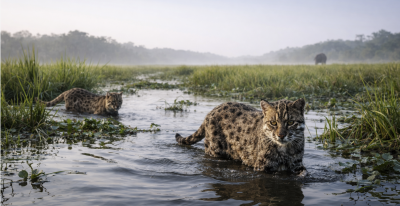
The first scientific assessment of the globally vulnerable fishing cat has identified [“Kaziranga National Park and Tiger Reserve”,”assam india”] as a major stronghold of this elusive wetland carnivore. Long celebrated for its one-horned rhinoceros, Kaziranga is now emerging as a critical refuge for the fishing cat (Prionailurus viverrinus), underscoring the ecological value of the Brahmaputra floodplains beyond charismatic megafauna.
What the New Study Reveals
The assessment, conducted by Kaziranga’s Tiger Cell in collaboration with the Fishing Cat Project, analysed camera-trap data originally collected for India’s all-India tiger estimation exercise.
A total of 57 unique fishing cats were identified across more than 450 sq. km of the reserve. Officials have noted that this figure likely represents a minimum estimate, as the camera traps were designed for monitoring tigers rather than small felines.
The findings were released on February 22, observed as Fishing Cat Day, and establish Kaziranga as one of the highest-density floodplain habitats for the species.
Understanding the Fishing Cat: A Wetland Specialist
The [“Fishing Cat”,”Prionailurus viverrinus”] is one of the few felids adapted to aquatic hunting. Unlike most wild cats, it possesses partially webbed feet and dense fur suited for marshy environments.
Key features include:
- Dependence on wetlands, marshes, and floodplains
- Diet primarily consisting of fish, amphibians, and crustaceans
- Strong association with lowland river basins
The species is listed as Vulnerable on the IUCN Red List and is protected under Schedule I of India’s Wildlife (Protection) Act, 1972, granting it the highest level of legal protection.
In Assam, it is locally known as “Meseka” and features in folklore as a symbol of ecological balance.
Comparative Population Landscape Across India
Data compiled under the Fishing Cat Project indicate that Kaziranga holds the highest population among Terai floodplain habitats.
Other significant freshwater habitats include:
- [“Kishanpur Wildlife Sanctuary”,”uttar pradesh india”] (35–51)
- [“Dudhwa National Park”,”uttar pradesh india”] (35–51)
- [“Pilibhit Tiger Reserve”,”uttarakhand india”] (14–17)
- [“Katerniaghat Wildlife Sanctuary”,”uttar pradesh india”] (12–14)
- [“Valmiki Tiger Reserve”,”bihar india”] (6–7)
In estuarine ecosystems, larger populations are reported from:
- [“Sunderban Tiger Reserve”,”west bengal india”] (approx. 385)
- [“Chilika Lagoon”,”odisha india”] (approx. 341)
- [“Bhitarkanika National Park”,”odisha india”] (83–115)
- [“Coringa Wildlife Sanctuary”,”andhra pradesh india”] (95–100)
This distribution highlights the fishing cat’s dependence on wetland mosaics — both freshwater and estuarine.
Why Kaziranga’s Landscape Matters
Kaziranga lies within the Brahmaputra floodplains, characterised by:
- Wet alluvial grasslands
- Shallow beels (floodplain wetlands)
- Wet meadows
- Wooded refuges aiding survival during annual floods
Such habitat heterogeneity provides ideal conditions for fishing cats. The annual flooding regime, often viewed as destructive, actually sustains nutrient-rich ecosystems that support diverse prey species.
The study demonstrates how flagship-species monitoring — such as tiger surveys — can yield valuable data for lesser-known carnivores.
Emerging Threats to a Wetland Carnivore
Despite encouraging numbers in Kaziranga, the fishing cat faces significant threats:
- Wetland degradation and conversion
- River modification and embankment construction
- Urban expansion in lowland areas
- Poaching and retaliatory killing
The species has reportedly disappeared from parts of Vietnam and Java, making South Asia its global core population zone. Climate change and altered river hydrology further threaten freshwater biodiversity.
Conservation Significance and Policy Lessons
The findings position Kaziranga not merely as a rhino or tiger habitat, but as a multi-species conservation landscape. It strengthens the argument for:
- Integrated wetland management strategies
- Inclusion of small carnivores in monitoring protocols
- Landscape-level conservation across river basins
- Climate-resilient biodiversity planning
Tracking wetland carnivores offers a proxy for assessing freshwater ecosystem health, especially amid increasing anthropogenic pressures.
What to Note for Prelims?
- [“Fishing Cat”,”Prionailurus viverrinus”] is listed as Vulnerable on the IUCN Red List.
- Protected under Schedule I of the Wildlife (Protection) Act, 1972.
- Adapted for aquatic hunting with partially webbed feet.
- Kaziranga National Park has recorded at least 57 individuals.
- Key habitats include wetlands, floodplains, and estuaries.
What to Note for Mains?
- Discuss the ecological importance of wetland-dependent carnivores in riverine ecosystems.
- Examine how tiger estimation data can support broader biodiversity assessments.
- Analyse the challenges of conserving freshwater biodiversity under climate change.
- Evaluate the role of floodplain dynamics in sustaining wildlife populations.