
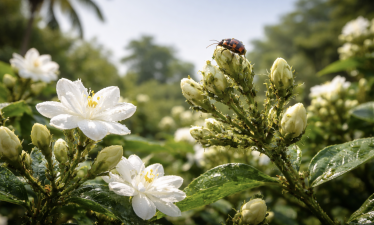
India’s floriculture sector has reported a significant scientific breakthrough with the discovery of a new blossom midge species infesting jasmine. Scientists led by Dr. D. M. Firake at the [“ICAR-Directorate of Floricultural Research”,”pune india”] have identified Contarinia icardiflores sp. nov., a pest attacking Jasminum sambac. The finding is crucial as jasmine cultivation supports thousands of small farmers and plays a vital role in the country’s ornamental flower economy.
How the New Species Was Discovered
The research team detected unusual infestations in jasmine flower buds that were causing economic losses. Detailed taxonomic examination revealed that the pest differed from previously known species.
Although morphologically similar to [“Contarinia maculipennis”,”insect species”] — the only earlier jasmine-infesting midge reported — the newly discovered species was found to be genetically distinct. It has been named [“Contarinia icardiflores”,”insect species”], in honour of the Indian Council of Agricultural Research’s floriculture institute.
The naming reflects a growing trend in taxonomy where institutional contributions to research are acknowledged through species nomenclature.
What Makes Contarinia icardiflores Distinct?
The scientists used integrative taxonomy — combining traditional morphological methods with molecular tools — to establish its identity.
Key distinguishing features include:
- Unique structure of female flagellomeres (antenna segments)
- Distinct cerci (terminal abdominal structures)
- Structural variation in the male aedeagus (reproductive organ)
Additionally, the team sequenced a partial region of the mitochondrial cytochrome oxidase subunit I (COI) gene. The COI gene is widely used in DNA barcoding for species identification and rapid diagnostics. This molecular evidence confirmed that the pest is genetically separate from known species.
Life Cycle and Economic Impact on Jasmine
The new blossom midge completes its life cycle within 16 to 21 days, enabling rapid population build-up under favourable conditions. The larvae infest flower buds, causing:
- Premature bud drop
- Distorted flowers
- Reduced yield and market value
Given jasmine’s commercial importance in states such as Tamil Nadu, Karnataka, and parts of Maharashtra, unchecked infestation could significantly affect farmer incomes and export prospects.
Why This Discovery Matters for Indian Floriculture
Blossom midges of the genus [“Contarinia”,”insect genus”] are globally recognised as serious pests of ornamental and food crops. The emergence of a new species indicates:
- Dynamic pest evolution in agro-ecosystems.
- The need for continuous surveillance in high-value crops.
- Potential influence of climate variability on pest emergence.
Early identification enables the design of targeted, eco-friendly pest management strategies rather than relying solely on broad-spectrum pesticides. This aligns with India’s emphasis on Integrated Pest Management (IPM) and sustainable agriculture.
Strengthening India’s Pest Preparedness
The discovery demonstrates the importance of institutional research capacity under the Indian Council of Agricultural Research framework. It highlights how combining classical taxonomy with molecular diagnostics enhances agricultural biosecurity.
For policymakers, the episode reinforces the need for:
- Investment in agricultural entomology research.
- Strengthened pest surveillance networks.
- Capacity building in DNA barcoding laboratories.
- Awareness programmes for jasmine growers.
In a globalised trade environment, early detection of emerging pests is critical to prevent large-scale crop damage and safeguard export credibility.
What to Note for Prelims?
- [“Contarinia icardiflores”,”insect species”] is a newly discovered blossom midge species in India.
- It infests [“Jasminum sambac”,”plant species”] (jasmine).
- COI gene sequencing is used in DNA barcoding for species identification.
- Life cycle duration: 16–21 days.
- Belongs to the genus [“Contarinia”,”insect genus”], known for crop pests.
What to Note for Mains?
- Discuss the role of integrative taxonomy in strengthening agricultural biosecurity.
- Examine the economic significance of floriculture and emerging pest threats.
- Analyse the importance of molecular diagnostics in modern pest management.
- Evaluate the role of ICAR institutions in ensuring sustainable agricultural development.