
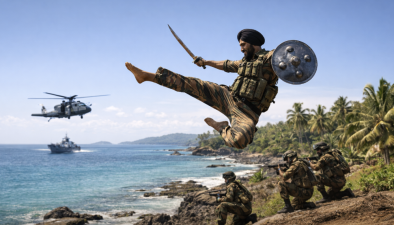
The Indian Air Force’s Southern Air Command has conducted a high-tempo joint maritime exercise, ‘Kalari Leap’, in the Lakshadweep and Minicoy archipelago. Designed to test rapid force projection and coordinated operational response in a complex maritime theatre, the exercise underlines India’s growing focus on island security and integrated tri-service preparedness in the Indian Ocean Region (IOR).
What Was Kalari Leap Designed to Test?
4
The exercise validated the ability of the Southern Air Command to conduct rapid force deployment and precision operations in maritime conditions.
Key operational components included:
- Anti-ship strike simulations.
- Maritime Search and Rescue (SAR) missions.
- Joint planning and inter-agency coordination.
- Special operations deployment.
The exercise was conducted in and around the strategically located Lakshadweep and Minicoy islands, which are critical to India’s maritime security grid.
Jointness and Multi-Agency Participation
Kalari Leap saw coordinated participation from:
Assets deployed included Coast Guard ships, Gemini boats, Dornier 228 aircraft, and IAF platforms. Such inter-service exercises reflect the emphasis on “jointness” — a core principle in India’s ongoing defence reforms aimed at theatre command integration.
Strategic Importance of Lakshadweep and Minicoy
4
Lakshadweep lies close to critical Sea Lines of Communication (SLOCs) in the Arabian Sea. The Minicoy island, located near the Eight Degree Channel, is particularly significant for monitoring maritime traffic.
The region’s strategic relevance stems from:
- Proximity to international shipping routes.
- Emerging maritime security challenges including piracy and trafficking.
- India’s expanding role in the Indian Ocean Region.
Strengthening operational readiness in island territories enhances deterrence and rapid response capability.
Rapid Force Projection in Maritime Domains
Force projection refers to the ability to deploy military capabilities swiftly across regions. In island territories, this involves:
- Air mobility for troop and equipment insertion.
- Coordination with naval and coast guard assets.
- Precision targeting in anti-ship roles.
- Search and rescue under challenging sea conditions.
Kalari Leap demonstrated integrated air-maritime synergy, crucial in an era of grey-zone threats and hybrid warfare in maritime spaces.
Broader Maritime Security Context
India’s maritime doctrine emphasises safeguarding island territories and ensuring stability in the IOR. With increasing strategic competition in the Indian Ocean, exercises such as Kalari Leap serve multiple objectives:
- Operational preparedness.
- Inter-operability enhancement.
- Signalling deterrence capability.
- Protection of maritime trade routes.
The exercise reinforces India’s approach of layered maritime defence combining surveillance, rapid response, and special operations capability.
What to Note for Prelims?
- Kalari Leap was conducted by Southern Air Command in Lakshadweep and Minicoy.
- Participating agencies included the Indian Air Force, Indian Coast Guard, and Armed Forces Special Operations Division.
- Minicoy lies near the Eight Degree Channel.
- Dornier 228 aircraft are used for maritime surveillance by the Coast Guard.
What to Note for Mains?
- Discuss the strategic importance of India’s island territories in maritime security.
- Examine the role of joint military exercises in enhancing operational readiness.
- Analyse India’s maritime strategy in the Indian Ocean Region.
- Evaluate the importance of integrated theatre commands for future warfare preparedness.