
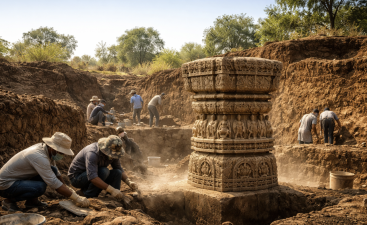
Recent archaeological findings near the Vena River in Hinganghat, Maharashtra, have brought to light remnants of a 12th-century stone pillar. These remains, linked to the Seuna (Yadava) dynasty, show Hinganghat’s historical and cultural significance during medieval India. The discovery offers fresh vital information about regional architecture and heritage.
Historical Context of the Yadava Dynasty
The Yadava dynasty ruled parts of present-day Maharashtra and surrounding regions during the 12th and 13th centuries. Known for their patronage of art, culture, and temple architecture, the Yadavas contributed to the Hemadpanti architectural style. This style is noted for its use of locally sourced black basalt and unique interlocking stone construction without mortar. Their reign marked a period of cultural and commercial prosperity in Vidarbha and adjacent areas.
Architectural Features of the Mandir Pillar
The discovered stone fragments include a finely carved lotus motif, a hallmark of skilled craftsmanship. The pillar likely belonged to a Mandir’s sabhamandap (assembly hall) or stood near the garbhagriha (sanctum sanctorum). Made from hard basalt, the pillar’s intricate carvings reflect advanced stone-working techniques of the era. The design elements align with Hemadpanti style, which emphasises durability and aesthetic simplicity.
Significance of the Discovery in Hinganghat
Hinganghat, situated near Nagpur, has now gained recognition as a site of historical importance due to this find. Previous records mention ancient settlements and temples along the Vena River, but tangible evidence was scarce. The discovery encourages further archaeological surveys to uncover more relics. Preservation efforts are urged to protect these fragments from weathering and human damage. Local authorities and citizens advocate for a museum to promote heritage conservation and academic research.
Future Prospects and Heritage Conservation
Experts recommend collaboration with the Archaeological Survey of India for proper excavation and study. Scientific examination could reveal more about the Yadava period’s religious and cultural life. Enhanced heritage tourism may follow, benefiting the local economy. The find also stresses the need for systematic documentation of lesser-known historical sites in Maharashtra and beyond.
Topics for Prelims:
Yadava Dynasty
- Ruled parts of Maharashtra and Karnataka during 12th-13th centuries.
- Known for patronage of art, culture, and temple architecture.
- Associated with Hemadpanti architectural style.
- Capital was Devagiri (modern Daulatabad).
- Fell to the Delhi Sultanate in the late 13th century.
Hemadpanti Architecture
- Named after minister Hemadri from Yadava rule.
- Uses black basalt stones with interlocking technique.
- No lime mortar used in construction.
- Simple yet durable and elegant designs.
- Common in Maharashtra and parts of Vidarbha.
Vena River and Hinganghat
- Vena River flows through Wardha district, Maharashtra.
- Hinganghat is a historic town near Nagpur.
- Region known for ancient settlements and temples.
- Site of recent archaeological discoveries.
- Potential hub for heritage tourism development.
Questions for UPSC:
- Critically discuss the role of regional dynasties like the Seuna (Yadava) in shaping medieval Indian temple architecture and culture.
- Examine the importance of architectural styles such as Hemadpanti in the context of sustainable construction practices in ancient India.
- Analyse the impact of archaeological discoveries on local economies and cultural identity; estimate the challenges in preserving such heritage sites in India.
- Point out the significance of riverine settlements in the development of ancient Indian civilisations and discuss how modern urbanisation affects their preservation.
Answer Hints:
1. Critically discuss the role of regional dynasties like the Seuna (Yadava) in shaping medieval Indian temple architecture and culture.
- Yadava dynasty patronized art, culture, and temple architecture during 12th-13th centuries in Maharashtra and Karnataka.
- They developed and popularized the Hemadpanti architectural style, noted for black basalt stonework and interlocking construction without mortar.
- Temples and mandirs under Yadavas served religious, cultural, and social functions, reflecting regional identity and craftsmanship.
- Regional dynasties contributed to decentralization of cultural development beyond major imperial centers, encouraging diverse architectural traditions.
- Their rule marked a period of cultural prosperity in Vidarbha and surrounding areas, integrating commerce, religion, and art.
- Yadava temples often combined simplicity with durability, influencing later regional temple designs and local religious practices.
2. Examine the importance of architectural styles such as Hemadpanti in the context of sustainable construction practices in ancient India.
- Hemadpanti style used locally sourced black basalt, reducing transportation impact and promoting sustainability.
- Interlocking stone technique eliminated the need for lime mortar, enhancing structural longevity and reducing material use.
- Durable construction suited to local climate, ensuring minimal maintenance and long-term preservation.
- Simple yet elegant designs balanced aesthetics with functionality, reflecting efficient use of resources.
- Use of hard basalt demonstrated advanced stone-working skills, maximizing material strength and lifespan.
- This style exemplifies indigenous knowledge of sustainable architecture adapted to regional ecology and materials.
3. Analyse the impact of archaeological discoveries on local economies and cultural identity; estimate the challenges in preserving such heritage sites in India.
- Discoveries boost local pride and reinforce cultural identity by connecting communities to their historical roots.
- Heritage tourism potential can stimulate local economies through increased visitor inflow and related businesses.
- Archaeological finds encourage academic research, education, and awareness about regional history.
- Challenges include exposure to weather, vandalism, inadequate funding, and lack of professional conservation efforts.
- Coordination between local authorities, ASI, and citizens is often weak, delaying protection and preservation.
- Rapid urbanization and land-use changes threaten archaeological sites, requiring urgent policy and community involvement.
4. Point out the significance of riverine settlements in the development of ancient Indian civilisations and discuss how modern urbanisation affects their preservation.
- Riverine settlements provided water resources, fertile land, and trade routes, encouraging early urbanization and civilization growth.
- Rivers like the Vena supported religious activities, temple construction, and cultural exchanges in ancient India.
- Many ancient temples and settlements were established along rivers, making them centers of socio-economic life.
- Modern urbanization leads to pollution, encroachment, and destruction of archaeological sites near rivers.
- Infrastructure development often disregards heritage conservation, causing irreversible damage to riverine archaeological remains.
- Balanced urban planning and heritage management are needed to preserve riverine cultural landscapes for future generations.