
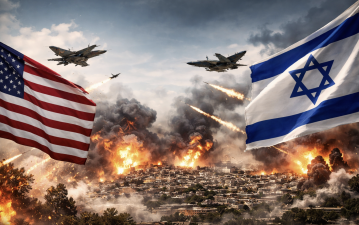
Recent events in 2026 saw the United States and Israel launch a joint military strike on Iran. The attack aimed to remove Iran’s leadership and control its hydrocarbon resources. This move is part of a broader US strategy to establish dominance in West Asia. Despite killing top Iranian leaders, the US has not achieved its political goals. Iran’s regime remains strong and resistance continues. The conflict risks becoming prolonged and costly for the US and its allies.
Background of the US-Israel Strike
The US targeted Iran when it seemed vulnerable. Internal protests were growing, and Iran’s allies like Russia were preoccupied with other conflicts. China avoided confrontation due to trade interests with the US. Iran’s regional allies Hamas, Hezbollah, and Houthis had weakened. The US aimed to remove Iran as a major obstacle to its influence in West Asia. Many regional states rely on US security, making Iran the key independent power.
Consequences of the Strike
Iran retaliated by attacking US bases in 12 countries and blocking the Strait of Hormuz. This caused global oil prices to rise sharply, affecting economies worldwide. The conflict disrupted global supply chains and increased inflation. The war expanded beyond Iran, involving multiple countries and raising tensions in the region. The sinking of an Iranian warship near Sri Lanka brought the conflict closer to India, raising security concerns.
Implications for Global Politics
The US hopes to prevent Russia and China from gaining influence in West Asia. However, regime collapse in Iran could trigger chaos and empower extremist groups, as seen in Iraq, Afghanistan, and Syria. Past US interventions in the region have often failed or led to unintended consequences. The ongoing conflict challenges global stability and tests international diplomatic efforts.
India’s Strategic Position
India faces risks due to its economic and strategic ties with Iran and the region. It must protect its citizens and ensure steady energy supplies. India’s policy of multi-alignment suggests it should play a proactive role in peace efforts. Collaborating with groups like BRICS and European nations could help resolve conflicts and maintain regional stability.
Topics for Prelims:
Iran
- Islamic Republic established in 1979 after revolution.
- Major player in West Asian geopolitics.
- Rich in oil and gas resources.
- Has nuclear ambitions under international scrutiny.
- Allied with groups like Hezbollah and Houthis.
Strait of Hormuz
- Strategic waterway between Persian Gulf and Gulf of Oman.
- About 20% of world’s oil passes through it.
- Blockades here disrupt global energy supply.
- Frequently a flashpoint in Iran-US tensions.
- Vital for global trade and energy security.
US Military Interventions in West Asia
- Involved in Iraq, Afghanistan, Syria conflicts.
- Spent trillions with limited success.
- Often aimed at regime change or counter-terrorism.
- Led to rise of extremist groups like ISIS.
- Faced domestic and international criticism.
Questions for Mains:
- Critically analyse the impact of US military interventions in West Asia on regional stability and global geopolitics. [GS-II-International Relations]
- Explain the strategic importance of the Strait of Hormuz and its role in global energy security. How do conflicts in this region affect the world economy? [GS-III-Economic Development]
- With suitable examples, comment on the challenges of regime change as a foreign policy tool in the context of Iran and Afghanistan. [GS-II-Governance]
- What are the implications of India’s multi-alignment policy in the context of rising conflicts in West Asia? How can India contribute to peace and stability in the region? [GS-II-Constitution of India & Polity]
Answer Hints:
1. Critically analyse the impact of US military interventions in West Asia on regional stability and global geopolitics. [GS-II-International Relations]
- US interventions aimed at regime change and counter-terrorism (Iraq, Afghanistan, Syria) often destabilized the region.
- Prolonged conflicts led to power vacuums, enabling extremist groups like ISIS to emerge.
- High military and economic costs with limited political success; Taliban resurgence despite 20 years of war.
- US actions strained relations with regional actors and global powers (Russia, China), complicating geopolitics.
- Interventions increased anti-US sentiments, affecting global alliances and security cooperation.
- Overall, US military involvement contributed to regional instability and challenged global diplomatic efforts.
2. Explain the strategic importance of the Strait of Hormuz and its role in global energy security. How do conflicts in this region affect the world economy? [GS-III-Economic Development]
- Strait of Hormuz is a narrow chokepoint connecting Persian Gulf to Gulf of Oman; vital for global oil transit.
- Approximately 20% of the world’s petroleum passes through this waterway, making it critical for energy supply.
- Blockades or disruptions (e.g., Iran’s blockade during conflict) cause sharp spikes in oil and gas prices globally.
- Such disruptions trigger inflation, slow down global economic growth, and impact energy-importing countries severely.
- Conflict escalation can disturb global trade routes, affecting supply chains beyond energy sector.
- Ensuring security of the Strait is key for global economic stability and energy market predictability.
3. With suitable examples, comment on the challenges of regime change as a foreign policy tool in the context of Iran and Afghanistan. [GS-II-Governance]
- Regime change often leads to prolonged conflict, instability, and unintended consequences (e.g., Iraq, Afghanistan, Iran attempts).
- In Afghanistan, US spent $2.3 trillion over 20 years, yet Taliban regained control, showing limits of military intervention.
- In Iran, despite killing top leaders, regime remains resilient and resistance continues, indicating complexity of internal dynamics.
- Collapse of regimes can empower extremist, radical, and secessionist groups, destabilizing entire regions.
- Regime change efforts risk alienating local populations and damaging international credibility.
- Diplomatic engagement and negotiated settlements often more sustainable than forced regime change.
4. What are the implications of India’s multi-alignment policy in the context of rising conflicts in West Asia? How can India contribute to peace and stability in the region? [GS-II-Constitution of India & Polity]
- India’s multi-alignment allows strategic flexibility amid competing global powers (US, Russia, China) and regional tensions.
- Ensures India safeguards energy security, protects diaspora, and maintains balanced diplomatic relations.
- India’s economic interests tied to stable West Asia; conflicts threaten oil, gas, and fertilizer supplies.
- Proactive engagement through BRICS and European partners can help facilitate dialogue and conflict resolution.
- India can promote peace by leveraging its soft power, development aid, and diplomatic mediation efforts.
- Strategic silence insufficient; active role needed to secure regional stability and protect national interests.