
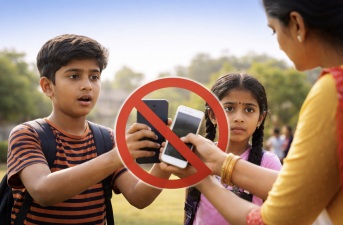
Recent developments in India show growing concern over children’s access to social media. Karnataka announced a ban on social media use for children under 16 years. Andhra Pradesh plans to restrict access for those below 13 years. These steps follow global trends where countries like Australia, France, and Germany have imposed similar bans or restrictions. The debate now centres on how India can regulate children’s social media use effectively while balancing safety, privacy, and freedom.
State vs Central Government Roles
The internet and communications fall under the Union List in India. This means the Central government usually makes laws on social media regulation. States like Karnataka and Andhra Pradesh face legal questions about their power to enforce bans independently. Uniform laws across states are lacking, raising concerns about fragmented rules and enforcement challenges. The role of states versus the Centre in internet governance remains unclear.
Challenges in Age Verification and Privacy
Age verification is critical for enforcing bans. Methods include self-declaration, ID checks, or technical detection by platforms. However, accurate verification often requires collecting sensitive data, risking privacy violations. Shared devices in Indian households complicate verification further. Children may misrepresent their age online, sometimes with parental consent. These factors make enforcement difficult and raise ethical issues about data protection.
Impact on Children’s Rights and Online Expression
Social media is important for children’s self-expression, identity formation, and social interaction. Bans may limit access for girls and young women due to existing gender norms. LGBTQIA+ children also rely on online spaces for support and identity. Restricting access risks silencing vulnerable groups. Instead of bans, safer online environments and digital literacy for children, parents, and educators are needed to protect against harms like addiction, mental health issues, grooming, and misinformation.
Future Policy Directions and Emerging Technologies
The Central government plans a nuanced law with graded age bands and time limits for social media access. Multi-stakeholder consultations involving civil society and academia are essential. Policies must address India’s multilingual diversity and include gaming and AI platforms. A comprehensive approach is needed to safeguard children’s best interests while adapting to emerging technologies and India’s unique social context.
Topics for Prelims:
Social Media Regulation in India
- Internet governance is under the Union List, centralised law-making.
- Karnataka bans social media for under-16s; Andhra Pradesh targets under-13s.
- Age verification methods include self-declaration and technical checks.
- Privacy concerns arise from data collection for age verification.
- Shared device use complicates enforcement of bans.
Global Social Media Bans for Children
- Australia banned social media use for under-16s in 2025.
- France, Germany, Indonesia have proposed or implemented similar bans.
- French President Macron urged India to follow suit at India AI Summit.
- Age limits vary by country, creating global diversity in policies.
- Challenges include enforcement and balancing rights with safety.
Children’s Online Safety and Rights
- Social media supports children’s self-expression and identity.
- Gender norms limit girls’ and young women’s digital access.
- LGBTQIA+ youth use online spaces for community and support.
- Risks include grooming, addiction, mental health issues, misinformation.
- Digital literacy and safer platforms are preferred over outright bans.
Questions for Mains:
- Critically analyse the challenges in implementing social media bans for children in a federal system like India. [GS-II-Constitution of India & Polity]
- Comment on the privacy concerns arising from online age verification mechanisms and their implications for children’s digital rights. [GS-III-Science & Technology]
- Explain the role of social media in shaping identity and social inclusion for marginalised groups such as LGBTQIA+ youth and girls in India. How can policies balance protection and access? [GS-I-Indian Society]
- With suitable examples, underline the impact of emerging technologies like AI and gaming platforms on children’s online safety and suggest policy measures to address these challenges. [GS-III-Environment & DM]
Answer Hints:
1. Critically analyse the challenges in implementing social media bans for children in a federal system like India. [GS-II-Constitution of India & Polity]
- Internet and communications governance fall under the Union List, giving legislative power primarily to the Central government.
- States like Karnataka and Andhra Pradesh have announced bans, raising legal questions on their authority to enforce such laws independently.
- Fragmented state-level bans with different age thresholds create enforcement difficulties and legal ambiguity.
- Challenges in assigning responsibility – whether platforms or users must verify age, and how enforcement would work practically.
- Shared device use in Indian households complicates verification and compliance.
- Potential conflicts between state and central laws may arise, requiring judicial or legislative clarity.
2. Comment on the privacy concerns arising from online age verification mechanisms and their implications for children’s digital rights. [GS-III-Science & Technology]
- Accurate age verification often requires collecting sensitive personal data, risking violation of data protection principles.
- Excessive data collection can infringe on children’s privacy and may be misused or inadequately protected.
- Self-declaration is easy to bypass; technical detection methods may require intrusive data processing.
- Shared devices and lack of uniform standards increase risks of inaccurate verification and privacy breaches.
- Privacy concerns may deter children from accessing digital spaces or lead to unsafe workarounds.
- Legal frameworks must balance effective verification with minimal data collection and robust privacy safeguards.
3. Explain the role of social media in shaping identity and social inclusion for marginalised groups such as LGBTQIA+ youth and girls in India. How can policies balance protection and access? [GS-I-Indian Society]
- Social media provides critical platforms for self-expression, identity formation, and community support for marginalized groups.
- Girls and young women face gender norms limiting their digital access and freedom of expression online.
- LGBTQIA+ youth rely on online spaces for safe articulation of identity and social connection.
- Bans or restrictions risk silencing these groups and exacerbating social exclusion.
- Policies should enable safer online environments rather than outright bans, promoting digital literacy and empowerment.
- Multi-stakeholder consultations and nuanced safeguards can protect children while preserving access and autonomy.
4. With suitable examples, underline the impact of emerging technologies like AI and gaming platforms on children’s online safety and suggest policy measures to address these challenges. [GS-III-Environment & DM]
- AI tools (e.g., ChatGPT) and gaming platforms (e.g., Roblox, Minecraft) create new avenues for interaction but also novel safety risks.
- Risks include exposure to inappropriate content, grooming, misinformation, addiction, and mental health challenges.
- Automated content moderation effectiveness varies by language and context, especially in India’s multilingual environment.
- Policies must address emerging tech by including gaming and AI platforms in safety regulations and age-appropriate access controls.
- Multi-layered safeguards – time limits, parental controls, AI-driven monitoring balanced with privacy protections.
- Consultations with civil society, academia, and tech experts are essential to develop adaptive, future-proof frameworks.