
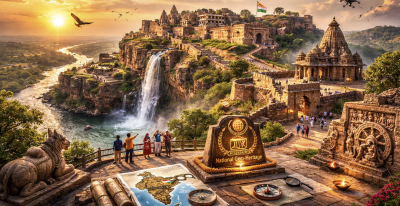
The Kalinjar Fort region in Banda was declared a National Geo-Heritage Site by the Geological Survey of India (GSI) on 16 March 2026. This recognition marks the area’s unique geological and cultural significance. The site is part of the Vindhya Mountain range and is known for its ancient fort and temples. The move aims to preserve the heritage and promote tourism by linking Kalinjar with nearby historic sites like Khajuraho and Chitrakoot.
Geological Importance of Kalinjar Region
The Kalinjar area shows a rare geological feature called the Eparchaean Unconformity. It marks the meeting of two rock layers from different ages. The base layer is the Bundelkhand granite, about 2.5 billion years old. Above it lies the Kaimur sandstone, around 1.2 billion years old. This formation gives valuable clues to Earth’s ancient history. The rocks were also used to build the fort’s massive walls, reflecting the local geo-cultural heritage.
Historical and Cultural Significance
Kalinjar Fort is famous for its strong walls and ancient temples, including the Neelkanth Mahadev temple from the Gupta period. Legends say Lord Shiva drank poison here during the Samudra Manthan. The region appears in Buddhist texts and was once ruled by the Chedi dynasty during Buddha’s time (563–480 BC). Later, it became part of the Maurya Empire and was known as Vindhya-Atavi.
Tourism and Conservation Efforts
The GSI’s declaration is expected to boost tourism in the region. Efforts include installing information boards to educate visitors about the site’s geological and historical importance. The government plans to develop a tourism circuit connecting Kalinjar with Khajuraho and Chitrakoot, enhancing visitor experience and local economy.
Role of Geological Survey of India
The announcement was made by Rajinder Kumar, Additional Director-General of GSI. The organisation plays a key role in identifying and preserving geo-heritage sites across India. Their work helps protect geological landmarks and promotes awareness among the public and policymakers.
Topics for Prelims:
Kalinjar Fort
- Located in Banda, Uttar Pradesh, part of Vindhya range.
- Famous for massive walls and Gupta-era temples.
- Associated with Lord Shiva and Samudra Manthan legend.
- Ruled by Chedi dynasty, later Maurya Empire.
- Important cultural and historical landmark.
Eparchaean Unconformity
- Geological phenomenon where two rock layers meet.
- Exposes Bundelkhand granite (2.5 billion years old).
- Overlain by Kaimur sandstone (1.2 billion years old).
- Rare and valuable for studying Earth’s history.
- Visible at Kalinjar Fort region.
Geological Survey of India (GSI)
- Government agency for geological studies and mapping.
- Declared Kalinjar a National Geo-Heritage Site in 2026.
- Promotes geo-heritage conservation and tourism.
- Installs information boards at heritage sites.
- Supports research on India’s geological resources.
Questions for Mains:
- Discuss in the light of Kalinjar Fort, how geo-heritage sites contribute to cultural tourism and local development. [GS-III-Economic Development]
- Analyse the significance of Eparchaean Unconformity in understanding Earth’s geological history and its implications for natural resource management. [GS-III-Science & Technology]
- With suitable examples, examine the role of Geological Survey of India in preserving geo-cultural heritage and promoting sustainable tourism. [GS-II-Governance]
- Critically discuss the integration of geological and historical heritage in regional development policies, taking Kalinjar Fort and related sites as case studies. [GS-II-Constitution of India & Polity]
Answer Hints:
1. Discuss in the light of Kalinjar Fort, how geo-heritage sites contribute to cultural tourism and local development. [GS-III-Economic Development]
- Geo-heritage sites like Kalinjar Fort combine geological uniqueness with rich cultural history, attracting diverse tourists.
- They promote local economy through increased tourism-related activities – hospitality, guides, transport, handicrafts.
- Preservation of local heritage enhances community pride and encourages sustainable development.
- Linking geo-heritage sites with other tourist circuits (e.g., Khajuraho, Chitrakoot) boosts regional connectivity and visitor inflow.
- Educational initiatives (information boards, guided tours) raise awareness and encourage conservation efforts.
- Geo-tourism helps generate employment opportunities and infrastructure development in remote areas.
2. Analyse the significance of Eparchaean Unconformity in understanding Earth’s geological history and its implications for natural resource management. [GS-III-Science & Technology]
- Eparchaean Unconformity represents a rare geological boundary between 2.5-billion-year-old Bundelkhand granite and 1.2-billion-year-old Kaimur sandstone.
- It provides direct evidence of vast geological time gaps, helping reconstruct Earth’s ancient crust formation and tectonic events.
- About such unconformities aids in identifying mineral deposits and groundwater reservoirs linked to rock formations.
- It offers vital information about sedimentation, erosion, and environmental changes over geological eras.
- Mapping these features supports sustainable exploration and management of natural resources like minerals and groundwater.
- Sites like Kalinjar serve as natural laboratories for geoscience research and education.
3. With suitable examples, examine the role of Geological Survey of India in preserving geo-cultural heritage and promoting sustainable tourism. [GS-II-Governance]
- GSI identifies, documents, and declares National Geo-Heritage Sites (e.g., Kalinjar Fort) to protect unique geological landmarks.
- It installs information boards and promotes awareness about geological and cultural significance to educate visitors.
- GSI collaborates with local authorities to integrate geo-heritage conservation with tourism development.
- Supports scientific research and mapping to guide sustainable resource use and heritage preservation.
- Promotes geo-tourism as a tool for economic growth while ensuring minimal ecological impact.
- Examples include Kalinjar Fort, Bhimbetka rock shelters, and other geo-heritage sites across India.
4. Critically discuss the integration of geological and historical heritage in regional development policies, taking Kalinjar Fort and related sites as case studies. [GS-II-Constitution of India & Polity]
- Integration ensures balanced preservation of natural and cultural assets, enhancing overall regional identity.
- Policies must address conservation, tourism promotion, and local community welfare simultaneously.
- Kalinjar Fort’s geo-historical significance supports multi-sectoral development – heritage tourism, education, infrastructure.
- Linking sites like Kalinjar, Khajuraho, and Chitrakoot creates comprehensive tourism circuits with wider economic impact.
- Challenges include managing environmental impact, preventing over-commercialization, and ensuring equitable benefit sharing.
- Effective governance requires coordination among geological, archaeological, tourism, and local administrative bodies.