
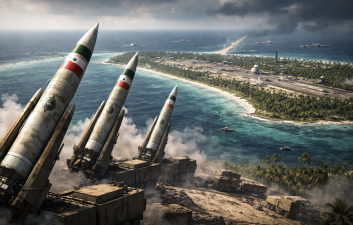
Recent news marks Iran’s attempt to strike Diego Garcia, a key US-UK military base in the Indian Ocean, with intermediate-range ballistic missiles (IRBMs). The missiles failed to hit the target; one malfunctioned mid-air and the other was intercepted by a US Navy warship. This marks the first public use of IRBMs by Iran, signalling expansion of its missile capabilities beyond the Middle East.
Strategic Importance of Diego Garcia
Diego Garcia is located in the central Indian Ocean, south of India and Sri Lanka. It is the largest island in the Chagos Archipelago and a critical US military base. The base hosts bombers, nuclear submarines, and missile destroyers. Its location allows rapid reach to vital maritime chokepoints like the Bab-el-Mandeb Strait and the Malacca Strait. The island also supports US Space Force tracking systems. Since the 1990 Gulf War, Diego Garcia has been central to US military operations in West Asia.
Iran’s Missile Capabilities and Intent
Iran’s missile launch revealed its possession of IRBMs with a 3,000-5,500 km range. Previously, Iran limited missile range to 2,000 km targeting regional foes. The strike on Diego Garcia, 4,000 km away, proves Iran’s ability to threaten US interests far beyond West Asia. Iran claimed its missile programme was defensive, but this launch contradicts that. The attack followed UK approval for US strikes from Diego Garcia against Iranian missile sites.
Ownership and Controversies Around Diego Garcia
The UK leased Diego Garcia to the US in 1966, with the lease extended until 2036. In 2019, the International Court of Justice ruled UK’s control over the Chagos Archipelago illegal. Recently, the UK agreed to transfer sovereignty to Mauritius but leased Diego Garcia back for 99 years, preventing other powers from establishing bases. Access to the island is strictly controlled by UK and US authorities.
Human and Historical Context
The Chagos Archipelago was uninhabited until the late 18th century when slaves were brought for plantations. After becoming British territory in 1814, the islands were cleared of indigenous Chagossians between 1968-73 to build the military base. Over 1,500 people were forcibly relocated to Mauritius and Seychelles with little compensation, a dark legacy tied to the island’s strategic use.
Topics for Prelims:
Diego Garcia Island
- Located in the central Indian Ocean, south of India and Sri Lanka.
- Hosts US strategic bombers, nuclear submarines, and missile destroyers.
- Key to controlling Bab-el-Mandeb and Malacca maritime chokepoints.
- Used in major US military operations since the Gulf War (1990).
- Access is highly restricted by UK and US authorities.
Iran’s Ballistic Missile Programme
- Includes short, medium, and intermediate-range ballistic missiles.
- IRBMs range between 3,000 to 5,500 km.
- First public use of IRBMs targeting Diego Garcia in 2026.
- Previously limited missile range to 2,000 km targeting regional foes.
- Missile launch counters Iran’s claim of a defensive-only programme.
Chagos Archipelago and Sovereignty
- Comprises 58 islands in the Indian Ocean.
- Originally uninhabited, settled by slaves for plantations in 18th century.
- UK ceded sovereignty to Mauritius in 2025 but leased Diego Garcia back.
- ICJ ruled UK’s original separation of islands illegal in 2019.
- Chagossians forcibly removed (1968-73) to allow military base construction.
Questions for Mains:
- Critically analyse the strategic importance of military bases like Diego Garcia in maintaining global maritime security. [GS-II-International Relations]
- Explain the implications of Iran’s intermediate-range ballistic missile development on regional and global security dynamics. [GS-III-Internal & External Security]
- With suitable examples, comment on the role of international law and sovereignty disputes in geopolitical conflicts, focusing on the Chagos Archipelago case. [GS-II-Constitution of India & Polity]
- What are the ethical and human rights concerns arising from forced displacement for strategic military purposes? How should states balance security needs with humanitarian obligations? [GS-IV-Ethics, Integrity and Aptitude]
Answer Hints:
1. Critically analyse the strategic importance of military bases like Diego Garcia in maintaining global maritime security. [GS-II-International Relations]
- Diego Garcia’s central location in the Indian Ocean enables control over key maritime chokepoints – Bab-el-Mandeb and Malacca Strait.
- Hosts US strategic assets – bombers, nuclear submarines, guided-missile destroyers, enhancing power projection.
- Serves as a critical hub for intelligence, surveillance, and space tracking operations (US Space Force).
- Supports rapid military response and logistical supply lines for operations in West Asia and Indo-Pacific.
- Ensures uninterrupted access to sea lanes vital for global trade and energy security.
- Its political status (leased from UK) provides strategic advantage with limited local population issues.
2. Explain the implications of Iran’s intermediate-range ballistic missile development on regional and global security dynamics. [GS-III-Internal & External Security]
- IRBMs extend Iran’s strike capability beyond West Asia to targets 3,000-5,500 km away, threatening US bases like Diego Garcia.
- Challenges existing security architectures by introducing a credible long-range missile threat.
- Contradicts Iran’s claims of a defensive-only missile program, increasing mistrust and escalation risks.
- Complicates regional power balance, prompting arms race and stronger missile defense deployments by adversaries.
- Potentially destabilizes maritime security and freedom of navigation in Indo-Pacific and Indian Ocean regions.
- Triggers international diplomatic tensions, sanctions, and military posturing involving global powers.
3. With suitable examples, comment on the role of international law and sovereignty disputes in geopolitical conflicts, focusing on the Chagos Archipelago case. [GS-II-Constitution of India & Polity]
- ICJ ruled UK’s separation of Chagos Archipelago from Mauritius illegal, affirming sovereignty claims of Mauritius (2019).
- UK’s 2025 agreement to transfer sovereignty but lease back Diego Garcia reflects complex geopolitical compromises.
- Sovereignty disputes affect legitimacy of military presence and influence regional diplomatic relations.
- International law provides frameworks but enforcement depends on political will and power dynamics.
- Similar disputes globally (e.g., South China Sea islands) show how sovereignty claims fuel strategic rivalries.
- Legal rulings can pressure states but often coexist with realpolitik considerations in conflict zones.
4. What are the ethical and human rights concerns arising from forced displacement for strategic military purposes? How should states balance security needs with humanitarian obligations? [GS-IV-Ethics, Integrity and Aptitude]
- Forced displacement of Chagossians (1968-73) involved uprooting 1,500-2,000 people with inadequate compensation.
- Violates rights to homeland, cultural identity, and livelihood; raises issues of justice and reparations.
- Ethical concerns over prioritizing strategic interests over vulnerable populations’ welfare.
- States should ensure transparency, consent, fair compensation, and rehabilitation in security projects.
- Balancing requires integrating human rights norms into security policies and seeking alternative solutions.
- International oversight and accountability mechanisms can help uphold humanitarian obligations alongside security.