
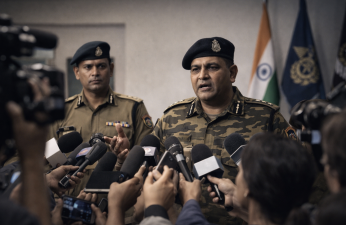
The Government of India plans to introduce the Central Armed Police Forces (General Administration) Bill, 2026, in the Rajya Sabha. The Bill aims to maintain the dominance of Indian Police Service (IPS) officers on deputation in leadership roles across the five CAPFs — BSF, CRPF, CISF, ITBP, and SSB. This move challenges a Supreme Court verdict that ordered a phased reduction of IPS officer deputations within two years to improve CAPF officers’ career growth and morale.
Supreme Court Verdict on CAPF Deputation
Recently, the Supreme Court directed the Centre to reduce IPS officer deputation in CAPFs at the ranks of DIG and IG progressively. The court ruled that IPS dominance hindered CAPF officers’ promotions and lowered their morale. A review petition filed by the Centre was dismissed in October 2025, reinforcing the judgment. The verdict aimed to prioritise CAPF officers for leadership roles to boost their career prospects.
Government’s Response and Bill Features
The Union Cabinet approved the draft Bill in March 2026 to retain IPS officers in senior CAPF posts. The government argues IPS officers are vital for effective coordination between Union and state police forces. The Bill proposes an umbrella law regulating recruitment, promotion, deputation, and service conditions of Group A CAPF officers. It mandates 50% deputation at IG rank, 67% at Additional DG rank, and exclusive deputation at Special DG and DG ranks. The Bill also asserts that its rules will override any conflicting laws or court orders.
Concerns of CAPF Officers and Retired Personnel
Retired CAPF officers oppose the Bill, claiming it stalls career advancement of CAPF officers. Many remain at entry-level ranks for over a decade, unlike expected timelines for promotion. They argue CAPF officers lead frontline operations and face risks, while IPS officers join at senior levels without operational exposure. CAPF officers also show denial of non-functional upgradation benefits available to other Group A central services, affecting their pay parity. They accuse the government of excluding the Department of Personnel and Training from the Bill’s scope to bypass existing service rules.
Operational Coordination and Administrative Issues
Supporters of IPS deputation stress the need for close Union-state coordination in CAPFs. IPS officers, often posted in state police and administrative roles, help streamline command and control. However, the debate continues over balancing operational efficiency with fair career progression for CAPF officers.
Topics for Prelims:
Central Armed Police Forces (CAPFs)
- Five CAPFs – BSF, CRPF, CISF, ITBP, SSB.
- Role – Border security, internal security, industrial security.
- Group A officers – From Assistant Commandant to Director General.
- Operational distinctiveness and coordination with state police.
- CAPFs under Ministry of Home Affairs.
Indian Police Service (IPS) Deputation in CAPFs
- IPS officers deputed in senior CAPF posts (IG and above).
- Supreme Court ordered reduction of IPS deputation in 2025.
- Government’s Bill mandates fixed percentage of deputation.
- Debate on career stagnation of CAPF officers due to IPS dominance.
- Coordination between Union and states cited as reason for deputation.
Non-Functional Upgradation (NFU)
- Introduced in 2006 for Group A central services.
- Ensures salary parity with IAS officers of same batch.
- CAPF officers claim NFU benefits not properly implemented.
- NFU affects pay and allowances of officers.
- Exclusion of DoPT from Bill may impact NFU applicability.
Questions for Mains:
- Critically analyse the impact of Indian Police Service deputation on the career progression of Central Armed Police Forces officers with suitable examples. [GS-II-Constitution of India & Polity]
- Point out the challenges in maintaining effective coordination between Union and state police forces in India and estimate the role of deputation in this context. [GS-II-Internal & External Security]
- With suitable examples, underline the significance of non-functional upgradation in central Group A services and critically analyse its implications on morale and efficiency. [GS-II-Governance]
- Estimate the constitutional and administrative issues involved in balancing judicial directives and executive decisions in the management of paramilitary forces in India. [GS-II-Constitution of India & Polity]
Answer Hints:
1. Critically analyse the impact of Indian Police Service deputation on the career progression of Central Armed Police Forces officers with suitable examples. [GS-II-Constitution of India & Polity]
- Supreme Court verdict (May 2025) mandated progressive reduction of IPS deputation at DIG and IG ranks to improve CAPF officers’ career growth.
- IPS officers dominate senior leadership posts (IG and above), limiting promotional opportunities for CAPF officers.
- CAPF officers often remain stuck at entry-level ranks (e.g., Assistant Commandant for 15+ years), exemplified by Ajay Malik’s case.
- Operational leadership and frontline risks are primarily borne by CAPF officers, while IPS officers join at higher ranks, often without field exposure.
- Deputation delays CAPF officers’ career advancement, lowers morale, and affects retention.
- Government Bill (2026) seeks to retain IPS dominance, potentially reversing SC’s efforts to balance career progression.
2. Point out the challenges in maintaining effective coordination between Union and state police forces in India and estimate the role of deputation in this context. [GS-II-Internal & External Security]
- CAPFs operate under Ministry of Home Affairs but work closely with state police for border and internal security operations.
- Diverse administrative structures and jurisdictional overlaps complicate coordination between Union forces and state police.
- IPS officers, posted in state police and administrative roles, facilitate seamless communication and command integration.
- Deputation of IPS officers to CAPFs at senior levels helps maintain Centre-state relations and operational coherence.
- However, excessive deputation risks sidelining CAPF officers and may affect operational distinctiveness.
- Balancing deputation with CAPF officers’ leadership is essential for both coordination and morale.
3. With suitable examples, underline the significance of non-functional upgradation in central Group A services and critically analyse its implications on morale and efficiency. [GS-II-Governance]
- Non-Functional Upgradation (NFU) introduced in 2006 to ensure salary parity with IAS officers of the same batch across Group A services.
- NFU provides pay benefits irrespective of post, aiding officers financially and boosting morale.
- CAPF officers claim NFU benefits have not been properly extended to them, causing pay disparities and dissatisfaction.
- Exclusion of DoPT from Bill’s ambit may undermine implementation of NFU and other central service rules for CAPF officers.
- Denial of NFU affects retention, motivation, and operational efficiency within CAPFs.
- Proper implementation of NFU is vital for equitable treatment and career satisfaction among CAPF officers.
4. Estimate the constitutional and administrative issues involved in balancing judicial directives and executive decisions in the management of paramilitary forces in India. [GS-II-Constitution of India & Polity]
- Supreme Court’s directive to reduce IPS deputation reflects judiciary’s role in safeguarding service conditions and career rights of CAPF officers.
- Executive’s introduction of the Central Armed Police Forces (General Administration) Bill, 2026 aims to override court orders to maintain operational needs.
- Conflict arises between judicial independence and executive’s administrative discretion in security sector management.
- Bill’s provision to override any court order or other laws raises constitutional questions about separation of powers.
- Paramilitary forces’ unique federal structure requires balancing Centre-state relations, judicial mandates, and administrative efficiency.
- Ensuring accountability, operational distinctiveness, and officers’ welfare demands harmonising judicial directives with executive policy without undermining either.