
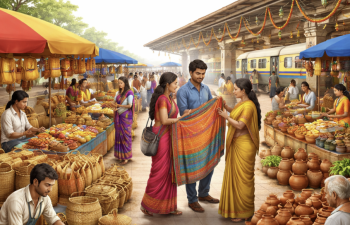
The One Station One Product (OSOP) initiative of Indian Railways is transforming over 2,000 railway stations across India into vibrant marketplaces for indigenous products. Launched in 2022, OSOP promotes local craftsmanship by providing retail spaces for artisans and Self-Help Groups (SHGs). As of January 2026, more than 1.32 lakh individuals have benefited from this scheme. This initiative supports regional diversity, sustainable livelihoods, and the ‘Vocal for Local’ campaign.
Implementation and Reach
OSOP began with a 15-day pilot at 19 stations and expanded nationwide. Railway divisions collaborate with state agencies, SHGs, and MSMEs to manage outlets. Stalls are allotted on a rotational basis with nominal fees to encourage wide participation. This model connects local producers directly with millions of passengers daily, offering them access to a national market.
Showcasing Regional Diversity
Each station marks products unique to its region. For example, Tenkasi Junction in Tamil Nadu features cane crafts, while Patna Railway Station in Bihar displays Madhubani paintings. West Bengal’s Asansol station offers handloom bags and carpets. Jaipur Junction in Rajasthan presents Sanganeri print textiles. This diversity reflects India’s rich cultural heritage and promotes regional identities.
Empowering Artisans and SHGs
OSOP prioritises artisans, farmers, weavers, and especially women-led SHGs. It targets those with limited market access, helping them sustain traditional livelihoods. The initiative offers economic stability by generating steady demand for handcrafted goods. It also encourages entrepreneurship at the grassroots level, preserving age-old skills and crafts.
Economic and Cultural Impact
By integrating local products into railway stations, OSOP transforms travel experiences into cultural exchanges. Passengers purchase authentic souvenirs while artisans gain recognition and income. This public infrastructure-based model strengthens inclusive growth and supports India’s indigenous talent on a national platform.
Topics for Prelims:
One Station One Product (OSOP) Initiative
- Launched in Union Budget 2022–23 by Indian Railways.
- Over 2,000 stations host 2,326 OSOP outlets.
- Benefits more than 1.32 lakh artisans and SHG members.
- Stalls allotted on rotational basis with nominal fees.
- Collaborates with state agencies, SHGs, and MSMEs.
Regional Craftsmanship and Products
- Tenkasi Junction, Tamil Nadu – Cane products.
- Patna Railway Station, Bihar – Madhubani paintings.
- Asansol Station, West Bengal – Handloom bags and carpets.
- Jaipur Junction, Rajasthan – Sanganeri print textiles.
- Balangir Station, Odisha – Handcrafted stuffed toys.
Artisans and Self-Help Groups (SHGs)
- Focus on women-led SHGs for empowerment.
- Provides market access beyond local boundaries.
- Supports traditional livelihoods and crafts.
- Generates sustainable income for grassroots producers.
- Encourages entrepreneurship and skill preservation.
Questions for Mains:
- Discuss in the light of the One Station One Product initiative how public infrastructure can promote inclusive economic growth and cultural preservation. [GS-III-Economic Development]
- Analyse the role of Self-Help Groups in empowering rural artisans and sustaining traditional crafts with suitable examples from Government of India schemes. [GS-II-Social Justice]
- Examine the impact of market access on indigenous artisans in India and how initiatives like OSOP help in integrating local economies with national markets. [GS-III-Economic Development]
- Critically discuss the challenges and opportunities in promoting regional handicrafts through national platforms like Indian Railways, taking examples from the OSOP scheme. [GS-II-Governance]
Answer Hints:
1. Discuss in the light of the One Station One Product initiative how public infrastructure can promote inclusive economic growth and cultural preservation. [GS-III-Economic Development]
- OSOP uses railway stations as retail spaces, leveraging public infrastructure with high footfall for market access.
- Promotes inclusive growth by supporting artisans, SHGs, MSMEs, especially women-led groups, generating sustainable livelihoods.
- Facilitates regional economic development by showcasing indigenous products, increasing income at grassroots level.
- Preserves cultural heritage by promoting traditional crafts like Madhubani paintings, cane products, handloom textiles.
- Nominal stall fees and rotational allotment ensure wider participation and equitable opportunities.
- Transforms transit spaces into cultural marketplaces, integrating commerce and community engagement.
2. Analyse the role of Self-Help Groups in empowering rural artisans and sustaining traditional crafts with suitable examples from Government of India schemes. [GS-II-Social Justice]
- SHGs provide collective bargaining power and market access to rural artisans, enhancing income and social status.
- Government schemes like OSOP collaborate with SHGs to provide retail platforms at railway stations.
- Women-led SHGs receive special focus, promoting gender empowerment and financial independence.
- SHGs help preserve traditional crafts by enabling artisans to sustain livelihoods through steady demand.
- Examples – Balangir (Odisha) SHGs producing handcrafted toys; coordination with MSMEs and state agencies under OSOP.
- SHGs encourage entrepreneurship and skill development at grassroots, encouraging community resilience.
3. Examine the impact of market access on indigenous artisans in India and how initiatives like OSOP help in integrating local economies with national markets. [GS-III-Economic Development]
- Market access allows artisans to sell beyond local boundaries, increasing income and economic stability.
- OSOP connects local producers with millions of railway passengers, providing a national platform.
- Enhanced visibility leads to recognition of regional crafts and boosts demand for indigenous products.
- Direct market linkage reduces dependence on middlemen, ensuring fair prices for artisans.
- Integration with national markets promotes ‘Vocal for Local’ and strengthens grassroots entrepreneurship.
- Examples – Madhubani paintings at Patna, Sanganeri textiles at Jaipur, cane crafts at Tenkasi.
4. Critically discuss the challenges and opportunities in promoting regional handicrafts through national platforms like Indian Railways, taking examples from the OSOP scheme. [GS-II-Governance]
- Opportunities – Large captive audience, wide geographic reach, institutional support, and cultural preservation.
- Challenges – Ensuring quality control, managing stall allocation fairly, sustaining artisans’ supply capacity.
- Need for coordination among railway divisions, state agencies, SHGs, and MSMEs for smooth operations.
- Risk of commercialization diluting traditional craftsmanship if not carefully managed.
- Examples – Rotational allotment and nominal fees promote inclusivity but may limit long-term vendor stability.
- Potential to expand digital marketing and e-commerce integration alongside physical stalls for scalability.