
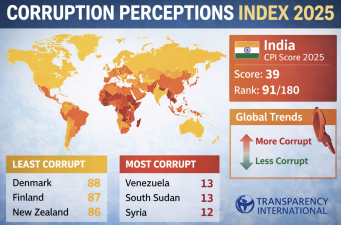
The Corruption Perceptions Index (CPI) 2025 by Transparency International reveals a worsening global corruption scenario. The average global score dropped to 42 out of 100, the lowest in over ten years. India scored 39, ranking 91st among 182 countries, showing stagnation despite its economic growth. This index marks corruption’s impact on governance and economic development worldwide.
Global Corruption Trends in 2025
The CPI 2025 shows corruption is deepening globally. Only five countries scored above 80, down from 12 a decade ago. Most countries (122 out of 182) scored below 50, indicating widespread governance challenges. Weak oversight and shrinking civic freedoms correlate with poorer corruption perceptions. Countries with strong institutions and transparency have improved their scores over time.
India’s Position and Challenges
India’s CPI score has hovered between 38 and 41 over the past decade. Despite becoming the world’s fourth-largest economy, India’s governance perception remains low. Compared to neighbours, India scores better than Bangladesh and Pakistan but lags behind several upper-middle-income democracies. Persistent issues include low transparency, weak oversight, and complex regulatory frameworks that increase corruption risks.
Economic Impact of Corruption
Corruption raises transaction costs and reduces productivity. It diverts resources from productive activities to rent-seeking. Globally, corruption costs over 5% of GDP annually, exceeding $2.6 trillion. For India, estimated losses range from 0.5% to 1.5% of GDP yearly. These losses limit funds for infrastructure, health, and education, slowing development and economic growth.
Regulatory Complexity and Reforms
India’s compliance system is complex, with over 26,000 imprisonment provisions in business laws. For example, a pharmaceutical start-up faces nearly 1,000 compliance requirements, half carrying criminal penalties. This complexity increases costs and discretionary power, encouraging corruption. However, digital public infrastructure and initiatives like GST and e-procurement are improving transparency and reducing leakages in welfare schemes and payments.
Topics for Prelims:
Corruption Perceptions Index (CPI)
- Published annually by Transparency International.
- Measures perceived public sector corruption.
- Scores range from 0 (highly corrupt) to 100 (very clean).
- Uses 13 independent data sources globally.
- Influences investment and governance credibility.
India’s Governance and Economic Impact
- India’s CPI score in 2025 is 39, ranked 91st.
- Score has remained stable over the last decade.
- Corruption costs India up to 1.5% of GDP annually.
- Complex regulatory environment increases corruption risks.
- Digital reforms improve transparency in welfare and taxation.
Digital Public Infrastructure in India
- Includes Direct Benefit Transfers and digital IDs.
- RBI Digital Payments Index rose from 493.22 to 516.76 in 2025.
- GST network enhances tax formalisation and traceability.
- E-procurement reduces rent-seeking opportunities.
- Technology supports institutional transparency and accountability.
Questions for Mains:
- Critically analyse the role of institutional reforms and technology in reducing corruption in developing economies with examples. [GS-III-Economic Development]
- Point out the economic consequences of corruption on GDP growth and public welfare in India and suggest measures to mitigate these effects. [GS-III-Economic Development]
- With suitable examples, estimate the impact of regulatory complexity on ease of doing business and corruption in India, and suggest reforms. [GS-II-Governance]
- Underline the relationship between democratic accountability and corruption perception globally and explain how civic freedoms influence governance quality. [GS-II-Constitution of India & Polity]
Answer Hints:
1. Critically analyse the role of institutional reforms and technology in reducing corruption in developing economies with examples. [GS-III-Economic Development]
- Institutional reforms strengthen transparency, oversight, and regulatory predictability, reducing discretionary power that encourages corruption.
- Examples – Countries improving CPI scores through sustained reforms (e.g., East Asian and European democracies enhancing institutional independence).
- Technology reduces leakages and rent-seeking by enabling digital public infrastructure like Direct Benefit Transfers (DBT), digital IDs, and e-procurement.
- India’s GST network and RBI Digital Payments Index show how digitisation formalises transactions and improves traceability.
- Digital reforms enhance governance credibility, encouraging investment and economic growth.
- However, reforms must be cumulative and sustained, not episodic crackdowns, to have lasting impact.
2. Point out the economic consequences of corruption on GDP growth and public welfare in India and suggest measures to mitigate these effects. [GS-III-Economic Development]
- Corruption increases transaction costs, raises compliance expenses, and diverts entrepreneurial energy to rent-seeking rather than value creation.
- Estimated corruption costs India 0.5% to 1.5% of GDP annually, equating to tens of billions of dollars lost each year.
- These losses reduce funds available for infrastructure, health, education, and industrial upgrading, slowing development.
- Corruption undermines fiscal efficiency and regulatory credibility, deterring investment and economic growth.
- Mitigation measures – Simplify regulatory frameworks, strengthen institutional transparency and accountability, and expand digital governance tools.
- Promote judicial efficiency and reduce criminalisation in business laws to lower discretionary power and corruption opportunities.
3. With suitable examples, estimate the impact of regulatory complexity on ease of doing business and corruption in India, and suggest reforms. [GS-II-Governance]
- India has over 26,000 imprisonment provisions in business regulations, creating a complex compliance environment.
- Example – Pharmaceutical start-ups face nearly 1,000 compliance obligations, with about half carrying criminal liability.
- Such complexity increases compliance costs, discretionary power, and rent-seeking opportunities, negatively impacting ease of doing business.
- Complex regulations discourage entrepreneurship, reduce investment, and perpetuate corruption cycles.
- Reforms needed – Regulatory simplification, decriminalisation of minor offences, and clearer compliance requirements.
- Leverage digital platforms (e.g., e-procurement, GST) to increase transparency and reduce discretionary interventions.
4. Underline the relationship between democratic accountability and corruption perception globally and explain how civic freedoms influence governance quality. [GS-II-Constitution of India & Polity]
- Weak democratic accountability correlates with worsening corruption perceptions globally, as oversight mechanisms falter.
- Civic freedoms (freedom of speech, press, assembly) enable transparency, public scrutiny, and holding officials accountable.
- Countries with shrinking civic freedoms tend to have higher corruption levels due to reduced checks on power.
- Strong democratic institutions, competitive elections, and independent judiciary enhance governance quality and reduce corruption.
- India’s constitutional foundations and competitive democracy provide a basis for accountability, but stagnation in reforms weakens perception.
- Enhancing civic freedoms and institutional independence is crucial to improving governance and lowering corruption perceptions.