
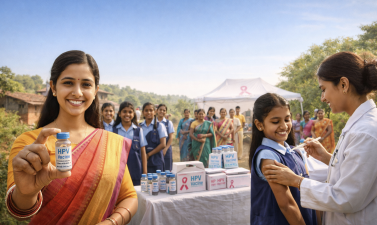
India made a historic move in 2026 by launching a nationwide Human Papillomavirus (HPV) vaccination programme for adolescent girls. This step aims to eliminate cervical cancer, a largely preventable disease that still causes many deaths in India. Globally, cervical cancer is the fourth most common cancer among women. India carries a heavy burden with over 78,000 new cases and nearly 43,000 deaths annually.
Cervical Cancer Burden in India
Cervical cancer is the second most common cancer among Indian women. It is caused mainly by HPV infection. Risk factors include early marriage, early sexual activity, multiple pregnancies, tobacco use, and poor hygiene. These factors increase the chance of HPV infection. Unlike many cancers, cervical cancer risk can be reduced by vaccination, screening, and awareness.
Global and National Efforts to Eliminate Cervical Cancer
The World Health Organization (WHO) aims to eliminate cervical cancer by reducing incidence to fewer than 4 cases per 100,000 women annually. WHO’s 90–70–90 targets include vaccinating 90% of girls by age 15, screening 70% of women aged 30 and above, and treating 90% of detected cases. India’s vaccination launch is a key step towards these goals.
HPV Vaccine Safety and Effectiveness
The HPV vaccine has a strong global safety record with minor side effects like pain or redness at the injection site. It was first licensed 20 years ago and has been widely used in over 140 countries. Studies show even a single dose offers long-term protection. Indian research, including work by Tata Memorial Centre, confirms its safety and effectiveness in Indian populations.
Challenges and Future Directions
While urban India shows some decline in cervical cancer due to better hygiene and awareness, rural areas still face high disease rates. Global experience warns that lapses in vaccination coverage can cause resurgence. Sustained vaccination, screening, and treatment are essential to eliminate cervical cancer in India.
Topics for Prelims:
Human Papillomavirus (HPV)
- HPV is a virus causing most cervical cancers.
- Transmitted through genital contact.
- Vaccination prevents HPV infection.
- Over 140 countries use HPV vaccines.
- Single dose offers long-term protection.
Cervical Cancer
- Second most common cancer among Indian women.
- Caused mainly by HPV infection.
- Risk factors include early marriage and tobacco use.
- Preventable by vaccination and screening.
- WHO aims to eliminate it globally.
WHO’s 90–70–90 Strategy
- 90% girls vaccinated by age 15.
- 70% women screened at 30+ years.
- 90% of detected cases treated.
- Targets global cervical cancer elimination.
- India’s programme aligns with this strategy.
Questions for Mains:
- Discuss in the light of India’s HPV vaccination drive, the role of immunisation in public health and disease prevention. [GS-III-Science & Technology]
- Critically examine the challenges in implementing nationwide vaccination programmes in India and suggest measures to overcome them. [GS-II-Governance]
- Explain the socio-economic factors influencing cervical cancer prevalence in India and discuss how public health policy can address these. [GS-I-Indian Society]
- With suitable examples, discuss the importance of global health initiatives like WHO’s 90–70–90 strategy in disease elimination efforts. Comment on India’s alignment with such initiatives. [GS-II-International Relations]
Answer Hints:
1. Discuss in the light of India’s HPV vaccination drive, the role of immunisation in public health and disease prevention. [GS-III-Science & Technology]
- Immunisation prevents infectious diseases by inducing immunity, reducing morbidity and mortality.
- HPV vaccine prevents cervical cancer by protecting against the main causative virus (HPV).
- Vaccination reduces disease burden, healthcare costs, and improves quality of life.
- India’s HPV drive targets adolescent girls to break transmission early and reduce future cancer cases.
- Successful immunisation programmes contribute to herd immunity and long-term disease elimination.
- Immunisation complements screening and awareness for comprehensive disease prevention.
2. Critically examine the challenges in implementing nationwide vaccination programmes in India and suggest measures to overcome them. [GS-II-Governance]
- Challenges – logistical issues in rural/remote areas, cold chain maintenance, and vaccine accessibility.
- Socio-cultural resistance, misinformation, and vaccine hesitancy hinder acceptance.
- Inadequate healthcare infrastructure and trained personnel affect programme delivery.
- Financial constraints and prioritisation issues at state and local levels.
- Measures – robust awareness campaigns, community engagement, and involvement of local leaders.
- Strengthening health infrastructure, ensuring cold chain, and capacity building of healthcare workers.
- Government funding, public-private partnerships, and monitoring mechanisms to ensure coverage and quality.
3. Explain the socio-economic factors influencing cervical cancer prevalence in India and discuss how public health policy can address these. [GS-I-Indian Society]
- Early marriage and sexual activity increase HPV infection risk, linked to socio-cultural norms.
- Poverty limits access to hygiene, healthcare, screening, and vaccination services.
- Low awareness and education levels reduce preventive health-seeking behaviour.
- Tobacco use and multiple pregnancies are more prevalent in marginalized communities.
- Public health policies should focus on education, awareness, and empowerment of women.
- Implement affordable, accessible vaccination and screening programmes targeting vulnerable groups.
- Integrate cervical cancer prevention with broader women’s health and social welfare schemes.
4. With suitable examples, discuss the importance of global health initiatives like WHO’s 90–70–90 strategy in disease elimination efforts. Comment on India’s alignment with such initiatives. [GS-II-International Relations]
- WHO’s 90–70–90 targets provide clear, measurable goals for vaccination, screening, and treatment.
- Global coordination helps share best practices, funding, and technical support.
- Examples – Countries with high HPV vaccine coverage have seen cervical cancer decline.
- India’s HPV vaccination launch aligns with WHO goals, aiming for 90% vaccination of girls by 15 years.
- India’s efforts in screening and treatment also contribute to meeting global elimination targets.
- Such initiatives encourage international collaboration, improving health outcomes and equity.