
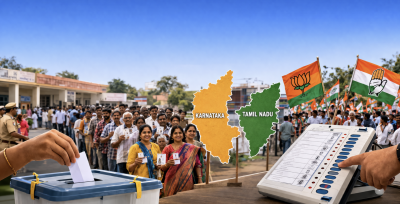
The recent elections in Karnataka and Tamil Nadu have witnessed significant political activity and voter engagement. These state assembly elections are crucial for determining the political landscape in southern India. Both states have seen intense campaigning by major political parties, leading to increased voter mobilisation and varying turnout levels across constituencies.
Political Landscape in Karnataka
Karnataka’s elections are marked by competition primarily among the Bharatiya Janata Party (BJP), Indian National Congress (INC), and Janata Dal (Secular) (JD(S)). The state is politically diverse, with urban and rural areas showing different voting patterns. The BJP aims to retain power, while the Congress and JD(S) are attempting to form alliances to challenge the incumbent government. Key issues influencing voters include development, agriculture, employment, and regional identity.
Electoral Dynamics in Tamil Nadu
Tamil Nadu’s political scene is dominated by Dravidian parties, mainly the DMK and AIADMK. The recent elections have seen an intense contest between these two, with alliances playing a crucial role. The DMK-led coalition has focused on social welfare and economic recovery post-pandemic, while the AIADMK emphasises governance continuity. Voter mobilisation has been driven by caste dynamics, welfare schemes, and regional sentiments.
Voter Turnout Trends
Voter turnout in both states has shown variation compared to previous elections. Karnataka recorded a moderate turnout, with urban constituencies showing a slight dip, while rural areas maintained steady participation. In Tamil Nadu, turnout was relatively higher, reflecting increased political engagement. Factors such as weather conditions, pandemic concerns, and voter enthusiasm influenced these trends. The Election Commission’s efforts to ensure safe and accessible voting also contributed to turnout levels.
Impact on Future Political Scenarios
The election results will shape governance and policy directions in both states. Karnataka’s outcome may influence regional alliances and national politics, given its strategic importance. Tamil Nadu’s political stability is vital for social welfare programmes and economic initiatives. The elections also reflect evolving voter behaviour, with increased youth participation and issue-based voting becoming more prominent.
What to Study for UPSC Exams?
- Federal Structure and State Elections
- Dravidian Political Movements
- Electoral Reforms in India
- Voter Behaviour and Political Mobilisation
- Role of Regional Parties in Indian Politics
Federal Structure and State Elections
India is a federal union with powers divided between the central government and states, as per the Constitution. State elections determine the composition of Legislative Assemblies, influencing governance at the state level. The Election Commission of India oversees free and fair elections. State governments have autonomy in subjects listed in the State List, including law and order, agriculture, and local governance. State election outcomes impact center-state relations and can influence national politics through alliances and coalition governments. State assemblies have five-year terms unless dissolved earlier.
Dravidian Political Movements
Dravidian political movements originated in Tamil Nadu in the early 20th century, emphasizing social justice, anti-Brahminism, and regional pride. Key parties include DMK and AIADMK, rooted in Dravidian ideology promoting Tamil identity and language rights. The movement challenged North Indian dominance and caste hierarchies. It led to significant social reforms and welfare schemes. Dravidian parties have dominated Tamil Nadu politics since the 1960s. The movement also influenced cultural and linguistic policies in southern India.
Electoral Reforms in India
Electoral reforms in India aim to enhance transparency, fairness, and inclusivity in elections. Key reforms include the introduction of Electronic Voting Machines (EVMs), the NOTA (None of the Above) option, and the Model Code of Conduct. The Election Commission enforces limits on campaign finance and criminalization of politics. Recent reforms focus on voter registration, voter ID cards, and postal ballots. Delimitation commissions redraw constituency boundaries to ensure balanced representation. These reforms seek to strengthen democratic processes and voter confidence.
Voter Behaviour and Political Mobilisation
Voter behaviour in India is influenced by factors like caste, religion, region, economic status, and candidate appeal. Political mobilisation involves parties engaging voters through campaigns, rallies, and welfare promises. Urban and rural voting patterns often differ due to socio-economic disparities. Youth and first-time voters have become significant electoral segments. Issues such as development, employment, and social justice shape voter choices. Election Commission initiatives and technology use have improved voter awareness and participation.
Role of Regional Parties in Indian Politics
Regional parties in India represent local interests, languages, and cultures, often dominating state politics. Examples include DMK in Tamil Nadu, TMC in West Bengal, and Shiv Sena in Maharashtra. They influence coalition governments at the center and shape federal dynamics. Regional parties address state-specific issues neglected by national parties. Their rise reflects India’s diversity and decentralization. They play a crucial role in policy-making, governance, and balancing central authority with regional aspirations.
Last Modified: April 9, 2026