
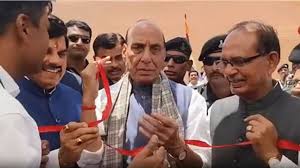
The three-day Unnat Krishi Mela started on April 11 at Dussehra Maidan, Raisen district, Madhya Pradesh. Defence Minister Rajnath Singh, Union Agriculture Minister Shivraj Singh Chouhan, and Madhya Pradesh Chief Minister Mohan Yadav inaugurated the event. The mela will run until April 13, bringing together farmers, scientists, policymakers, and agri-industries nationwide.
Event Overview and Objectives
The mela focuses on technology-driven farming and long-term agricultural planning. It features 20 sessions covering various agricultural topics, including live demonstrations. The event aims to provide a comprehensive roadmap from ‘lab to field’ and ‘seed to market’ to improve productivity and farmer income. Raisen falls under the Vidisha Lok Sabha constituency, represented by Agriculture Minister Chouhan.
Exhibition and Demonstrations
Approximately 300 stalls display agricultural solutions such as improved seed varieties, fertilisers, pesticides, micro-irrigation systems, and advanced machinery. Live demonstrations include equipment like happy seeders, super seeders, reaper-binders, balers, and rotavators. Experts provide hands-on training on these machines to farmers.
Seminars and Expert Interactions
Continuous seminars address soil health management, crop diversification, natural farming, integrated nutrient and pest management, and post-harvest technologies. Scientists from the Indian Council of Agricultural Research (ICAR), agricultural universities, and Krishi Vigyan Kendras interact directly with farmers to offer locally tailored solutions.
Additional Facilities and Roadmap Launch
The mela features a mobile soil testing laboratory, live integrated farming models, and units for dairy, fisheries, poultry, and goat rearing. Insurance companies and banks provide on-the-spot crop insurance and credit assistance. On April 13, Union Minister Nitin Gadkari will unveil an agricultural roadmap for Raisen, Vidisha, Sehore, and nearby areas, focusing on crop diversification, water conservation, market linkages, and income enhancement.
What to Study for UPSC Exams?
- Integrated Pest Management Techniques
- Role of ICAR in Indian Agriculture
- Crop Diversification Strategies
- Micro-irrigation and Water Conservation
Integrated Pest Management Techniques
Integrated Pest Management (IPM) combines biological, cultural, mechanical, and chemical methods to control pests sustainably. It minimizes pesticide use by promoting natural predators and pest-resistant crop varieties. IPM originated in the 1950s as a response to pesticide resistance and environmental concerns.
Role of ICAR in Indian Agriculture
The Indian Council of Agricultural Research (ICAR), established in 1929, coordinates agricultural education and research in India. It manages over 100 research institutes and 75 agricultural universities, pioneering innovations like high-yield crop varieties and sustainable farming practices.
Crop Diversification Strategies
Crop diversification involves growing a variety of crops to reduce risk and improve soil health. It enhances income stability by mixing cereals, pulses, fruits, and vegetables. This strategy also mitigates pest outbreaks and adapts to climate variability.
Micro-irrigation and Water Conservation
Micro-irrigation delivers water directly to plant roots via drip or sprinkler systems, reducing water use by up to 60%. It improves crop yield and nutrient efficiency while conserving groundwater. Originating in Israel, it is increasingly adopted in arid and semi-arid regions globally.
Last Modified: April 12, 2026