
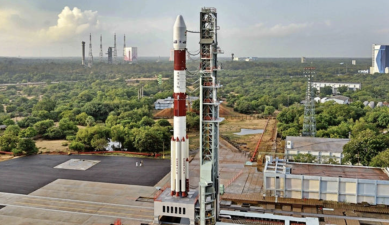
ISRO is set to begin 2026 with the PSLV-C62 mission from Sriharikota, carrying the EOS-N1 Earth observation satellite, codenamed Anvesha, into orbit. The launch is scheduled for 12 January at 10.17 am from the first launchpad. The mission is important for India’s remote sensing, surveillance and space technology capabilities.
PSLV-C62 Mission Overview
PSLV-C62 is a multi-payload launch with one primary satellite and 18 secondary payloads. The mission will carry satellites from Indian startups, universities and international partners. It is also closely watched because it follows the failure of PSLV-C61 in May 2025, when the third stage developed a technical issue.
EOS-N1 Satellite
EOS-N1 is a hyperspectral imaging satellite developed mainly for DRDO. It can observe the Earth in hundreds of wavelengths, allowing more precise identification of materials and objects. This makes it useful for:
- Border surveillance and national security.
- Strategic monitoring and reconnaissance.
- Agriculture planning and crop assessment.
- Urban mapping, mineral detection and environmental monitoring.
Secondary Payloads and New Space Milestones
The mission includes several notable payloads. Europe’s Kestrel Initial Demonstrator is an experimental re-entry capsule. Indian payloads include AayulSAT by OrbitAID Aerospace, CGUSAT-1 by CV Raman Global University, DA-1 by Dhruva Space, SR-2 by Space Kidz India, Lachit-1 by Assam Don Bosco University, Solaras-S4 by Akshath Aerospace and DSAT-1 by Dayanand Sagar University. AayulSAT is especially as India’s first on-orbit satellite refuelling payload.
Importance for ISRO
A successful PSLV-C62 launch would restore confidence in the PSLV programme after the PSLV-C61 setback. It would also reinforce the reliability of PSLV as India’s workhorse launch vehicle and support future missions in satellite servicing, Earth observation and commercial space applications.
Last Modified: April 25, 2026