
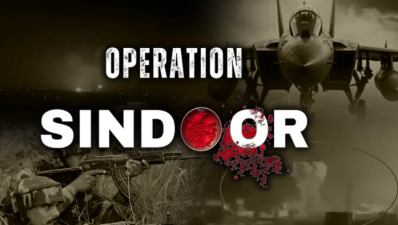
India has marked the first anniversary of Operation Sindoor, a tri-service military operation launched in May 2025 after the terror attack in Pahalgam in Jammu and Kashmir that killed 26 people. The operation is seen as a major shift in India’s counter-terrorism doctrine, combining precision strikes, joint military action, and advanced defence systems.
Launch and Objective
Operation Sindoor began on the night of 6-7 May 2025. Indian forces targeted terror infrastructure in Pakistan and Pakistan-occupied Jammu and Kashmir. The strikes were based on intelligence inputs and were aimed at dismantling camps linked to Jaish-e-Mohammed, Lashkar-e-Taiba, and Hizbul Mujahideen.
- More than 100 terrorists, including handlers and trainers, were reportedly killed.
- The operation was described as a measured act of self-defence.
- It was designed to avoid civilian casualties while hitting terror networks.
Military Response and Escalation
After the strikes, Pakistan launched retaliatory attacks using drones, missiles, and electronic warfare systems against Indian military targets. India’s layered air defence systems, including indigenous platforms, intercepted these threats and protected key installations.
- India then carried out further strikes on Pakistani airbases and military infrastructure.
- Targets included Chaklala, Sargodha, and Rahimyar Khan.
- Pakistan later sought de-escalation, leading to a ceasefire on 10 May 2025.
Jointness and Indigenous Capability
Operation Sindoor brought into light coordination among the Army, Air Force, Navy, and border forces. The Air Force executed precision strikes, the Army maintained pressure along the Line of Control, and the Navy deployed assets in the North Arabian Sea to deter escalation.
- The BSF also helped prevent infiltration along the International Border.
- Indigenous systems such as Akash missiles and integrated air command networks were used effectively.
- The operation underlined India’s progress in defence indigenisation and Aatmanirbhar Bharat.
Strategic Significance
The operation had wider diplomatic and strategic effects. India suspended trade ties, took diplomatic steps, and placed the Indus Waters Treaty in abeyance. It also signalled a tougher doctrine, with terror attacks increasingly treated as acts of war. The operation is now viewed as a benchmark in intelligence-led, proportionate, and technology-driven military response.
Last Modified: April 25, 2026