
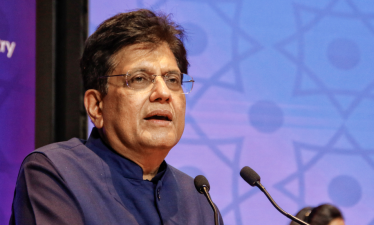
Union Commerce and Industry Minister Piyush Goyal, speaking at the Citi India Conference 2026, highlighted India as the world’s most trusted investment destination and fastest-growing large economy. He outlined the country’s sustained growth prospects, driven by targeted government interventions across manufacturing, infrastructure, and technology adoption. The address showcased rising investor confidence observed during recent trade engagements in Canada and the United States. Goyal reaffirmed India’s strategic transition from basic assembly-based manufacturing to innovation-led industrial growth, supported by digital infrastructure and renewable energy expansion, aiming for a USD30 trillion economy by 2047.
Economic Indicators and Growth Drivers
India’s economic trajectory positions it as a primary engine of global growth, supported by strong macroeconomic fundamentals and structural reforms.
Macroeconomic Stability
The country maintains a high GDP growth rate relative to other major economies, supported by stable inflation management, a controlled fiscal deficit, and comfortable foreign exchange reserves. This stability lowers sovereign risk for foreign portfolio investors and direct investments.
Target 2047 Vision
The long-term development strategy anchors on the “Viksit Bharat” vision. This blueprint aims to transform India from a developing economy into a USD30 trillion developed nation by the centenary of its independence in 2047, requiring a sustained compound annual growth rate.
Structural Reforms and Ease of Doing Business
The government has implemented legal, administrative, and labor reforms to reduce compliance burdens and attract global capital.
Regulatory Streamlining
The Ministry of Commerce and Industry has systematically decriminalized minor technical offenses across various corporate laws. The National Single Window System (NSWS) serves as a unified digital platform for tracking and securing central and state-level clearances, reducing bureaucratic delays.
Labor and Tax Reforms
The consolidation of 29 central labor laws into four simplified Labor Codes aims to modernize employment relations, enhance social security, and simplify factory licensing. The implementation of the Goods and Services Tax (GST) and the reduction of corporate tax rates for new manufacturing units provide a predictable tax regime.
Manufacturing and Infrastructure Expansion
India is shifting away from low-value assembly lines to high-tech, innovation-driven domestic production ecosystems.
Production Linked Incentive (PLI) Schemes
The PLI scheme covers 14 critical sectors with an outlay of over 1.97 lakh crore rupees. It incentivizes domestic manufacturing, attracts large-scale foreign direct investment (FDI), and builds global champions in strategic fields.
| Core PLI Sector | Strategic Focus and Key Objective |
| Mobile Manufacturing & Electronics | Shifting from semi-knocked-down assembly to full localization of printed circuit boards and components. |
| Advanced Chemistry Cell (ACC) Battery | Establishing domestic energy storage capacity for electric vehicles and grid stabilization. |
| Specialty Steel | Upgrading domestic steel production to high-grade steel used in automotive and defense industries. |
| Pharmaceuticals | Reducing dependence on imported Active Pharmaceutical Ingredients (APIs) and key starting materials. |
Infrastructure Development
The PM GatiShakti National Master Plan integrates multimodal connectivity projects across railways, roadways, and ports to lower logistics costs. This framework coordinates infrastructure planning among 16 ministries to eliminate project delays.
Technology Adoption and Renewable Energy
The scaling up of digital public infrastructure and green energy infrastructure forms the backbone of India’s industrial modernization.
Digital Public Infrastructure (DPI)
The “India Stack,” which includes Aadhaar, the Unified Payments Interface (UPI), and the Open Network for Digital Commerce (ONDC), lowers transaction costs for businesses. It enables financial inclusion and allows global enterprises to deploy scalable digital solutions.
Clean Energy Transition
India has set a target to achieve 500 gigawatts of non-fossil fuel energy capacity by 2030 and reach net-zero emissions by 2070. Massive capital investments are flowing into green hydrogen production, solar parks, and high-capacity wind energy projects.
Global Trade Integration and FTAs
India is actively renegotiating its trade relationships to secure preferential market access and integrate into resilient global supply chains.
New-Age Free Trade Agreements
The country has shifted toward signing comprehensive bilateral trade pacts that cover modern trade areas like digital commerce, intellectual property, and sustainability. Recent pacts include the UAE-India Comprehensive Economic Partnership Agreement (CEPA) and the India-Australia Economic Cooperation and Trade Agreement (ECTA).
Supply Chain Resilience
In response to geopolitical shifts, India positions itself as an alternative manufacturing hub through partnerships like the Indo-Pacific Economic Framework for Prosperity (IPEF), focusing on secure supply chains for semiconductors and critical minerals.
IASPOINT Booster Facts for UPSC
- FDI Policy Liberalization: India allows 100% Foreign Direct Investment under the automatic route in several key sectors, including defense manufacturing (up to 74%), civil aviation, space sector components, and greenfield pharmaceuticals.
- National Single Window System (NSWS): Launched by the Ministry of Commerce and Industry, this platform integrates various clearance systems, reducing the need for investors to visit multiple separate government portals.
- Viksit Bharat @2047: This national initiative represents the official government plan to transform India into a developed nation by 2047, focusing on structural economic growth, social progress, and environmental sustainability.
- Foreign Exchange Reserves Composition: India’s forex reserves managed by the Reserve Bank of India (RBI) consist of four main components: Foreign Currency Assets (FCAs), Gold holdings, Special Drawing Rights (SDRs) with the IMF, and the Reserve Position in the International Monetary Fund.
- PM GatiShakti Pillars: The master plan relies on six structural pillars: Comprehensiveness, Prioritization, Optimization, Synchronization, Analytical focus, and Dynamic execution, all powered by geographic information system (GIS) mapping tools.