
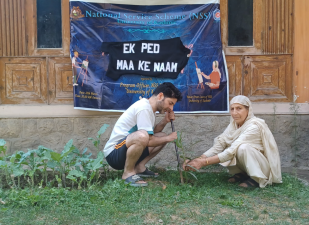
The Government of Gujarat launched the third phase of the statewide “Ek Ped Maa Ke Naam” campaign on World Environment Day to accelerate urban forestry and community-led conservation. Chief Minister Bhupendra Patel inaugurated this phase from Gandhinagar by planting saplings via the specialized ‘Van Kavach’ micro-forest methodology. The mass plantation drive aims to expand the forest cover across the state and transform the Gandhinagar Lok Sabha constituency into a model green zone. Administered by the Gujarat Forest Department, the initiative blends automated state resources with widespread public volunteering to address climate adjustments.
Phase 3 Objectives and Mass Targets
The third phase scales up regional afforestation targets to create dense urban ecological shelters across diverse landscapes.
- Acreage Expansion: The campaign focuses on developing multiple Van Kavach zones by planting more than 50 lakh saplings across 500 hectares of land.
- Green Constituency Project: A targeted segment of the campaign works to turn the Gandhinagar Lok Sabha constituency into a model ‘Green Lok Sabha’ through concentrated rural and urban tree-planting drives.
- Single-Day Milestone: The execution plan mobilized nearly 50,000 group-level units in villages and cities. With each group planting 12 saplings, the network completed approximately 6 lakh plantations in a single day.
- Taluka Level Decentralization: The state scheduled 265 taluka-level programs to distribute more than 1.87 lakh saplings free of cost to local families, academic centers, and youth clubs.
Technical Blueprint of the Van Kavach Model
The Van Kavach system is Gujarat’s localized adaptation of the Miyawaki method, a dense afforestation technique pioneered by Japanese botanist Dr. Akira Miyawaki. It relies on a close-interval spacing pattern of 1 meter by 1 meter to achieve rapid growth.
Scientific Structure of the Three-Tier Canopy
The model requires a strict proportional placement of indigenous flora across three ecological layers to maximize sunlight interception and vertical space utilization.
| Canopy Layer | Structural Allocation | Species Representation | Functional Purpose |
| Upper Canopy | 20% of total saplings | 16 native species | Forms the primary overhead shield, captures direct light, and limits wind velocity |
| Middle Canopy | 50% of total saplings | 25 native species | Fills the mid-level vertical space, increases biomass, and supports local bird nesting |
| Lower Canopy | 30% of total saplings | 16 native species | Covers ground spaces, reduces water evaporation, and stops weed propagation |
Operational Dynamics of Micro Forests
Van Kavach units grow 10 times faster and achieve 30 times higher density compared to standard, single-species linear plantations. The close proximity of the saplings forces rapid upward growth as the plants compete for sunlight. Within two years of maintenance, the dense root networks lock the underlying soil matrix to prevent erosion. The thick canopy shade limits moisture loss, enabling the micro-forest to mature into a self-sustaining ecosystem within 20 to 30 years, whereas traditional natural forests take centuries to reach a similar stage.
Origin and Pan-India Context
The global “Ek Ped Maa Ke Naam” campaign, internationally known by the hashtag #Plant4Mother, started as a mass climate initiative combining resource conservation with community traditions.
National Inception
Prime Minister Narendra Modi launched the global campaign on World Environment Day, June 5, 2024, by planting a sacred Peepal tree (Ficus religiosa) at Buddha Jayanti Park in New Delhi. The initiative urges citizens to plant and nurture a tree as a tribute to their mothers and Earth.
Evolution of Phases
- Phase 1 (2024): Focused on baseline organizational mobilization across central ministries, armed forces, and public sector units, planting over 5.5 crore saplings.
- Phase 2 (2025): Scaled up under the “Ek Ped Maa Ke Naam 2.0” banner, setting a national milestone target of 10 crore trees between June and September to back India’s Mission LiFE goals.
- Phase 3 (2026): Transitioned into deep sub-state execution, as seen in Gujarat’s block-level Van Kavach models and Uttar Pradesh’s single-day target of 5 crore saplings centered around urban river zones like the Kukrail forest area.
IASPOINT Booster Facts for UPSC
- Miyawaki Method: A technique developed by Dr. Akira Miyawaki utilizing multi-layered native species to regenerate dense, natural forests on degraded land, widely adapted in Indian urban planning under schemes like the Nagar Van Yojana.
- Mission LiFE (Lifestyle for Environment): An India-led global mass movement introduced at COP26 that focuses on shifting individual behaviors from thoughtless consumption to mindful resource utilization.
- Mines and Minerals Contribution: State forest setups combine Van Kavach funding with allocations from the District Mineral Foundation (DMF) and Compensatory Afforestation Fund Management and Planning Authority (CAMPA) to clear barren commercial plots.
- Peepal Tree Significance: Chosen for the national launch due to its high ecological capacity; Ficus religiosa acts as a keystone species in Indian ecosystems, providing year-round shelter and food to diverse insects, birds, and mammals.
- Constitutional Directive: The campaign directly addresses Article 51A(g) of the Indian Constitution, which mandates that it shall be the fundamental duty of every citizen to protect and improve the natural environment, including forests, lakes, rivers, and wildlife.