
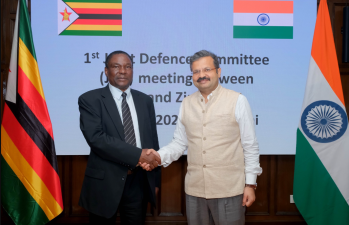
The inaugural meeting of the India-Zimbabwe Joint Defence Committee (JDC) took place in New Delhi on June 4, 2026, aimed at strengthening bilateral military and strategic relations. Co-chaired by Joint Secretary (International Cooperation) Amitabh Prasad from the Indian Ministry of Defence and Permanent Secretary Aaron Daniel Tonde Nhepera from Zimbabwe, the meeting formalised operational plans for enhanced security cooperation. The discussions operationalised the core objectives outlined in the Memorandum of Understanding (MoU) on Defence Cooperation, which the defence ministers of both nations signed on the sidelines of the Aero India exhibition in Bengaluru in February 2025.
Structural Framework and Delegations
Institutional Representation
The JDC serves as the primary institutional mechanism to monitor, evaluate, and expand defense engagements between New Delhi and Harare. The Indian delegation included senior officials from the three Armed Services (Army, Navy, and Air Force), the Department of Defence Production (DDP), and the Armed Forces Medical Services (AFMS). The Zimbabwean side consisted of a 12-member high-level delegation representing the Zimbabwe Defence Forces (ZDF) and the Zimbabwe Defence Industries (ZDI).
Industrial Engagement at DPSU Bhawan
Apart from official ministerial interaction, the Zimbabwean delegation held institutional talks at DPSU Bhawan in New Delhi. This interaction with representatives from the Indian defence industry explored direct commercial sourcing, technical maintenance partnerships, and modernization programs for Zimbabwe’s state security apparatus.
Key Areas of Agreed Cooperation
The two countries agreed to diversify their military engagement by upgrading existing programs and initiating partnerships across several distinct operational pillars:
- Maintenance of Air Assets: Collaborating on technical support, supply chains, and structural maintenance for common aerial platforms operated by both air forces.
- Military Training: Expanding slots for Zimbabwean officers in premier Indian military training institutions under the Indian Technical and Economic Cooperation (ITEC) framework.
- Joint Defence Manufacturing: Exploring joint ventures to manufacture light weaponry, ammunition, protective gear, and military transport vehicles within Zimbabwe.
- Counter-Terrorism Operations: Sharing real-time intelligence, operational tactics, and capacity building to tackle transnational terrorist networks.
- Border Management Systems: Exchanging technological frameworks, surveillance methodologies, and border policing practices to enhance territorial security.
- UN Peacekeeping Operations: Developing joint pre-deployment training modules, tactical sharing, and logistical cooperation under United Nations mandates.
Comparative Matrix of Bilateral Institutional Mechanisms
The table below outlines the core components of the current institutional frameworks driving defense cooperation between India and Zimbabwe:
| Institutional Mechanism / Agreement | Year of Genesis | Primary Operational Focus | Executing Authorities |
| MoU on Defence Cooperation | 2025 | Broad strategic blueprint for military ties | Ministry of Defence (India) & Ministry of Defence (Zimbabwe) |
| Joint Defence Committee (JDC) | 2026 | Project implementation and operationalization | Joint Secretary (India) & Permanent Secretary (Zimbabwe) |
| Defence Industry Interaction | 2026 | Commercial procurement and joint manufacturing | Department of Defence Production (India) & Zimbabwe Defence Industries |
| ITEC Capacity Building | Ongoing | Professional military education and training | Ministry of External Affairs (India) & Zimbabwe Armed Forces |
IASPOINT Booster Facts for UPSC
- First Military Cooperation Framework: India and Zimbabwe signed their first formal defense pact in the late 1980s, which led to the deployment of an Indian Army training team at the Zimbabwe Staff College in Harare to build localized institutional training frameworks.
- Air Force Connection: The “common air assets” discussed during the JDC meeting refer historically to helicopters and jet trainers, including the Alouette and basic trainer platforms, where India possesses localized overhaul capabilities.
- The Aero India 2025 Context: The foundation of the 2026 JDC was laid during the 15th edition of Aero India held at Yelahanka Air Force Station in Bengaluru, where India projected its indigenous platforms like the LCA Tejas and ALH Dhruv to African defense ministers.
- National War Memorial Protocol: As part of the official defense diplomacy protocol, the visiting head of the Zimbabwean delegation commenced the state visit by laying a wreath at the National War Memorial in New Delhi to honor fallen soldiers.
- Geostrategic Relevance: Strengthening defense ties with Zimbabwe aligns with India’s broader “SAGAR” (Security and Growth for All in the Region) initiative and the “Africa Outreach” policy, counterbalancing competing strategic presences in Southern Africa.