
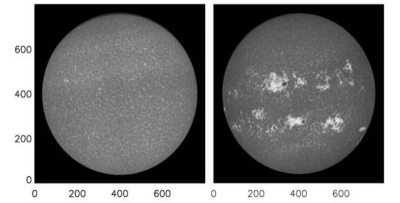
Researchers from the Indian Institute of Astrophysics (IIA) have utilized a century-long (1907–2007) archival database from the Kodaikanal Solar Observatory to uncover the long-term behavior of supergranulation patterns. By analyzing over 34,000 Calcium II K spectral images, the team confirmed that supergranular cell lane widths and intensities fluctuate in sync with the 11-year solar cycle.
Solar Dynamics: The Science Behind the Study
- Supergranules: These are large convective cells on the solar photosphere, measuring approximately 30,000–35,000 km in diameter. Their boundaries (lanes) serve as collectors for concentrated magnetic fields.
- The 11-Year Solar Cycle: Driven by the Sun’s internal magnetic dynamo, this cycle involves a periodic reversal of the Sun’s magnetic poles, dictating the intensity of sunspots, solar flares, and space weather.
- Key Finding: The study established that supergranular features vary in tandem with sunspot numbers and show distinct latitude-dependent correlations, providing essential observational evidence for how magnetic flux influences solar convection.
The Kodaikanal Solar Observatory (KSO)
Established in 1899 in the Palani Hills, Tamil Nadu, KSO remains a premier global archive for solar data. It was originally founded to investigate the link between solar activity and the Indian monsoon.
| Instrument / Data Type | Spectral Line | Primary Scientific Use |
| H-alpha Telescope | 656.3 nm | Flares, filaments, and prominences. |
| Twin Spectroheliograph | 393.4 nm (Ca II K) | Chromospheric networks and plages. |
| White-light Photograph | Broadband | Sunspot tracking and positioning. |
IASPOINT Booster Facts
- Evershed Effect: Discovered at KSO in 1909, this describes the radial outward flow of gas in a sunspot’s penumbra.
- Calcium II K Line: A violet spectral line used to image the chromosphere; it is critical for identifying strong magnetic field concentrations (plages).
- Aditya-L1 Synergy: The century-long ground-based dataset at KSO is now being used to validate and complement real-time data from India’s space-based Aditya-L1 mission (specifically the SUIT and VELC instruments).
- Babcock Model: A theoretical framework explaining the solar cycle as a process of winding and twisting magnetic field lines due to the Sun’s differential rotation.