
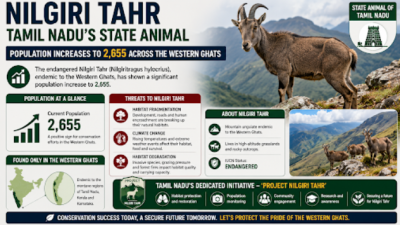
The third synchronised population survey of the endangered Nilgiri Tahr, Tamil Nadu’s state animal, reveals that its wild population in the state has risen to an estimated 1,364 individuals. This data marks a 4.68% increase from the 1,303 animals recorded in 2025 and a 32% rise from the 1,031 individuals estimated during the first synchronised survey in 2024. Conducted jointly by the Tamil Nadu and Kerala Forest Departments under Project Nilgiri Tahr, the four-day exercise mapped habitats across the Western Ghats using advanced technology to improve ecological data accuracy and strengthen long-term habitat management plans.
Key Findings of the 2026 Synchronised Survey
The census exercise spanned 177 survey blocks across 14 forest divisions, 43 forest ranges, and 126 forest beats in Tamil Nadu, tracking the ungulate across an altitudinal spectrum ranging from 270 metres to over 2,630 metres above mean sea level.
Habitat Distribution and Strongholds
- Anamalai Landscape: Serves as the primary stronghold, supporting 44.87% of the total population in the state. Within this, the Grass Hills National Park inside the Anamalai Tiger Reserve holds a contiguous population of 360 individuals.
- Nilgiris Landscape: Accounts for 29.25% of the state’s total count, with the Mukurthi National Park hosting 313 individuals in a single contiguous habitat.
- Fragmented Habitats: The remaining population survives across isolated pockets. Among these fragmented zones, the Tiruppur division recorded 148 individuals, followed by the Kalakad division with 115 and the Pollachi division with 78.
- New Sightings: The 2026 survey confirmed the re-emergence of the species in five previously unconfirmed habitat blocks: Tiruvannamalai Mottai (Kalakad), Rasivarai (Tiruppur), Thoovanam Mottai (Megamalai), and Kalaiyanputhur and Puramedu (Kodaikanal).
Population Demographics and Health Indicator Metrics
- Male-to-Female Ratio: Calculated at 55 males per 100 females, establishing balanced demographics.
- Female-to-Young Ratio: Estimated at 100 females to 66 young individuals, which signifies a highly active and healthy breeding cycle.
- Population Structure: Adult females constitute 38.4% of the observed population, adult males make up 34.6%, yearlings account for 15.5%, and young calves represent the remaining 11.5%.
Conservation Initiatives under Project Nilgiri Tahr
Launched by the Tamil Nadu government for an operational timeline of 2022 to 2027 with an outlay of Rs 25.14 crore, the macro-project targets habitat expansion and threat mitigation.
Technological Integrations
- VARUDAI Mobile Application: Named after the Sangam literature term for the mountain goat, this Android-based software was deployed for real-time field data collection and automatic GPS-marking of animal sightings, eliminating manual recording errors.
- Genomic Mapping: The complete mitochondrial genome of the Nilgiri Tahr has been sequenced and uploaded to the National Center for Biotechnology Information database by the Advanced Institute for Wildlife Conservation.
- Radio Telemetry and Collaring: Implementation of radio-collaring programs to systematically monitor migration patterns, home range sizes, and behavioral reactions to changing weather conditions.
Shola Grassland Restoration
The project executes target-oriented habitat restoration by mechanically removing exotic invasive species like Eucalyptus, Wattle, and Pine from the high-altitude Shola-grassland ecosystems. This process encourages the regeneration of indigenous grass species, directly expanding the natural foraging grounds of the mountain ungulate while improving regional hydrology.
Ecological Profile and Threats to Nilgiri Tahr
Understanding the biological specificities and threats facing the species provides the foundational framework for protective interventions.
| Parameter | Scientific and Ecological Details |
| Scientific Name | Nilgiritragus hylocrius |
| Taxonomical Status | Only mountain ungulate species distributed in Southern India; sole living species of genus Nilgiritragus. |
| Legal Protection Status | Schedule I of the Wildlife Protection Act, 1972. |
| IUCN Red List Status | Endangered. |
| Primary Habitat Type | Montane grasslands and rocky cliffs of the Southern Western Ghats. |
| Key Anthropogenic Threats | Habitat fragmentation, expansion of monoculture plantations, and poaching. |
| Key Environmental Threats | Frequent forest fires destroying food resources and spread of diseases from domestic livestock. |
IASPOINT Booster Facts for UPSC
- Sangam Literature References: The cultural and ecological presence of the Nilgiri Tahr is documented in ancient Tamil Sangam texts like Silappathigaaram and Seevagasinthamani dating back nearly 2,000 years.
- Nilgiri Tahr Day: October 7 is celebrated annually as Nilgiri Tahr Day to honor Dr. E.R.C. Davidar, who pioneered the first comprehensive scientific survey of the species in 1975.
- Eravikulam Connection: While the current data focuses on Tamil Nadu, Eravikulam National Park in Kerala maintains the largest single surviving wild population of the Nilgiri Tahr across the entire Western Ghats landscape.
- Institutional Collaborators: The 2026 census combined field inputs from the Wildlife Institute of India, World Wide Fund for Nature-India, International Union for Conservation of Nature-India, Wildlife Trust of India, and Tamil Nadu Veterinary and Animal Sciences University.
- Synchronised Survey Reports Co-release: On World Environment Day 2026, the report was launched alongside three other key biological inventories: the State-level Synchronised Wetland Birds Survey, the Terrestrial Birds Survey, and the Tamil Nadu State-wide Raptor Assessment Report.