
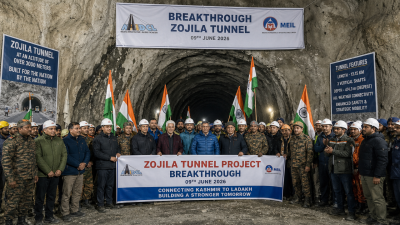
The Zojila Tunnel achieved a major breakthrough on 9 June 2026 with the physical connection of both ends at Minamarg in Ladakh’s Kargil district. The event was attended by Union Road Transport and Highways Minister Nitin Gadkari, Jammu & Kashmir Lieutenant Governor Manoj Sinha, and Chief Minister Omar Abdullah.
About Zojila Tunnel
- The Zojila Tunnel is a 13.15 km long road tunnel on the Srinagar–Leh corridor.
- It connects Baltal in Ganderbal district, Jammu & Kashmir, with Minamarg in Ladakh.
- Construction began in October 2020 and is expected to be fully operational by 2028.
- The estimated project cost is between ₹6,500 and ₹6,800 crore.
Engineering Features
- Constructed using the New Austrian Tunnelling Method (NATM), involving selective blasting and staged excavation.
- Built at elevations above 3,000 metres (11,578 feet) in a high-altitude environment.
- Includes three vertical ventilation and rescue shafts, with the deepest shaft measuring 474.3 metres.
- Designed to withstand extreme cold temperatures down to -30°C and risks such as avalanches.
Challenges and Solutions
- Faced unstable rock formations and variable rock strata during excavation.
- Encountered significant water ingress from underground reservoirs and snowmelt.
- Implemented shotcrete and rock bolts to secure tunnel walls.
- Safety systems are integrated to maintain operational safety in difficult mountain conditions.
Strategic and Regional Importance
- The tunnel reduces travel time between Sonamarg and Minamarg from nearly two hours to 15-20 minutes.
- Provides all-weather connectivity on the Srinagar–Leh route, which is often blocked by snow in winter.
- Supports strategic mobility for the Indian Armed Forces in border areas.
- Aims to boost tourism, trade, and access to essential services in Ladakh and Jammu & Kashmir.
The Zojila Tunnel is one of India’s largest road tunnel projects in a high-altitude environment. It is a key infrastructure project for improving connectivity in the Himalayas. The tunnel’s operationalisation is scheduled for 2028.
Last Modified: June 14, 2026