
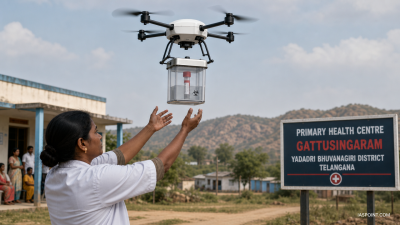
ICMR’s i-DRONE programme was evaluated in Yadadri Bhuvanagiri district, Telangana via an AIIMS Bibinagar study on drone-based sputum transport for tuberculosis testing, measuring patient expenditure, diagnostic turnaround and reporting delays.
Study Findings (Telangana)
- Cost reduction: Average out-of-pocket expenditure per patient fell from ₹9,451 to ₹91 with drone-based sample transport.
- Turnaround time: Median time to TB diagnosis declined from 15 days to 5 days.
- Reporting delay: Before drones >92% of patients waited more than 2 days; during drone phase 76.3% received results the next day.
- Service footprint: Network linked 11 Primary Health Centres, 60 subcentres and four TB Units to testing centres.
Operational Features
- Command centre: AIIMS Bibinagar acted as the central coordination hub for routing and scheduling.
- Use-cases: Transport of sputum specimens to laboratories and return flights for medicines to peripheral facilities.
- Field example: On 18 January 2025 a documented flight covered ~55 km in 20 minutes and delivered 11 sputum samples.
Technical and Programme Links
- i-DRONE: ICMR initiative employing unmanned aerial vehicles (UAVs) for medical logistics.
- NTEP integration: Activities were implemented under the National TB Elimination Programme framework.
- Sample pathway: Sputum collected at PHCs and tested at higher-level laboratories under the diagnostic network.
IASPOINT Booster Facts
- ICMR: Apex medical research body under the Department of Health Research, Ministry of Health and Family Welfare.
- NTEP history: Previously called the Revised National TB Control Programme (RNTCP).
- PHC role: Primary Health Centres serve as first-contact nodes in rural public health logistics.