
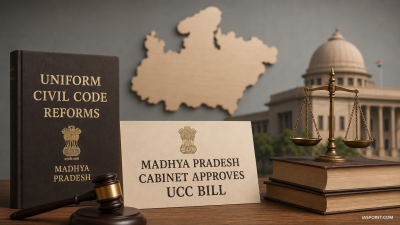
Madhya Pradesh Cabinet approved a draft Uniform Civil Code (UCC) Bill on 19 July 2026 and the bill is scheduled for introduction in the state assembly during the Monsoon Session commencing 20 July 2026. The draft follows public consultations that generated over 9.5 lakh suggestions.
What is the issue?
Brief
The Madhya Pradesh draft seeks a common civil law for marriage, divorce, inheritance, adoption and live‑in relationships. Core provisions: mandatory marriage registration, monogamy, equal inheritance for sons and daughters, legal marriage ages (21 for men, 18 for women), live‑in registration within one month and penal sanction for married persons entering live‑in relationships. Scheduled Tribes and PVTGs in protected areas are exempt.
Why it matters
- Governance: State legislation on personal law affects administration of justice and civil registries.
- Rights and law: Intersects Directive Principles (Article 44), fundamental rights (Articles 14, 21, 25, 26) and concurrent legislative competence.
- Social impact: Affects gender justice, minority rights and tribal customary systems within the state.
Constitutional and legislative dimensions
- Legislative competence: Entry 5, Concurrent List: states may legislate on marriage, divorce, succession, adoption, wills and related subjects. Parliament and states both possess competence.
- Article 44: DPSP obliges the State to endeavour to secure a uniform civil code throughout India; it is non‑justiciable but carries directive weight for legislation.
- Presidential assent: Where state UCC laws conflict with central statutes on concurrent subjects, Article 254(2) requires presidential assent for state law to operate despite central law.
- Federal implication: Multiple state UCCs create territorial heterogeneity in civil law, producing differing rights and obligations for citizens across states.
Social and gender implications
- Gender justice: Provisions banning polygamy, nikah halala and triple talaq and granting equal inheritance remove explicit gender biases in customary personal laws.
- Marriage and registration: Compulsory registration strengthens proof of marital status and access to statutory entitlements for women.
- Tribal exemption: Exempting Scheduled Tribes and PVTGs preserves customary practices and cultural autonomy but excludes tribal women from statutory gender‑equal protections, creating intra‑state legal asymmetry.
Fundamental rights, privacy and criminal sanctions
- Right to privacy: K.S. Puttaswamy (2017) recognises privacy as fundamental. Mandatory registration of live‑in relationships and criminal penalties for consensual adult conduct raise issues under the legality, legitimate aim and proportionality tests.
- Freedom of religion and cultural rights: Articles 25–26 protect religious practices; restrictions are permissible only by law and for public order, morality or health and must meet proportionality.
- Potential conflicts: Criminalising private conduct may be vulnerable to constitutional challenge as disproportionate state intrusion into intimate life.
Comparative state landscape
| State | Status | Key features | Tribal exemption |
|---|---|---|---|
| Goa | Single civil code (Portuguese law) | Uniform code for all residents on many personal law matters | Not applicable |
| Uttarakhand | Enacted and in force | Compulsory registration; gender‑neutral provisions; live‑in regulation | Exemptions for tribal/customary groups |
| Gujarat | Passed state UCC | Standardised succession, marriage, adoption rules | Exemptions included |
| Assam | Passed state UCC | Regional specifications; live‑in registration | Exemptions for STs and PVTGs |
| Madhya Pradesh | Draft approved; to be introduced in assembly | Monogamy, compulsory marriage registration, equal inheritance, live‑in registration with penalties | Exempts STs and PVTGs in protected areas |
Legal challenges and enforcement issues
- Constitutional litigation: Challenges likely on grounds of fundamental rights (privacy, religion, equality) and federal competence where conflicts with central law exist.
- Implementation capacity: Mandatory registration requires robust civil registration infrastructure, training of local authorities and grievance redress mechanisms.
- Enforcement risks: Penal provisions may produce selective enforcement, administrative harassment and disproportionate impact on marginalised groups.
- Inter‑state mobility: Differing state codes raise uncertainty for migrants and cross‑border family situations; judicial uniformity may be sought by the Supreme Court.
Policy options and procedural pathway
- Harmonisation: Use Law Commission recommendations to align state provisions with central statutes and constitutional standards.
- Sunset and review clauses: Include periodic review and sunset provisions for controversial penal measures to allow judicial and legislative reassessment.
- Targeted reform: Prioritise non‑controversial gender‑equal measures (inheritance, registration) while engaging communities on culturally sensitive practices.
- Safeguards: Ensure adequate legal aid, grievance redress, and administrative safeguards to prevent misuse of penal provisions.
- Dialogue and consensus: Institutionalise consultations with religious, tribal and women’s rights groups prior to enactment and during implementation.
Model Questions
1. Examine the legislative competence of states to enact a Uniform Civil Code. Does a state‑by‑state UCC approach conflict with Article 44 and the idea of national uniformity? [GS-II: Constitution of India & Polity]
State legislatures may legislate on marriage, divorce, succession and related subjects under Entry 5, Concurrent List. Article 44 is a non‑justiciable DPSP urging uniformity nationwide but does not negate state competence. Conflicts with central law trigger Article 254(2) and require presidential assent. Multiple state UCCs produce territorial divergence, creating functional uniformity gaps and potential legal uncertainty for citizens crossing state boundaries.
2. Analyse the social and gender consequences of state‑level UCCs, with reference to exemptions for tribal communities. [GS-I: Indian Society]
State UCCs remove many gendered disparities by banning polygamy, securing equal inheritance and mandating registration, improving legal protection for women. Exemptions for Scheduled Tribes and PVTGs preserve customary autonomy but exclude tribal women from statutory protections, producing unequal access to rights within the same state. Policy must reconcile cultural pluralism with measures to protect vulnerable women within exempted communities.
3. Assess the constitutional validity of mandatory registration of live‑in relationships and associated criminal penalties under recent state UCCs. [GS-II: Governance]
Mandatory registration and penal sanctions impinge on privacy and personal autonomy recognised under Article 21 (Puttaswamy). Validity requires a lawful statute, legitimate state aim (e.g. protection of dependants) and proportionality. Criminal penalties for consensual adult relations risk failing proportionality and invite challenge as excessive state intrusion; non‑criminal administrative registration and support measures present less intrusive alternatives.
4. Critically discuss the ethical tension between protecting community‑based personal laws and enforcing a uniform civil code. How should legislatures balance communal identity and individual autonomy? [GS-IV: Ethics, Integrity and Aptitude]
Ethical tension arises between collective rights to cultural and religious identity (Articles 25–26) and individual rights to equality and autonomy. Balance requires minimally intrusive laws that eliminate clear gender discrimination while respecting legitimate cultural practices. Procedural ethics: transparent consultation, impact assessment, incremental reforms and safeguards against coercive enforcement protect autonomy without erasing legitimate communal identities.
Last Modified: July 20, 2026