
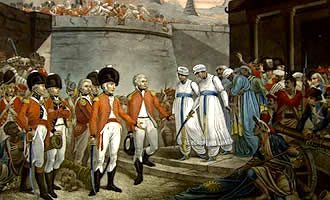

The Revolt of 1857, also known as the First War of Indian Independence, was uprising against British rule in India. It marked important turning point in Indian history. This revolt spread across various regions, with key centres and notable leaders emerging.
Major Centres of the Revolt
The revolt encompassed several regions, particularly in northern India. The main centres included:
- Kanpur
- Lucknow
- Bareilly
- Jhansi
- Gwalior
- Arrah (Bihar)
Kanpur
- Kanpur was a very important site during the revolt.
- Leadership – Nana Sahib, the adopted son of Peshwa Baji Rao II, led the uprising.
- Motivation – He revolted due to the cessation of his pension by the British.
- Events – The British forces faced severe shortages, leading to General Sir Hugh Wheeler’s surrender on June 27, 1857.
- Outcome – Despite initial success, the British recaptured Kanpur, resulting in brutal reprisals. Nana Sahib escaped, while his commander, Tantia Tope, continued the fight until his eventual defeat and execution.
Lucknow
- Lucknow served as the capital of Awadh and was battleground.
- Leadership – Begum Hazrat Mahal took charge, rallying the sepoys against the British.
- Siege – The siege of the British residency began on June 4, 1857.
- Conflict – The Begum and her forces inflicted heavy casualties, including the death of Sir Henry Lawrence.
- Defeat – The revolt in Lucknow persisted until late 1857, ultimately ending with British reinforcements under Sir Colin Campbell overpowering the rebels.
Jhansi
- Jhansi was another critical centre of the revolt.
- Leadership – Rani Lakshmi Bai, only twenty-two years old, led the resistance.
- Claim to Throne – She fought after the British denied her adopted son’s claim to the throne.
- Battle – Despite her valiant efforts, she faced defeat against the superior British forces led by Sir Hugh Rose.
- Legacy – Rani Lakshmi Bai became a symbol of courage and resistance, inspiring future generations.
Gwalior
- Gwalior played role in the latter stages of the revolt.
- Alliance – After escaping from Jhansi, Rani Lakshmi Bai joined forces with Tantia Tope.
- Capture – Together, they captured Gwalior, leading to fierce fighting.
- Final Stand – The Rani fought bravely but ultimately succumbed to British forces.
- Gwalior was retaken, marking important defeat for the rebels.
Bihar
- Bihar was another important region in the revolt.
- Leadership – Kunwar Singh, from a royal lineage in Jagdispur, led the revolt in Bihar.
- Tactics – He employed guerrilla warfare against the British.
- Impact – Singh’s leadership inspired many local uprisings, showcasing resilience against British authority.
Important Leaders of the Revolt
Numerous leaders emerged during the Revolt of 1857, each contributing to the resistance in their respective regions.
- Delhi: Bahadur Shah II, General Bakht Khan
- Lucknow: Begum Hazrat Mahal, Birjis Qadir, Ahmadullah
- Kanpur: Nana Sahib, Rao Sahib, Tantia Tope, Azimullah Khan
- Jhansi: Rani Lakshmi Bai
- Bihar: Kunwar Singh, Amar Singh
- Rajasthan: Jaidayal Singh, Hardayal Singh
- Farrukhabad: Tufzal Hasan Khan
- Assam: Kandapareshwar Singh, Maniram Dutta Baruah
- Orissa: Surendra Shahi, Ujjwal Shahi
The Delhi Uprising
Delhi was a focal point of the revolt. – Leadership – The sepoys declared Bahadur Shah II as the new ruler. – Mughal Revival – The Mughal Empire was briefly reinstated, but the leadership was ineffective. – British Response – General Hudson captured the city, leading to the execution of Bahadur Shah II’s sons and the emperor’s exile to Burma.
The Role of Technology and Tactics
The British employed advanced military tactics and technology. – Artillery – The British had superior artillery and weaponry. – Training – British troops were well-trained and experienced in modern warfare. – Communication – Efficient communication and supply lines aided British forces in quelling the uprising.
Impact on Indian Society
The revolt had deep effects on Indian society and governance. – Awakening – It sparked a sense of nationalism among Indians. – Reforms – The British implemented administrative reforms in response to the revolt. – Legacy – The revolt is often viewed as the first step towards Indian independence.
Aftermath of the Revolt
- Suppression – The British responded with brutal suppression.
- Reorganisation – The British Crown took direct control of India, ending the East India Company’s rule.
- Cultural Shift – The revolt led to a cultural awakening, influencing future independence movements.


