
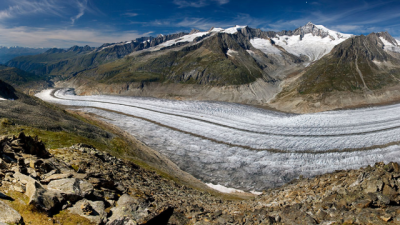
Post-glacial rebound (also known as isostatic rebound or Glacial Isostatic Adjustment – GIA) is the gradual rise of landmasses that were once depressed by the massive weight of ice sheets during the last glacial period. This process is a key component of isostasy, the state of gravitational equilibrium between Earth’s lithosphere and asthenosphere.
Mechanism of Rebound
The Earth’s crust behaves elastically and viscoelastically over geological timescales. The process follows a specific cycle of loading and unloading:
- Loading Phase (Isostatic Depression): The weight of ice sheets (up to several kilometers thick) forces the rigid lithosphere to warp downward. This pressure displaces the underlying ductile asthenosphere, pushing mantle material laterally away from the glaciated region.
- The Forebulge: As mantle material is pushed out, the areas immediately surrounding the ice sheet are forced upward, creating a “forebulge” or peripheral ring of elevated land.
- Unloading Phase (Rebound): When the glaciers melt, the vertical pressure is removed. The lithosphere begins to “spring” back. This happens in two stages:
- Elastic Response: An immediate, relatively fast upward movement.
- Viscous Flow: A much slower, long-term rise as mantle material gradually flows back under the deglaciated area.
Global Impacts and Geologic Significance
| Feature | Impact of Rebound | Regional Example |
| Vertical Crustal Motion | Land continues to rise at rates of up to 1 cm/year. | Fennoscandia (Sweden/Norway) and Northern Canada. |
| Relative Sea Level | Sea levels appear to fall in rebounding areas as the land rises out of the water. | Hudson Bay, Canada (raised shorelines). |
| Forebulge Collapse | Areas that were once “puffed up” at the ice edge are now sinking as mantle material returns to the center. | U.S. East Coast (Chesapeake Bay) and the Netherlands. |
| Seismic Activity | The shifting crust creates stress, leading to “intraplate” earthquakes in otherwise stable regions. | Eastern Canada and parts of Scandinavia. |
| Earth’s Rotation | The redistribution of mass shifts the Earth’s moment of inertia, contributing to “True Polar Wander.” | Global axial shift. |
Major Rebounding Regions
- Laurentide Ice Sheet Region: Most of Canada and the northern United States are still rising, while the mid-Atlantic coast is subsiding due to forebulge collapse.
- Fennoscandian Ice Sheet Region: Scandinavia continues to experience significant uplift. The Gulf of Bothnia is narrowing as the sea floor rises.
- Scotland: Northern Scotland is rising, while Southern England is slowly sinking.
- Antarctica and Greenland: Current melting of modern ice sheets is triggering new, contemporary rebound processes that scientists monitor to predict future sea-level rise.
Key Terminology for UPSC Prelims
- Asthenosphere: The semi-fluid layer of the mantle that allows the crust to move vertically.
- Eustatic Sea Level Change: Global changes in sea level due to the volume of water (e.g., from melting ice).
- Relative Sea Level Change: The perceived change in sea level at a specific location, which is a combination of eustatic changes and local crustal movement (rebound or subsidence).
- Pneumatophores (Contextual Trivia): While associated with mangroves, in a broader geographic sense, “rebound” can create new coastal habitats where such flora may eventually colonize.
Geodetic Monitoring
Today, scientists use GPS (Global Positioning System) and GRACE (Gravity Recovery and Climate Experiment) satellite missions to measure these minute changes in Earth’s crust and gravity field. These measurements are vital for correcting sea-level rise data, as sinking land (subsidence) can make global sea-level rise appear much worse in certain coastal cities.
Last Modified: April 16, 2026