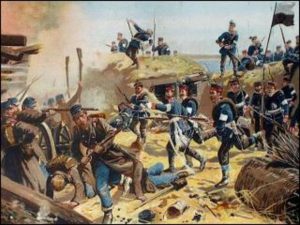
The early 19th century was a period of significant political upheaval in Europe. The actions of Napoleon Bonaparte, in particular, had far-reaching impacts on the geopolitical landscape, especially...
Nationalism has been a driving force behind major historical events across Europe and the world. In the 19th century, it emerged as a defining factor in European history,...
The rise of nationalism in the 19th century marked a significant shift in the political landscape of Europe. By the year 1871, this ideology had firmly established itself...
With the end of World War I, a wave of nationalism swept across Europe, marking a significant shift in the continent's political landscape. This sentiment did not remain...
The concept of national consolidation is multifaceted, with various factors contributing to the unification and strengthening of a nation. One such factor is the shared heritage or history...
Napoleon Bonaparte, a figure synonymous with European history, played a pivotal role in shaping the future of Germany. His actions inadvertently sparked the flames of German nationalism, which...
The French Revolution marked a pivotal moment in human history, fundamentally transforming the concept of nationalism. This transformation was not just political but also cultural, as people began...
The French Revolution marked a turning point in the history of Europe, and its impact was felt far beyond the borders of France. It set into motion a...
In the historical context, the concept of national identity was not always as clear-cut as it is today. The sense of belonging to a nation was a gradual...
The late 19th century was a pivotal era for the development of nationalism in Western political spheres. During this period, specifically from 1850 to 1871, nationalism evolved from...