
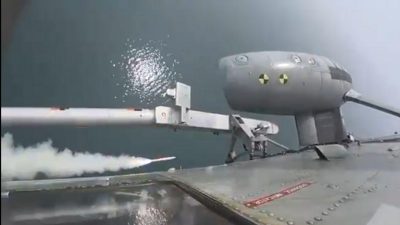
The Defence Research and Development Organisation (DRDO) and the Indian Navy conducted successful flight trials of a naval anti-ship missile at the Integrated Test Range, Chandipur. This achievement demonstrated advanced capabilities in missile technology and naval warfare.
Missile Overview
The Naval Anti-Ship Missile Short Range (NASM-SR) is designed for precision strikes against maritime targets. It features a unique man-in-loop capability, allowing real-time retargeting during flight. This flexibility enhances operational effectiveness in dynamic combat scenarios.
Flight Trial Details
The trials took place on 25 February 2025. The missile was launched from a helicopter and successfully hit a small ship target using sea-skimming mode. The missile’s design incorporates an indigenous imaging infra-red seeker for terminal guidance. This technology ensures high accuracy in target engagement.
Technological Features
The missile employs a fibre optic gyroscope-based inertial navigation system. It also uses a radio altimeter for mid-course guidance. An integrated avionics module manages various systems, while electro-mechanical actuators control aerodynamic and jet vanes. These features enhance the missile’s performance and reliability.
Mission Objectives
All mission objectives were successfully met during the trials. The missile’s high bandwidth, two-way datalink system transmitted live images back to the pilot. This capability allowed the pilot to select a smaller hidden target during the terminal phase, demonstrating the effectiveness of in-flight retargeting.
Production and Development
The NASM-SR is being produced in collaboration with development and production partners, including micro, medium, and small enterprises, as well as start-ups. This approach encourages innovation and strengthens India’s defence manufacturing ecosystem.
Official Statements
Defence Minister Rajnath Singh congratulated all stakeholders involved in the successful tests. He brought into light the uniqueness of the man-in-loop feature, which enhances the missile’s operational capabilities in naval warfare.
Future Implications
The successful trials signify a leap forward in India’s naval capabilities. This advancement may lead to improved maritime security and deterrence in regional waters. The integration of indigenous technology also boosts self-reliance in defence production.
Questions for UPSC:
- Critically analyse the significance of indigenous technology in India’s defence sector.
- Estimate the impact of the man-in-loop feature on modern naval warfare strategies.
- What are the key components of a successful missile system? Discuss with examples.
- Point out the role of micro, medium, and small enterprises in enhancing India’s defence production capabilities.
Answer Hints:
1. Critically analyse the significance of indigenous technology in India’s defence sector.
- Enhances self-reliance, reducing dependency on foreign military imports.
- Promotes innovation and technological advancement within the country.
- Strengthens national security by ensuring access to critical defence systems.
- Boosts local economies through job creation in the defence manufacturing sector.
- Facilitates tailored solutions to meet specific operational requirements of the Indian Armed Forces.
2. Estimate the impact of the man-in-loop feature on modern naval warfare strategies.
- Allows real-time retargeting of missiles, increasing strike accuracy and effectiveness.
- Enhances decision-making capabilities of pilots during dynamic combat scenarios.
- Improves operational flexibility, adapting to changing battlefield conditions.
- Reduces collateral damage by enabling precise targeting of hidden threats.
- Strengthens deterrence by showcasing advanced capabilities to potential adversaries.
3. What are the key components of a successful missile system? Discuss with examples.
- Guidance system – Ensures accurate targeting (e.g., imaging infra-red seeker in NASM-SR).
- Propulsion – Provides necessary thrust for range and speed (e.g., solid propulsion with ejectable booster).
- Control systems – Maintain stability and trajectory (e.g., electro-mechanical actuators).
- Warhead – Determines the missile’s lethality and effectiveness against targets.
- Communication systems – Enable data transmission and retargeting (e.g., two-way datalink system).
4. Point out the role of micro, medium, and small enterprises in enhancing India’s defence production capabilities.
- Encourages innovation through specialized skills and technologies.
- Provides cost-effective solutions, enhancing competitiveness in defence procurement.
- Facilitates collaboration with larger defence firms, boosting overall production capacity.
- Drives local economic growth by creating jobs and supporting regional development.
- Contributes to a diversified supply chain, reducing vulnerability in defence manufacturing.