
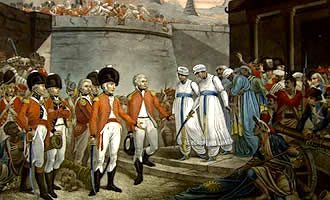

he 1857 Revolt, also known as the Indian Rebellion, marked uprising against British rule in India. It began in May 1857 and involved various Indian soldiers and civilians. The revolt was eventually suppressed by British forces, leading to major political changes in India.
Key Events of the Revolt
- The revolt began in Meerut on May 10, 1857.
- Delhi was recaptured by British forces on September 20, 1857.
- Bahadur Shah II, the last Mughal emperor, was captured and exiled to Rangoon.
- Key leaders like Nana Saheb and Tantia Tope played roles in the uprising. – The revolt saw intense battles in Kanpur, Jhansi, and Awadh.
Military Leaders
- Sir Colin Campbell – Led the recapture of Kanpur.
- Sir Hugh Rose – Recaptured Jhansi and defeated Rani Laxmibai.
- Colonel Neill – Known for his harsh measures in Benaras.
- John Nicholson – Key figure in the siege of Delhi; died from injuries sustained during the conflict.
Suppression Tactics
- The British employed brutal military tactics to suppress the revolt.
- They executed captured leaders and suspected rebels.
- Martial law was imposed in several regions.
- The British forces targeted prominent rebel leaders systematically.
Reasons for Failure of the Revolt
- Limited Territorial Spread – The revolt was concentrated in northern and central India, with little participation from eastern, southern, and western regions.
- Loyalty of Indian Rulers – Many Indian rulers remained loyal to the British, undermining the revolt.
- Zamindar and Moneylender Support – Wealthy landowners and moneylenders often opposed the uprising, favouring British rule.
- Poor Quality of Arms – Indian soldiers were poorly equipped compared to British forces.
- Lack of Coordination – The revolt lacked a unified command, leading to disorganized attacks.
Absence of a Unified Ideology
The revolt suffered from a lack of cohesive ideology. The rebels had diverse grievances but no common political vision. This absence of unity hindered their efforts to challenge British authority effectively.
Social and Economic Context
- The revolt was influenced by social and economic grievances, such as oppressive taxation and land policies.
- The cartridge controversy, involving the use of animal fat in Enfield rifles, sparked unrest among sepoys.
- Many Indians believed that British rule would modernise India, leading to disappointment and resentment.
Impact of the Revolt
- The suppression of the revolt led to the end of the East India Company’s rule.
- The British Crown took direct control over India in 1858.
- The revolt brought into light the need for reforms in British policy towards India.
Regional Participation
- The revolt was not an all-India uprising; it was largely confined to specific regions.
- Key areas of participation included Delhi, Kanpur, Lucknow, Jhansi, and Awadh.
- Local leaders emerged, such as Rani Laxmibai and Kunwar Singh, who rallied support in their regions.
Class Divisions
- Not all social classes participated in the revolt.
- Wealthy zamindars and taluqdars often sided with the British.
- The educated middle class viewed the revolt as regressive and conservative.
Military Disadvantages
- Indian soldiers faced severe limitations in weaponry.
- Many were armed with outdated swords and spears, while British forces had modern firearms.
- The use of communication technology, like the telegraph, gave British commanders a strategic advantage.
Hindu-Muslim Unity
- The revolt saw a notable degree of unity between Hindus and Muslims.
- Bahadur Shah Zafar, a Muslim, was recognised as the emperor by all rebels.
- Leaders from both communities collaborated in various capacities.
Aftermath of the Revolt
- The British government imposed strict measures to prevent further uprisings.
- The Indian population faced heavy taxation to cover the costs of suppression.
- The events of 1857 inspired future movements for independence and unity among Indians.
Legacy of the Revolt
- The revolt is often viewed as the first war of independence in India.
- It laid the groundwork for emerging nationalist movements.
- The memory of the revolt continues to influence Indian history and identity.
Key Figures in the Revolt
- Bahadur Shah II – Last Mughal emperor, captured and exiled.
- Nana Saheb – Leader in Kanpur, later escaped to Nepal.
- Rani Laxmibai – Led the defence of Jhansi; became a symbol of resistance.
- Tantia Tope – Close associate of Nana Saheb, executed after capture.
British Response
- The British response was characterised by military might and political repression.
- They implemented reforms to strengthen their control over India post-revolt.
- The British aimed to pacify Indian rulers and ensure loyalty through incentives.
International Reaction
- The revolt attracted international attention, raising questions about British colonial policies.
- Various European powers observed the situation closely, considering their own colonial interests.
- The suppression of the revolt was seen as a demonstration of British military superiority.
Historical Interpretations
- Historians have debated the causes and consequences of the revolt.
- Some view it as a nationalistic uprising, while others see it as a series of regional rebellions.
- The revolt’s legacy is complex, reflecting the diverse motivations of its participants.
Influence on Future Movements
- The revolt inspired later leaders, including figures in the Indian National Congress.
- It set the stage for subsequent uprisings and movements against colonial rule.
- The spirit of resistance from 1857 influenced the freedom struggle that culminated in 1947.


