Economic development refers to the process of improving the economic well-being of a region. It involves increasing wealth, reducing poverty, and enhancing living standards. This can be achieved through various means, such as industrialisation, infrastructure development, and education. In India, economic development has been influenced by historical events, government policies, and cultural factors. Sustainable practices are essential for long-term growth.
India’s Goods and Services Tax (GST) underwent its most reform in September 2025. The overhaul reduced tax slabs from four to two main rates with a special higher...
India is rapidly advancing its shipbuilding sector to become a top global player by 2047. Currently holding less than 1% of the world market, the country aims to...
The Government of India launched the Next-Gen GST reforms in 2025 to simplify the tax structure. This reform reduced GST slabs from four to two, at 18% and...
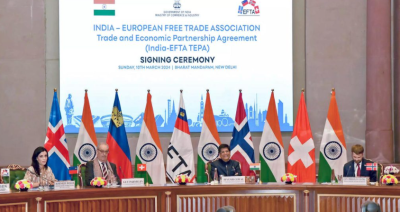
The recent signing of the Trade and Economic Partnership Agreement (TEPA) between India and the European Free Trade Association (EFTA) marks milestone. This pact with Switzerland, Norway, Iceland,...
Recent reforms in the Goods and Services Tax (GST) structure in India aim to rationalise rates and improve ease of doing business. The GST Council, comprising the Union...
India implemented a major Goods and Services Tax (GST) reform on September 22, 2025. The new system simplifies GST slabs to primarily 5% and 18%, with a special...
The India Rankings 2025, based on the National Institutional Ranking Framework (NIRF), continue to reflect the dominance of older public institutions with a strong academic legacy. Since its...
India’s Global Capability Centres (GCCs) have become force in the country’s IT and services exports by 2025. Nearly 1,600 GCCs operate across multiple sectors including finance, retail, electronics,...
India’s Goods and Services Tax (GST) Council announced a major simplification of tax slabs in September 2025. The system moved to two main rates - 5 per cent...
India’s household consumption drives 60 per cent of its GDP. Two main government datasets measuring this show a large and growing difference. The Private Final Consumption Expenditure (PFCE)...