
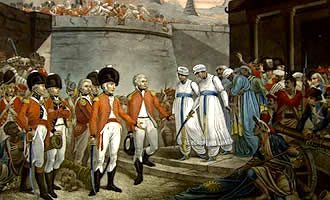

The Anglo-Maratha and Anglo-Mysore Wars were conflicts that shaped Indian history. These wars involved the British East India Company and the Maratha Empire, as well as the Kingdom of Mysore. They marked the decline of indigenous powers and the rise of British dominance in India.
Background of the Anglo-Maratha Wars
The Anglo-Maratha Wars occurred between 1775 and 1819. They were driven by internal discord within the Maratha Empire following the Third Battle of Panipat in 1761. The Marathas faced leadership struggles, with factions led by Peshwa Madhav Rao and former Peshwa Raghunath Rao. The British exploited these divisions to expand their influence.
First Anglo-Maratha War (1775-1782)
Background
The First Anglo-Maratha War began due to disputes over the Peshwa’s succession. The British signed the Treaty of Surat with Raghunath Rao, promising him support but later faced backlash. The Treaty of Purandar replaced it, recognising Madhav Rao II as Peshwa.
Course
The British suffered defeats early in the war. In 1781, Captain Popham led a successful campaign against Mahadaji Scindia. The war concluded with the Treaty of Salbai in 1782.
Outcomes
The Treaty of Salbai established British control over Salsette and Bassein. It recognised Madhav Rao II as Peshwa and ensured a temporary peace between the British and the Marathas.
Second Anglo-Maratha War (1803-1806)
Background
The Second Anglo-Maratha War arose as the Marathas resisted British efforts to impose a subsidiary alliance. The death of Nana Fadnavis led to internal conflicts among the Maratha chiefs.
Course
Peshwa Baji Rao II’s leadership was ineffective. The Treaty of Bassein was signed in 1802, leading to British military intervention. The British defeated Scindia and Bhonsle’s forces in several battles.
Outcomes
The war ended with the Treaty of Deogaon and the Treaty of Surji-Arjangaon. The British expanded their territory, bringing Shah Alam II under their protection.
Third Anglo-Maratha War (1817-1818)
Background
The Third Anglo-Maratha War was marked by weakened Maratha power and internal strife. The Pindari raids prompted British action against the Marathas.
Course
The British suppressed the Pindaris and engaged in skirmishes with Maratha forces. The Treaty of Poona was signed, forcing Peshwa Baji Rao II to relinquish aspirations of Maratha supremacy.
Outcomes
The Maratha Empire was effectively dismantled. The British annexed Peshwa’s territories, and the Maratha confederacy was reduced to a shadow of its former self.
Critical Analysis of the Anglo-Maratha Wars
The Marathas faced several challenges leading to their defeat. Economic instability and lack of coherent leadership undermined their efforts. Internal rivalries and poor alliances with other state of Indias further weakened their position. The British exploited these weaknesses, enabling their expansion across India.
Background of the Anglo-Mysore Wars
The Anglo-Mysore Wars occurred between 1767 and 1799, involving the British East India Company and the Kingdom of Mysore, ruled by Haider Ali and later his son, Tipu Sultan. Mysore’s rise posed threat to British interests in southern India.
First Anglo-Mysore War (1767-1769)
Background
The British sought to establish control over the Northern Circars, leading to tensions with Haider Ali. The Marathas and Nizam of Hyderabad allied against Mysore.
Course
The war began with Maratha attacks on Mysore. Haider Ali initially resisted but eventually negotiated peace through the Treaty of Madras.
Outcomes
The Treaty of Madras restored territories to both sides and established a defensive alliance.
Second Anglo-Mysore War (1780-1784)
Background
The Second Anglo-Mysore War arose from British failures to honour the Treaty of Madras and Haider Ali’s alliances with the Nizam and Marathas.
Course
The British faced initial defeats but ultimately isolated Haider Ali through diplomatic efforts. The war concluded with the Treaty of Mangalore.
Outcomes
The Treaty of Mangalore restored territories and brought into light Mysore’s military strength under Tipu Sultan.
Third Anglo-Mysore War (1790-1792)
Background
Tipu Sultan sought to expand his power and avenge previous defeats. His actions alarmed the British and led to the formation of a tripartite alliance against him.
Course
The war was fought in three phases, with the British eventually capturing Srirangapattinam.
Outcomes
The Treaty of Srirangapattinam forced Tipu to cede half his territory and pay a substantial indemnity.
Fourth Anglo-Mysore War (1798-1799)
Background
Tipu Sultan aimed to strengthen Mysore and sought alliances against the British. His correspondence with revolutionary France raised alarms in Britain.
Course
The British launched a decisive invasion of Mysore. Tipu fought valiantly but was ultimately killed during the siege of Srirangapattinam.
Outcomes
The Wodeyar dynasty was restored, and Mysore became a princely state under British suzerainty.
Critical Analysis of the Anglo-Mysore Wars
The Anglo-Mysore Wars showcased the military capabilities of both sides. Tipu Sultan’s innovative use of rockets influenced British military technology. The wars marked the decline of Mysore and the consolidation of British power in South India.
Frequently Asked Questions (FAQs)
Who won the Second Anglo-Mysore War?
The Second Anglo-Mysore War ended in a stalemate with the Treaty of Mangalore, restoring territories to both sides.
What were the effects of the Second Anglo-Mysore War?
The war brought into light Mysore’s military strength, establishing a temporary balance of power with the British.
What caused the Anglo-Mysore Wars?
The main causes were British expansionist ambitions and Mysore’s growing power under Haider Ali and Tipu Sultan, leading to territorial conflicts.


