
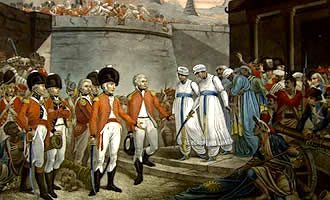

The Divide and Rule policy is a colonial strategy aimed at maintaining control over a population by encouraging divisions. This approach was notably employed by the British in India. The intent was to weaken collective resistance by creating discord among various groups.
Historical Context
The British Empire established control over India in the 18th century. The need to manage a vast and diverse population led to the adoption of Divide and Rule tactics. This strategy was particularly prominent during the 19th and early 20th centuries, as British rule faced increasing resistance.
Mechanisms of Implementation
The British employed several methods to implement the Divide and Rule policy:
- Religious Division: The British encouraged divisions between Hindus and Muslims. Separate electorates were introduced to create political rifts.
- Caste and Ethnic Manipulation: The British exploited existing caste hierarchies and ethnic differences to encourage distrust.
- Regional Disparities: Development projects were unevenly distributed, leading to regional tensions.
- Control of Information: The British controlled the media to shape public perception and suppress dissent.
The Role of the Media
The British government exercised strict control over newspapers and publications. Only selected information was allowed to circulate. This manipulation of media helped to shape public opinion and maintain British authority.
Preferential Treatment
Certain groups received preferential treatment, leading to jealousy and resentment among communities. By favouring specific regions or castes, the British created a sense of competition rather than unity.
Impact on Education
The British controlled the education system, limiting access to certain groups. This led to the emergence of a class system that perpetuated inequality. Education became a tool for maintaining colonial control.
Imperialism Defined
Imperialism is the practice of extending a country’s power through colonisation or military force. The British Empire exemplified this in India by exerting political, economic, and cultural dominance.
Economic Exploitation
The British exploited India’s natural resources for their benefit. Raw materials were extracted and exported, while local industries suffered. This economic control contributed to widespread poverty.
Cultural Imposition
British colonial rule imposed Western values and beliefs. Traditional customs were often undermined. This cultural dominance created lasting changes in Indian society.
The Indian Rebellion of 1857
The Divide and Rule policy contributed to the Indian Rebellion of 1857. Discontent grew among various groups, leading to a united uprising against British rule. The rebellion marked moment in India’s struggle for independence.
Shift in British Policy
In response to the rebellion, the British adopted a new strategy known as Divide and Maintain. This approach aimed to prevent unity among Indians by encouraging divisions and communal disharmony.
Rise of Nationalist Leaders
The early 20th century saw the emergence of leaders like Mahatma Gandhi and Jawaharlal Nehru. They worked to unite diverse groups against British rule. Their efforts marked a turning point in the struggle for independence.
Growth of Separatist Movements
The Divide and Rule policy also led to the growth of separatist movements. The Muslim League and Sikh separatist movements gained traction during this period. These movements reflected the divisions sown by colonial rule.
The Morley-Minto Reforms
The Indian Councils Act of 1909, known as the Morley-Minto Reforms, introduced separate electorates for Muslims. This reform was a key component of the Divide and Rule strategy. It aimed to weaken the nationalist movement by encouraging communal divisions.
Lord Minto’s Role
Gilbert Elliot-Murray-Kynynmound, the 4th Earl of Minto, was the Viceroy of India who implemented the Morley-Minto Reforms. His actions were very important in promoting communal discord. He sought to undermine the growing wave of nationalism.
Legislative Changes
The Morley-Minto Reforms expanded the legislative councils. However, these reforms were limited in scope. The introduction of separate electorates was a deliberate attempt to slow down the nationalist movement.
Lasting Impact on Indian Society
The Divide and Rule policy had deep and lasting effects on Indian society. It entrenched divisions that continue to influence social and political dynamics . The legacy of this policy is evident in ongoing communal tensions.
Resistance to Colonial Rule
Despite the challenges posed by the Divide and Rule strategy, resistance to British rule persisted. Various movements and uprisings emerged throughout the colonial period. These efforts laid the groundwork for eventual independence.
The Role of the Indian National Congress
The Indian National Congress played important role in the fight against British rule. Founded in 1885, it sought to unify Indians across religious and ethnic lines. The Congress aimed to challenge British authority and promote self-governance.
The Partition of India
The culmination of the Divide and Rule policy was the partition of India in 1947. This division led to the creation of India and Pakistan, resulting in communal violence. The partition remains a contentious issue in South Asian history.
Contemporary Relevance
The effects of the Divide and Rule policy can still be seen in modern India. Communal tensions and political divisions continue to shape the socio-political landscape. About this history is vital for addressing current challenges.


