
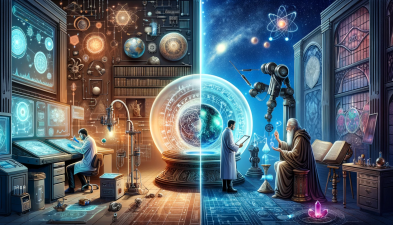
Science and mysticism represent two different approaches to understanding reality and gaining knowledge about the world. At first glance, they appear to be in fundamental opposition as paradigms for acquiring truth. Science relies on reason, empiricism, and scepticism, while mysticism looks inward through meditation, intuition, and subjective experience. However, the relationship between science and mysticism is more complex than a simple dichotomy. As Albert Einstein noted, “A legitimate conflict between science and religion cannot exist. Science without religion is lame; religion without science is blind.” Elements of both converge in the pursuit of knowledge, meaning, and purpose within human existence.
Body
Science emerged in the 16th and 17th centuries as an empirical method for studying the natural world. Pioneers like Copernicus, Galileo, Newton, and Bacon challenged the dogma of the church by relying on evidence, models, and hypotheses to systematically understand phenomena. This ushered in a view of the universe as like a sophisticated machine whose secrets could be unlocked through the scientific method of observation, experimentation, and falsification. Francis Bacon emphasized inductive reasoning from facts over deductive logic, further establishing the empirical basis for scientific epistemology.
In contrast, mysticism has much older origins, with contemplative and introspective practices found in many ancient philosophical and religious traditions. Mystics seek transcendence of normal conscious experience and hidden truths about the nature of reality through inner contemplation aimed at direct union with the divine or absolute. Meditative techniques, for example, are found in Hindu Vedic scriptures possibly dating back over 5,000 years, as well as early Buddhist teachings. Mystics pursue enlightenment and transformation of consciousness, rather than observation and control of the external world.
At first glance, science and mysticism appear opposed in their epistemology, or how knowledge is created, and in their metaphysics, or fundamental assumptions about the nature of reality. Science holds a mechanistic view that the physical universe operates according to natural laws that humans can discern through empirical testing. Mysticism sees consciousness as primary and seeks intimate experiential knowledge of larger metaphysical realities or cosmic unity.
However, there are areas where science and mysticism converge in pursuit of truths about existence. Modern physics in the 20th century radically departed from classical Newtonian science and surfaced metaphysical questions that blur lines between science and mysticism. Quantum theory revealed a strange probabilistic realm at the subatomic level where particles exist as fuzzy superpositions until precisely observed and measured. Schrödinger’s famous thought experiment of a cat that is simultaneously dead and alive highlighted this paradoxical quantum state where everyday assumptions of space, time, matter, and causality no longer neatly apply.
The role of human consciousness and observation in apparently “collapsing” quantum potentials into defined states led some physicists, including Schrödinger himself, to propose connections between quantum phenomena and ancient mystical philosophies, particularly monistic views of reality as an undifferentiated holistic oneness instead of discrete particles. Quantum entanglement and nonlocality also seem to defy conventional assumptions about spatial separation and causation. While chemist Ilya Prigogine saw quantum physics as compatible with free will, some mystics took its findings as validation of the illusory nature of reality and the primacy of consciousness proposed for centuries in Vedic and Buddhist thought.
Cosmology and astrophysics likewise reveal a vast, perhaps infinite physical universe of billions of galaxies and trillions of stars, evoking again those enduring mysteries of existence debated by philosophers and mystics across civilizations. Natural scientists now critically engage some of the same big questions that were historically theological – the origin, evolution, and ultimate fate of the cosmos. Einstein saw parallels between the pursuit of scientists and mystics: “The most beautiful emotion we can experience is the mysterious. It is the fundamental emotion that stands at the cradle of all true art and science.”
The emergence of consciousness studies as a modern field has also forged some links between scientific inquiry and mystical traditions in trying to better understand subjective experience and the nature of mind. Scientists study meditation practices and altered states of consciousness induced through psychedelic compounds as ways to gain insights into consciousness and mystical experiences. Brain imaging technology allows researchers to see neural correlates of contemplative states, while also raising questions about interpretation.
Comparative religious studies reveal structural similarities in the reports of mystics across cultures and faiths, suggesting common core phenomenological experiences that come from exploring non-ordinary states of consciousness rather than the doctrinal content of any particular religion. There may be universal psychophysical processes that help explain phenomena mystics describe like sense of unity, transcendence of space and time, hyper connectivity, ego dissolution, visions, and inner light. But some philosophers, like Ken Wilber, argue that a causal understanding of biological processes during mystic states does not necessarily exhaust all ontology – the meaning, significance, and purpose – that contemplatives discover in their direct experiences.
So while science aims to demystify mystical experiences, there remains an explanatory gap between third-person objective measurement and first-person subjective experience. As Wilber says, “Mysticism is the direct experience of the Divine or Absolute, and since no experience is merely subjective, then genuine mysticism entails the direct apprehension of That or Reality.” Bridging this gap requires both perspectives. Huston Smith argued that science and mysticism ask different but complementary questions about reality that need not put them in irreconcilable conflict.
Conclusion
In conclusion, science and mysticism need not clash but can offer complementary truths about existence. Science investigates outer empirical realities, while mysticism explores inner dimensions of being and meaning. Both approaches involve wonder and imagination. Though opposed in methodology, science and mysticism reflect humanity’s shared pursuit of knowledge, purpose, and transcendence. Physics reveals the mechanistic operations of the cosmos, while contemplative practices provide insight into consciousness and subjective experience. Rather than mutually exclusive paradigms, science and mysticism can coexist to provide a more holistic understanding of ourselves and the universe. Integrating their approaches allows us to see both the “how” and the “why” of existence.
Last Modified: February 8, 2024